
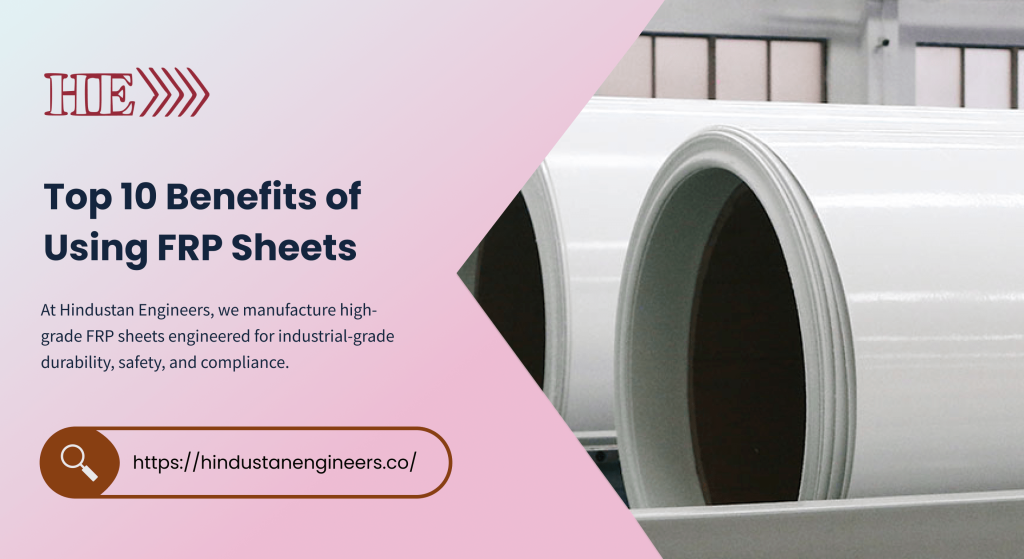

Top 10 Benefits of Using FRP Sheets - HindustanEngineers

In industrial environments like chemical and food processing plants, material selection isn’t just a design decision—it’s a strategic move for long-term operational safety, efficiency, and compliance. FRP sheets (Fiber Reinforced Plastic sheets) have rapidly emerged as a preferred material in these sectors, offering a wide range of performance, safety, and cost benefits.

At Hindustan Engineers, we specialize in high-performance FRP sheets designed to withstand the toughest industrial demands. This blog explores the top 10 benefits of using FRP sheets in the chemical and food processing industries, providing insights into why these composites are transforming material usage in harsh environments.

1. Unmatched Anti-Corrosion Performance

Corrosion is the silent destroyer in chemical plants. From acids and alkalis to brines and solvents, traditional metal sheets corrode over time, leading to leaks, hazards, and frequent replacements. FRP sheets, however, are inherently corrosion-resistant, making them ideal for chemical plant materials.

Whether exposed to aggressive reagents or high humidity environments, FRP sheets maintain their structural integrity, drastically reducing downtime and replacement costs.

2. Chemically Inert and Non-Reactive

In both chemical manufacturing and food processing, non-reactive surfaces are critical. FRP sheets are engineered to be chemically inert, ensuring they do not react with process materials or contaminate products.

This makes FRP a safe and approved choice for food industry FRP applications where hygiene and product purity are paramount.

3. Easy to Maintain and Clean

Time is money, especially in 24/7 production environments. Unlike metal or wood, FRP sheets are smooth, non-porous, and stain-resistant, making them easy to clean and maintain.

Their surface resists build-up of grime, chemicals, or organic material, reducing the need for harsh cleaning agents and labor-intensive maintenance—a key benefit for hygiene-sensitive food processing plants.

4. Lightweight Yet Structurally Strong

One of the most remarkable features of FRP sheets is their high strength-to-weight ratio. They are significantly lighter than steel or aluminum but still offer excellent mechanical strength.

This reduces the load on structural frameworks and simplifies transportation and installation—important advantages for modular plant expansions or mobile food processing units.

5. Thermal and Electrical Insulation

FRP sheets are excellent insulators, both thermally and electrically. In chemical plants where electrical safety is a concern or in food facilities with fluctuating temperatures, FRP provides a safer, more efficient solution than metal alternatives.

This property enhances worker safety and reduces energy loss in temperature-controlled environments.

6. Long Service Life

Durability translates to lower lifecycle costs. Thanks to their resistance to weathering, chemicals, and UV radiation, FRP sheets offer an extended service life—often outlasting traditional materials by years.

At Hindustan Engineers, our FRP solutions are tested for longevity even under high-stress industrial conditions, making them a smart investment for long-term use.

7. Customizable and Versatile

Unlike rigid steel or brittle ceramics, FRP sheets are easy to customize. They can be molded, cut, or fabricated into any desired shape, thickness, or pattern—perfect for building plant-specific ducts, trays, baffles, wall linings, or partitions.

Our manufacturing expertise allows us to deliver tailored FRP solutions across a wide range of chemical and food industry use cases.

8. Fire Retardant Options Available

Safety regulations in industrial environments require materials to meet flame spread and smoke emission standards. Fire-retardant FRP sheets are available for high-risk zones, offering superior protection while maintaining all the other benefits of FRP.

This makes them ideal for both chemical storage facilities and food manufacturing units operating in high-temperature environments.

9. Moisture and Bacterial Resistance

In food processing environments, damp conditions can lead to mold, bacterial growth, and degradation of materials. FRP sheets resist moisture absorption, and their non-porous nature ensures that bacteria cannot embed into the surface—crucial for FDA-compliant food industry setups.

10. Cost-Effective Over the Long Term

While the upfront cost of FRP sheets may be slightly higher than traditional materials, their reduced maintenance, longer lifespan, and lower risk of breakdowns lead to a much lower total cost of ownership.

In industries where downtime can result in substantial revenue loss, FRP is the reliable choice that pays off over time.

Final Thoughts: Why FRP Is the Future of Industrial Sheet Materials

From chemical tanks and exhaust ducts to wall linings and machine guards, FRP sheets are redefining the standards for performance and reliability in hostile industrial environments. Their combination of corrosion resistance, cleanliness, lightweight construction, and customizability makes them a superior material choice for both chemical plant materials and food industry FRP applications.

At Hindustan Engineers, we manufacture high-grade FRP sheets engineered for industrial-grade durability, safety, and compliance. Our team works closely with clients to customize FRP solutions tailored to specific operational challenges.

Explore Our Range of FRP Solutions

Looking to upgrade your plant with modern, maintenance-free material technology?

Contact Hindustan Engineers today to discuss your FRP requirements or visit our FRP Product Page for specifications and customization options.

About Hindustan Engineers
We are a leading manufacturer and supplier of advanced FRP composites, carbon fiber products, and custom-engineered plastic components serving industries across India and beyond. With over two decades of experience, we combine technical expertise with innovation to deliver material solutions built for performance and endurance.

Recent Post