
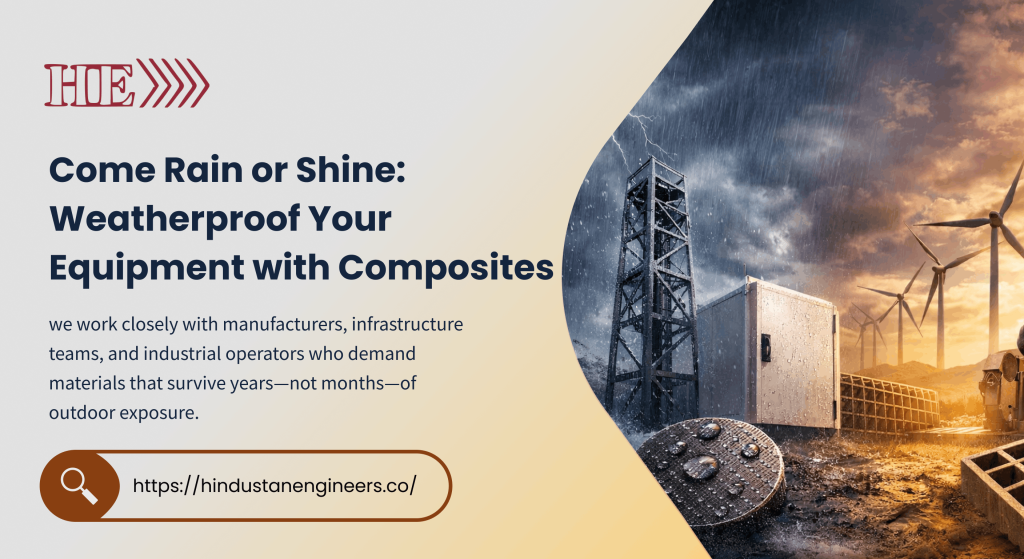
Come Rain or Shine: Weatherproof Your Equipment with Composites
When industrial equipment is exposed to the outdoors, the real test isn’t just performance—it’s endurance. Sunlight that never lets up. Rain that seeps into everything. Heat that warps materials. Wind that adds constant mechanical stress. For industries operating in open environments, material choice becomes a long-term strategic decision, not just a procurement one.
At Hindustan Engineers, we work closely with manufacturers, infrastructure teams, and industrial operators who demand materials that survive years—not months—of outdoor exposure. That’s where carbon fiber and FRP (Fiber Reinforced Plastic) stand out. But how weather-resistant are they really? Let’s break it down from a practical, application-first perspective.
Why Carbon Fiber and FRP Are Preferred for Outdoor Use
Traditional materials like steel and aluminum have known weaknesses outdoors—corrosion, weight fatigue, thermal expansion, and high maintenance costs. Composite materials change that equation.
High strength-to-weight ratio
Natural corrosion resistance
Minimal thermal deformation
Long service life with low maintenance
These advantages make carbon fiber outdoor use and FRP weather resistance critical considerations for industries such as infrastructure, utilities, industrial cleaning systems, renewable energy, and transportation.
UV Resistance: Standing Strong Under Harsh Sunlight
Carbon Fiber & UV Exposure
Carbon fiber itself is extremely stable under UV radiation. However, the resin system that binds the fibers can degrade over prolonged sun exposure if left unprotected. This is where advanced surface engineering plays a role.
At Hindustan Engineers, carbon fiber components intended for outdoor use are paired with:
UV-stabilized epoxy or vinyl ester resins
Protective gel coats
Clear or pigmented UV-resistant top coatings
These layers prevent yellowing, micro-cracking, and surface chalking—ensuring both mechanical integrity and aesthetics remain intact for years.
FRP & UV Resistance
FRP materials are particularly well-suited for outdoor environments when manufactured with:
UV-inhibited resins
Weather-grade gel coats
Additives that block UV penetration
This makes FRP a popular choice for outdoor enclosures, panels, poles, grating systems, and structural profiles exposed to continuous sunlight.
Result: With proper formulation and coating, both carbon fiber and FRP perform exceptionally well under intense UV exposure.
Rain, Heat & Wind Performance: Built for Real-World Conditions
Rain & Moisture Resistance
Unlike metals, composites do not rust or corrode. Carbon fiber and FRP are:
Non-porous
Chemically stable
Resistant to water absorption
This makes them ideal for monsoon-prone regions and coastal environments where moisture and salinity accelerate material failure.
Heat Resistance
Outdoor temperatures can fluctuate drastically. Composite materials excel here because:
They have low thermal expansion
They retain dimensional stability in high heat
They don’t soften or deform under typical industrial temperature ranges
Carbon fiber, in particular, maintains stiffness even under prolonged heat exposure—making it suitable for precision-driven outdoor equipment.
Wind & Mechanical Stress
Strong winds introduce vibration, torsion, and fatigue stress. Thanks to high tensile strength and fatigue resistance:
Carbon fiber components handle dynamic loads effortlessly
FRP structures absorb stress without cracking or permanent deformation
This is why composite tubes, poles, and frames are increasingly replacing metal in exposed environments.
Coating Technologies: The Real Game-Changer
While composites are inherently weather-resistant, coating technology elevates them from durable to virtually maintenance-free.
Advanced Coatings Used in Outdoor Composites
UV-resistant polyurethane coatings
Epoxy barrier layers
Gel coats with anti-weathering additives
Chemical- and abrasion-resistant top layers
These coatings act as a shield—protecting against UV rays, rain impact, dust abrasion, chemical exposure, and temperature cycling.
At Hindustan Engineers, coating selection is tailored to:
Environmental conditions
Application type
Load and wear expectations
This ensures every carbon fiber or FRP product performs optimally throughout its lifecycle.
Carbon Fiber vs FRP: Which Is Better Outdoors?
| Criteria | Carbon Fiber | FRP |
|---|---|---|
| UV Resistance | Excellent with coating | Excellent with gel coat |
| Rain & Moisture | Outstanding | Outstanding |
| Heat Stability | Superior | Very Good |
| Wind Load Handling | Exceptional | Very Good |
| Weight | Ultra-light | Lightweight |
| Cost Efficiency | Premium | Highly cost-effective |
Takeaway:
Choose carbon fiber when weight, stiffness, and performance are critical.
Choose FRP when durability, weather resistance, and cost efficiency are the priority.
Real-World Outdoor Applications We Support
Carbon fiber telescopic tubes for industrial cleaning & maintenance
FRP structural components for outdoor installations
Lightweight composite poles and supports
Weather-resistant enclosures and panels
Each product is engineered with outdoor endurance in mind—right from material selection to final coating.
The Future Is Composite—and Weatherproof
As industries move toward lightweight, sustainable, and long-lasting materials, carbon fiber and FRP are becoming the gold standard for outdoor applications. With advanced resin systems and coating technologies, these materials don’t just survive harsh weather—they thrive in it.
At Hindustan Engineers, we don’t just manufacture composite products—we engineer them for the real world. Rain, heat, wind, or sun—our solutions are built to perform, year after year.
Recent Post
Why Leading OEMs Are Replacing Metal Parts with Carbon Fiber Components in 2026
Carbon Fiber vs Aluminum: The Ultimate Material Showdown for Modern...
Read More
Carbon Fiber: The Ultimate Guide to Benefits, Applications, and Composites
Carbon fiber, a marvel of modern engineering, has revolutionized industries...
Read More
10 Benefits of Using FRP Sheets in Chemical and Food Processing Industries
In industrial environments like chemical and food processing plants, material...
Read More