The Future is carbon Why Industries Are Switching to Carbon Fiber

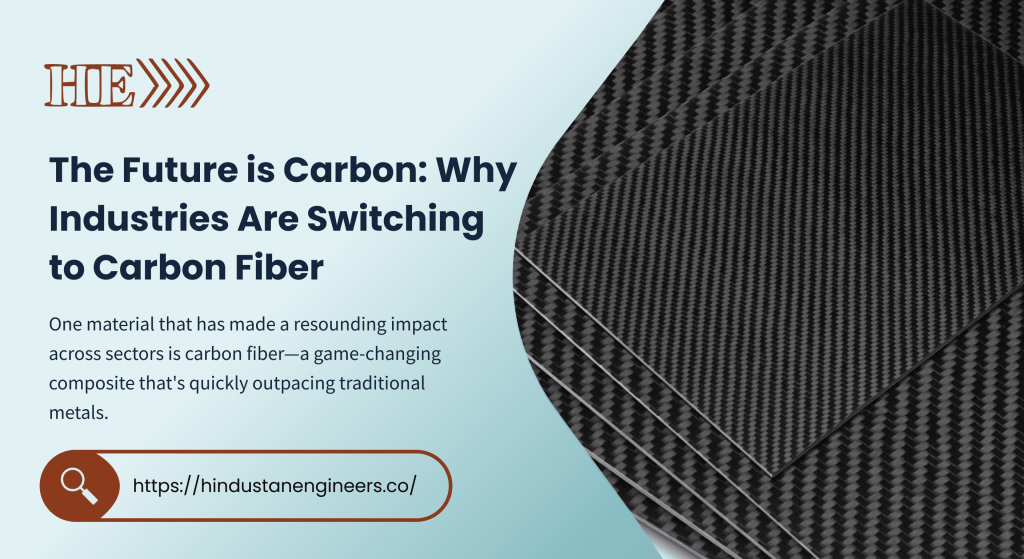
In the fast-evolving world of industrial manufacturing, material innovation plays a pivotal role in boosting efficiency, longevity, and performance. One material that has made a resounding impact across sectors is carbon fiber—a game-changing composite that’s quickly outpacing traditional metals.

At Hindustan Engineers, we’ve seen this shift firsthand. As leading manufacturers and suppliers of carbon fiber sheets, components, tubes, molded parts, and custom industrial solutions, we are at the forefront of this material revolution. But what exactly makes carbon fiber so transformative?

Let’s dive deep into the benefits of carbon fiber, its real-time applications, and why it’s the material of choice in the modern manufacturing landscape.

The Carbon Fiber Advantage Over Metals

For decades, metals like aluminum and steel have dominated industrial applications. However, the emergence of carbon fiber composites has disrupted this status quo with significant advantages:

1. Superior Strength-to-Weight Ratio

Carbon fiber is five times stronger than steel and twice as stiff—yet significantly lighter. This combination allows manufacturers to build parts that are not only more robust but also drastically lighter, improving overall system efficiency.

2. Reduced Weight, Increased Efficiency

A lighter machine or component means lower power consumption, faster cycle times, easier handling, and better structural performance. Whether you’re manufacturing a robotic arm or a drone propeller, reducing weight is a critical factor in modern design—and carbon fiber delivers.

3. Corrosion and Chemical Resistance

Unlike metals, carbon fiber does not rust or corrode. This makes it ideal for harsh environments, including marine, chemical processing, and outdoor applications where traditional materials would degrade quickly.

4. Thermal Stability

Carbon fiber has low thermal expansion, which ensures dimensional stability even under fluctuating temperatures. Some high-temperature variants can withstand exposure up to 200°C or more, making them ideal for high-heat processes.

Benefits of Carbon Fiber in Manufacturing

When we talk about carbon fiber benefits in industrial manufacturing, it’s not just about replacing metals. It’s about enhancing the core functionalities of your products and processes.

Higher Performance at Lower Weight

Ideal for applications requiring dynamic movement and precision, such as CNC machines, robotic assemblies, and telescopic cleaning poles. At Hindustan Engineers, our carbon fiber telescopic tubes are popular in industrial cleaning and maintenance systems due to their unmatched stiffness and low mass.

Longer Product Lifecycle

Thanks to its excellent fatigue resistance, carbon fiber parts tend to last longer than metal parts. This improves the total cost of ownership and reduces maintenance frequency, especially in rotating or load-bearing components.

Design Flexibility

With custom molding, layering, and cutting options, carbon fiber allows for complex geometries and bespoke engineering solutions. Our clients often come to us with unique challenges—from lightweight load-bearing arms to precision-insulating bushings—and carbon fiber makes the solution possible.

Real-Time Applications Across Industries

Automotive & EVs

In the automotive industry, carbon fiber components help reduce vehicle weight, improve fuel efficiency, and enhance structural strength. Battery housings, interior panels, crash structures, and more are now being built with composites.

Aerospace & Defense

Carbon fiber’s lightweight strength is critical in aerospace for fuel savings and payload efficiency. It is widely used in drone frames, airfoils, satellite brackets, and structural panels.

Industrial Machinery

From carbon fiber sheets for machine enclosures to composite shafts, rollers, and insulators, the material enhances performance while reducing wear-and-tear and maintenance requirements.

Marine and Offshore

Its corrosion-resistant properties make carbon fiber perfect for boats, underwater robotics, and offshore energy equipment. Our FRP and carbon composite plates offer extended durability in these environments.

Cleaning & Utility Tools

Our vacuum cleaning poles and telescopic tubes are widely used for industrial cleaning, offering extreme length with minimal flex and user fatigue—a perfect match for carbon fiber’s properties.

Our Product Line at Hindustan Engineers

At Hindustan Engineers, we offer a wide range of carbon fiber-based solutions tailored for industrial use:

  • Carbon Fiber Sheets (multi-thickness, high-tensile, matte/glossy finishes)

  • Carbon Fiber Tubes (round, square, telescopic, custom length)

  • FRP Molded Components (machine covers, plates, casings)

  • Carbon Fiber Nuts, Bolts & Fasteners (for high-vibration applications)

  • Insulators & Vane Plates (for electrical insulation and rotational systems)

  • CT Terminals and Bushings (electrical-grade carbon composites)

Every product is engineered for performance and customizable to your specifications—whether you’re in aerospace, manufacturing, electronics, or industrial automation.

Conclusion: The Future is Carbon

As manufacturing technologies continue to evolve, the materials driving them forward must be equally advanced. Carbon fiber is not just a trend; it’s a structural leap into the future of engineering. Its unparalleled combination of strength, lightness, thermal resistance, and corrosion durability makes it an ideal material for a wide array of industrial applications.

At Hindustan Engineers, we’re proud to be a part of this transformation. Our deep expertise in carbon fiber sheets, components, and custom engineering solutions ensures that your business benefits from the very best in composite technology.

Recent Post