How to Identify High-Quality Carbon Fiber Sheets: 6 Key Parameters
By Hindustan Engineers – Chennai, India
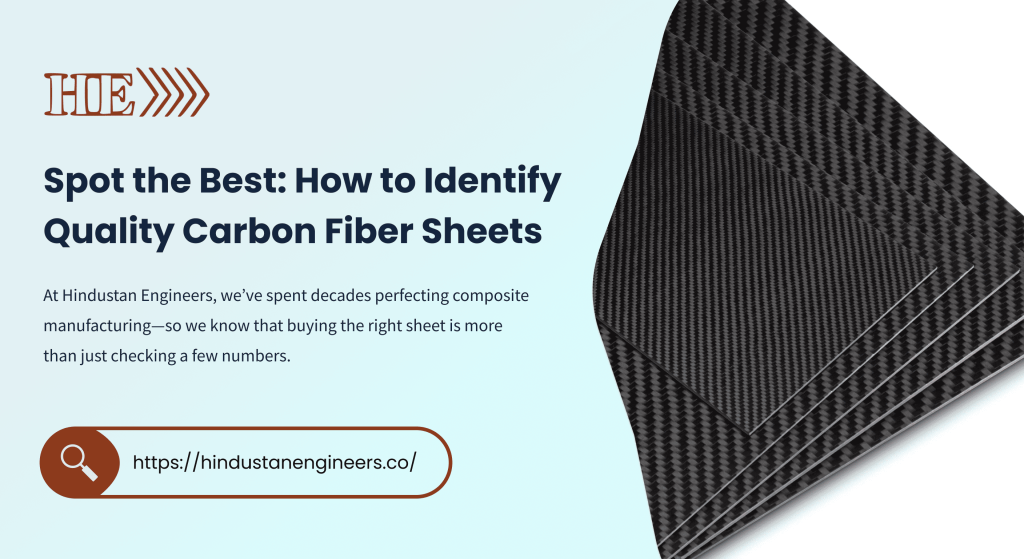
When industrial engineers, designers or procurement specialists set out to choose carbon fiber sheets, their goal is simple: maximise performance, minimise waste, and ensure long-term reliability. At Hindustan Engineers, we’ve spent decades perfecting composite manufacturing—so we know that buying the right sheet is more than just checking a few numbers. A high-quality carbon fiber sheet doesn’t just look good—it performs optimally under tough conditions. In this post we’ll walk you through six key parameters that separate premium carbon fibre sheets from the average, and show how you can inspect them properly.
1. Surface Finish
A flawless surface finish is your first visible clue to quality. At Hindustan Engineers we offer our carbon fibre sheets with glossy or matte finishes on one or both sides, depending on the end-use.
When inspecting:
Look for an even finish without waviness, streaks, or visible resin pooling.
Check for consistent weave patterns (e.g., plain weave, twill) across the panel.
Run your hand gently across the surface—any bumps, depressions or delaminations are red flags.
A high-quality finish not only supports aesthetics (in visible parts) but also signals that the sheet was manufactured with care: proper curing, uniform resin distribution and good mold preparation.
2. Layering Quality (Laminate Integrity)
A sheet may be lightweight and strong—but if the layers are poorly consolidated or the resin content is inconsistent, performance will suffer. At Hindustan Engineers our carbon fibre sheets are built from multiple layers of carbon fibres embedded in an epoxy resin matrix, not mere skins over a core.
Key inspection points:
Edge check: Look at a clean cut (or request one) and examine the layer stack—do the fibre layers appear uniform, without voids, gaps or resin-rich zones?
Peel test (for non-critical parts): A small corner can be scratched/peeled slightly to reveal if the internal fibres are well bonded.
Thickness consistency: Good manufacturing ensures layer build-up is uniform, no thin spots or local bulges.
Why it matters? Because the true strength of a carbon fibre sheet comes from consistent fibre-resin interaction, proper lamination and even curing. Skimping here can lead to early delamination, fatigue cracking or unpredictable behaviour in service.
3. Tolerance & Thickness
Dimension control is another hallmark of quality. When you order a sheet, you don’t just need the right nominal thickness—you need tight tolerances, flatness and correct dimensions for downstream processing (machining, bonding, assembly). Hindustan Engineers standard sizes include 1000 × 1000 mm, 500 × 600 mm, etc., with thickness tolerance ±0.2 mm.
Here’s what to check:
Use a calibrated micrometer or thickness gauge to verify thickness at multiple points (corners + centre).
Check flatness: Lay the sheet on a flat surface and see if any edges lift.
Confirm size dimensions match your specification—especially important for CNC machining or automated assembly.
Why this matters: In tool-making, aerospace or industrial applications, even small deviations can cause misalignment, increased scrap or bonding failures. A manufacturer committed to tight tolerance shows process control excellence.
4. Fibre Type, Weave and Orientation
The internal construction of the carbon fiber sheet—what fibre is used, how it is woven, and how it is oriented—greatly influences performance. At Hindustan Engineers we reference 3K plain/twill weave carbon fibre cloth (200 GSM) and note that inferior sheets sometimes simply press skins over a resin-core.
What to evaluate:
Ask for specification: 3K? 6K? T700/T800 grade fibre? (Indicates higher performance).
Weave type: Plain weave gives balance; twill has better appearance and drapability; unidirectional gives maximum strength in one direction.
Orientation: For quasi-isotropic performance (balanced in all directions) the layers must be oriented properly (which we manufacture).
With a deeper understanding of your application you can match the fibre/weave to the load conditions. For example: if you have multi-directional loads, a balanced weave and orientation is vital.
5. Quality Tests & Visual Indicators
Beyond the visible checks, a high-quality carbon fibre sheet will have undergone lab-grade tests or documented inspection processes. At Hindustan Engineers we focus on fatigue resistance, thermal stability and strength—which our sheets provide.
Inspection plan for purchasers:
Request test certificates: tensile strength, modulus, CTE (coefficient of thermal expansion), fatigue data.
Visual inspections: Check for bubbles/voids in surface, resin pooling, misaligned fibres or warpage.
Measure density: high-quality sheets tend toward expected density (~1.4-1.6 g/cm³ depending on resin content) which Hindustan notes.
Impact check: Gently tap the sheet—solid sound implies good consolidation; a hollow sound may indicate delamination or poor bonding.
These tests separate the commodity sheets from engineered plates ready for demanding industrial or structural use.
6. Traceability, Customisation & Manufacturing Transparency
Finally, the sheet’s pedigree matters. At Hindustan Engineers we emphasise: a long-term customer experience, full support, manufacturing expertise of four decades, and willingness to customise and deliver turnkey solutions.
Does the manufacturer provide batch traceability (resin lot, fibre lot, date of manufacture)?
Can the sheet be customised (thickness, size, surface finish, fibre orientation) to your exact requirement? Hindustan offers both standard and customised sheets. hindustanengineers.co
Is there documentation about manufacturing process (compression moulding, hot/cold set) and whether the sheet is 100% layered rather than just skins over core? Hindustan distinguishes this in its specification.
Support & service: Does the vendor help you integrate the sheet into your process, provide machining support or after-sales guidance?
When you source a carbon fibre sheet from a supplier with full transparency and custom capability, you’re far more likely to get repeatable performance than sourcing from a generic commodity vendor.
Final Thoughts
Choosing high-quality carbon fiber sheets isn’t about checking off a single spec—it’s about a holistic evaluation of finish, lamination integrity, thickness tolerances, fibre type & weave, quality testing, and supplier transparency. At Hindustan Engineers we’ve built our reputation on mastering each of these parameters so that our industrial clients—from aerospace to automotive to construction—get sheets they can trust.
If you’re ready to upgrade your materials and demand true performance, give us a call. We’ll help you select sheets that meet your exact performance, size and finish requirements—and provide the inspection checklist, documentation and support to integrate seamlessly into your workflow.
Recent Post
Your Carbon Fiber Supplier Checklist
When it comes to buying carbon fiber sheets, the quality...
Read MoreBeyond the Basics: How to Select the Best Carbon Fiber Tube for Your Application
Carbon fiber tubes have revolutionized industries ranging from aerospace to...
Read MoreEngineering Guide: Comparing Tensile Strength of Carbon Fiber vs Other Materials
In modern engineering, strength is no longer just about “how...
Read More