Building a Greener Future with Advanced Composite Solutions
Sustainability is no longer a buzzword—it is a responsibility. Across industries, manufacturers, engineers, and innovators are rethinking materials, processes, and product lifecycles to reduce environmental impact without compromising performance. At Hindustan Engineers, we believe that advanced composite materials are not just the future of engineering—they are a powerful pathway toward a more sustainable planet.
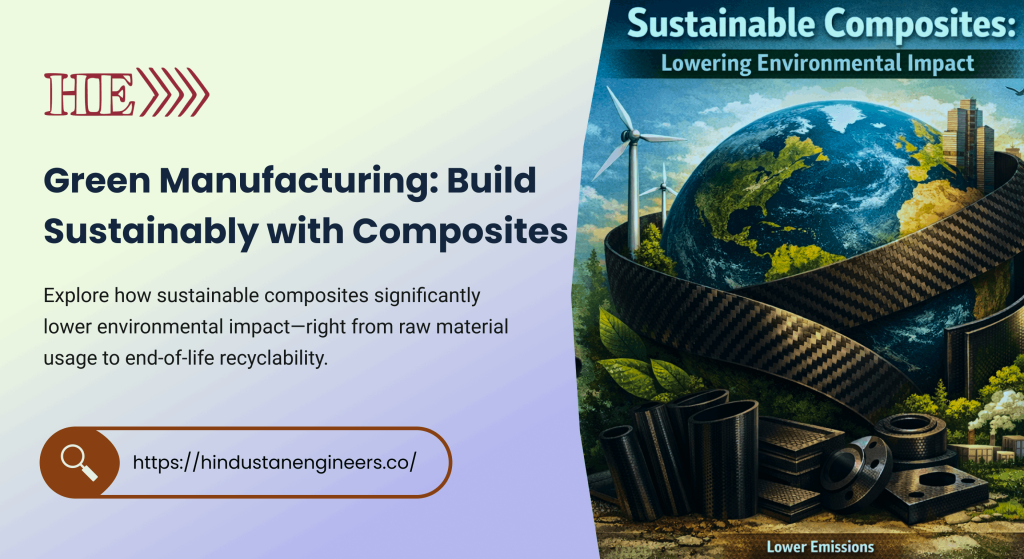
From eco-friendly carbon fiber products to fiber-reinforced polymer (FRP) components, composite materials are transforming how industries balance strength, durability, and environmental consciousness. Let’s explore how sustainable composites significantly lower environmental impact—right from raw material usage to end-of-life recyclability.
1. Lifecycle Advantages: Sustainability That Lasts for Decades
One of the most overlooked aspects of sustainability is product lifespan. Traditional materials like steel, aluminum, or wood often require frequent replacement due to corrosion, fatigue, or environmental degradation. Composite materials, on the other hand, are engineered for longevity.
Why lifecycle matters:
-
-
Longer service life = fewer replacements
-
Reduced manufacturing cycles = lower carbon emissions
-
Less transportation and logistics over time
-
Longer service life = fewer replacements
-
Reduced manufacturing cycles = lower carbon emissions
-
Less transportation and logistics over time
Our carbon fiber sheets, tubes, molded components, FRP parts, and structural composites are designed to withstand extreme mechanical stress, moisture, chemicals, and harsh environmental conditions. This durability ensures that products last years—even decades—longer than conventional materials.
For industries such as:
-
-
Industrial cleaning systems
-
Electrical insulation and bushings
-
Vacuum cleaning poles and telescopic tubes
-
Engineering and infrastructure components
-
the extended lifecycle of composites directly translates into lower resource consumption and reduced waste generation.
Sustainability doesn’t start at disposal—it starts with durability.
2. Less Raw Material Use: Doing More with Less
One of the strongest sustainability advantages of composite materials is their exceptional strength-to-weight ratio.
What does that mean?
You need significantly less material to achieve the same—or better—structural performance compared to metals or traditional plastics.
For example:
-
-
Carbon fiber components can be up to 70% lighter than steel
-
FRP products offer superior stiffness with minimal material thickness
-
Lightweight structures reduce overall system load and energy consumption
-
At Hindustan Engineers, we engineer composite solutions that are:
-
-
Lightweight yet structurally robust
-
Optimized for minimal material waste
-
Tailored for application-specific performance
-
This reduction in raw material usage has a direct environmental benefit:
-
-
Lower extraction of natural resources
-
Reduced energy required for processing
-
Smaller carbon footprint during manufacturing
-
By choosing sustainable composites, industries can meet performance goals while actively reducing environmental strain.
3. Energy Efficiency Beyond Manufacturing
The sustainability impact of composites extends well beyond production.
Lightweight composite components contribute to:
Lower energy consumption during operation
Reduced fuel or power requirements in moving systems
Easier handling, installation, and maintenance
In applications such as telescopic cleaning poles, industrial tools, rotating components, and structural assemblies, reduced weight means:
Less operator fatigue
Higher productivity
Lower energy demand over the product’s lifecycle
Every kilogram saved translates into long-term energy efficiency, making eco-friendly carbon fiber a material of choice for future-focused engineering.
4. Recyclability of Carbon Fiber & FRP: Closing the Loop
A common misconception is that composite materials are not recyclable. The reality is changing—fast.
Modern advancements now allow:
Recovery of carbon fibers from end-of-life components
Reprocessing of FRP materials for secondary applications
Reuse of fibers in non-structural and semi-structural products
At Hindustan Engineers, we actively align our manufacturing philosophy with circular economy principles:
Optimized cutting and molding processes to reduce scrap
Design-for-reuse approaches wherever applicable
Material efficiency that minimizes waste generation
Recovered carbon fibers retain a significant portion of their original strength, making them suitable for:
Industrial panels
Reinforcement materials
Secondary structural components
This evolution makes eco-friendly carbon fiber not just high-performance—but also environmentally responsible.
5. Corrosion Resistance = Fewer Chemicals & Coatings
Unlike metals, composite materials:
Do not rust
Do not require anti-corrosion coatings
Resist chemicals, moisture, and UV exposure
This eliminates the need for:
Toxic surface treatments
Frequent repainting or chemical maintenance
Environmentally harmful protective layers
By choosing FRP and carbon fiber components, industries significantly reduce their dependence on chemical-intensive maintenance processes—another win for sustainability.
6. The Future of Sustainable Engineering is Composite
As industries move toward net-zero goals, smart material selection will define sustainability leadership. Composite materials sit at the intersection of:
High performance
Design flexibility
Environmental responsibility
At Hindustan Engineers, we see composites not as alternatives—but as enablers of a cleaner, stronger, and more efficient future.
Our commitment lies in delivering:
Sustainable composite solutions engineered for longevity
Eco-friendly carbon fiber products that reduce environmental impact
Custom-built components that align with modern sustainability goals
Final Thoughts: Sustainability Engineered Into Every Layer
True sustainability isn’t about compromise—it’s about innovation. Composite materials prove that performance and environmental responsibility can coexist seamlessly.
By reducing raw material consumption, extending product lifecycles, enabling recyclability, and lowering energy usage, sustainable composites redefine how industries approach environmental impact.
At Hindustan Engineers, we don’t just manufacture composite products—we engineer future-ready solutions that support a greener planet.
The future is lightweight. The future is durable. The future is composite.
Recent Post
Advanced Manufacturing of Vane Plates for Industrial Equipment
In the world of high-performance industrial equipment, where precision, efficiency,...
Read MoreMolded Components for Custom Engineering Needs – Why Precision Matters
Molded Components for Custom Engineering Needs – Why Precision Matters...
Read MoreSustainability Angle: How Composite Materials Lower Environmental Impact
Building a Greener Future with Advanced Composite Solutions Sustainability is...
Read More