
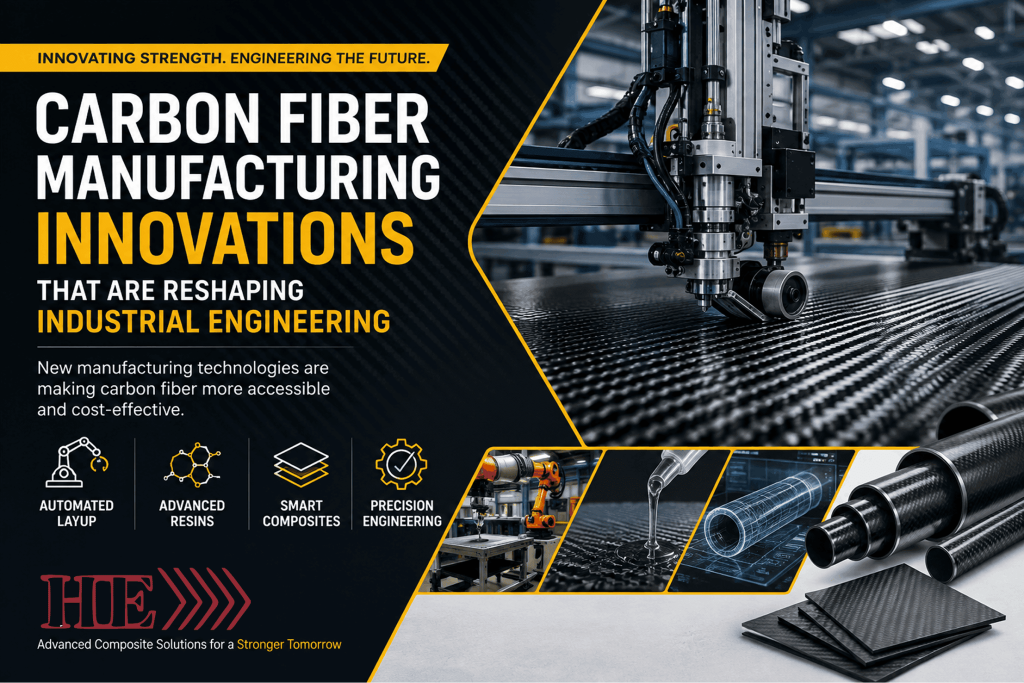
Carbon Fiber Manufacturing Innovations That Are Reshaping Industrial Engineering
Carbon Fiber Manufacturing Is Entering a New Era
Industrial engineering is rapidly evolving, and Carbon Fiber Manufacturing is leading this transformation. Manufacturers across aerospace, automotive, defense, medical, robotics, renewable energy, and industrial automation are increasingly replacing traditional materials with advanced carbon fiber composites to achieve superior performance, reduced weight, and longer service life.
However, what is truly reshaping the industry isn’t just the material itself—it’s the manufacturing innovations behind it.
From automated fiber placement and precision resin technologies to intelligent quality control and smart composite structures, today’s manufacturing advancements are making carbon fiber components more consistent, scalable, and cost-effective than ever before.
At Hindustan Engineers, we continuously invest in modern composite engineering practices to manufacture high-performance carbon fiber products that meet the demanding requirements of today’s industries. With over four decades of expertise in composite manufacturing, we develop lightweight, durable, and application-specific carbon fiber solutions for industrial and commercial applications.
Why Manufacturing Innovation Matters in Carbon Fiber
Carbon fiber has always been recognized for its exceptional:
- High strength-to-weight ratio
- Excellent stiffness
- Corrosion resistance
- Fatigue resistance
- Dimensional stability
- Long operational lifespan
While these benefits have existed for years, earlier manufacturing processes were often labor-intensive, expensive, and time-consuming.
Modern Composite Innovation has dramatically changed this landscape by improving production speed, reducing material waste, enhancing quality consistency, and making carbon fiber solutions more accessible for a wider range of industrial applications. Recent advances in automation and manufacturing techniques are helping bring composite production to broader industrial use.
1. Automated Layup Is Revolutionizing Carbon Fiber Manufacturing
One of the biggest breakthroughs in modern Carbon Fiber Manufacturing is the adoption of automated layup technologies.
Instead of manually positioning every carbon fiber layer, automated systems place fibers with exceptional precision according to engineered fiber orientations.
This provides several advantages:
- Higher dimensional accuracy
- Uniform laminate quality
- Reduced human error
- Lower production time
- Better repeatability across batches
- Reduced material wastage
Automated layup is especially valuable when manufacturing structural components such as:
- Carbon Fiber Tubes
- Carbon Fiber Sheets
- Telescopic Tubes
- Machine Structural Components
- Industrial Composite Assemblies
At Hindustan Engineers, precision manufacturing enables every carbon fiber component to deliver consistent mechanical performance across demanding industrial environments.
2. Advanced Resin Systems Are Enhancing Composite Performance
Carbon fiber alone does not determine the final strength of a composite.
The resin system plays an equally important role.
Today’s advanced epoxy and engineered resin technologies offer:
- Better fiber bonding
- Higher impact resistance
- Improved fatigue performance
- Enhanced temperature resistance
- Increased chemical resistance
- Longer service life
Modern resin formulations also reduce void formation while improving structural integrity during curing.
The result is a composite that performs reliably under continuous mechanical stress, harsh industrial conditions, and demanding operating environments.
This is particularly valuable for industries requiring long-lasting structural reliability with minimal maintenance.
3. Smart Composite Design Is Changing Product Engineering
One of the most exciting Industrial Engineering Trends is the development of smarter composite structures.
Modern carbon fiber products are no longer designed simply to replace metal.
Instead, engineers optimize:
- Fiber orientation
- Layer thickness
- Load paths
- Stiffness zones
- Impact resistance
- Weight distribution
This engineering-first approach allows each component to deliver maximum performance while using only the material required.
The outcome includes:
- Lower overall weight
- Higher efficiency
- Better energy performance
- Reduced operational costs
From industrial equipment to automation systems, optimized composite design helps manufacturers build stronger products without unnecessary material usage.
4. Precision Manufacturing Improves Product Consistency
Industrial customers demand consistent quality.
Modern carbon fiber manufacturing incorporates precision-controlled production processes that minimize variation between parts.
This improves:
- Dimensional accuracy
- Surface finish
- Mechanical properties
- Structural reliability
- Assembly compatibility
Consistent manufacturing is especially important for applications where multiple composite components must fit together with tight tolerances.
At Hindustan Engineers, every carbon fiber solution is manufactured with a focus on quality, precision, and long-term reliability to support industrial performance.
5. Lightweight Engineering Is Driving Industrial Innovation
Across almost every engineering sector, reducing weight has become a strategic objective.
Lighter components help improve:
- Equipment efficiency
- Machine acceleration
- Energy consumption
- Handling and installation
- Worker safety
- Transportation costs
Unlike traditional metals, carbon fiber offers exceptional stiffness while weighing significantly less.
This makes it ideal for products such as:
- Carbon Fiber Tubes
- Carbon Fiber Telescopic Poles
- Structural Panels
- Machine Components
- Vacuum Cleaning Poles
- Custom Composite Parts
By combining lightweight construction with high structural strength, manufacturers can achieve greater productivity without sacrificing durability. Hindustan Engineers designs products including carbon fiber tubes, sheets, telescopic tubes, and vacuum cleaning poles for demanding industrial applications.
6. Improved Quality Inspection Is Increasing Manufacturing Confidence
Manufacturing innovation is not limited to production.
Quality inspection technologies have also advanced significantly.
Modern inspection methods help identify:
- Internal defects
- Fiber alignment issues
- Surface imperfections
- Bonding inconsistencies
- Structural anomalies
Earlier detection reduces production losses while ensuring only high-quality composite components reach customers.
Advanced inspection methods, including automated non-destructive evaluation techniques, continue to improve confidence in carbon fiber manufacturing.
7. Sustainable Manufacturing Is Becoming a Competitive Advantage
Manufacturers today are expected to improve both operational performance and environmental responsibility.
Modern carbon fiber manufacturing contributes by:
- Reducing material waste
- Improving manufacturing efficiency
- Extending product lifespan
- Lowering maintenance frequency
- Supporting lightweight designs that reduce operational energy consumption
Long-lasting composite products also reduce replacement cycles, contributing to improved lifecycle value.
As sustainability becomes an important purchasing factor, innovative composite manufacturing is helping industries balance performance with responsible resource utilization.
Where These Innovations Deliver the Greatest Value
Modern Carbon Fiber Manufacturing innovations benefit numerous industries, including:
- Aerospace & Aviation
- Defense
- Industrial Automation
- Textile Machinery
- Electrical & Electronics
- Renewable Energy
- Automotive
- Robotics
- Medical Equipment
- Material Handling Systems
- Cleaning Equipment
- Precision Engineering
Each industry gains from stronger, lighter, and more reliable composite components tailored to demanding operational requirements.
Why Hindustan Engineers Is Your Trusted Carbon Fiber Manufacturing Partner
At Hindustan Engineers, innovation is built into every stage of our manufacturing process.
With decades of expertise in composite engineering, we specialize in designing and manufacturing high-performance carbon fiber and FRP composite components for diverse industrial applications. Our product portfolio includes:
- Carbon Fiber Tubes
- Carbon Fiber Sheets
- Carbon Fiber Telescopic Tubes
- Vacuum Cleaning Poles
- Carbon Vane Plates
- Custom Composite Components
Every product is developed with precision manufacturing, rigorous quality control, and a commitment to delivering dependable performance for modern industrial engineering applications.
Conclusion
The future of Carbon Fiber Manufacturing is being shaped by automation, advanced resin systems, precision engineering, and smart composite design. These innovations are making carbon fiber solutions more efficient, cost-effective, and accessible across a wide range of industries.
As Industrial Engineering Trends continue to emphasize lightweight performance, durability, and operational efficiency, businesses that embrace modern Composite Innovation will be better positioned to improve productivity and remain competitive.
At Hindustan Engineers, we remain committed to delivering advanced carbon fiber solutions that combine engineering excellence, manufacturing precision, and long-term reliability—helping industries build the next generation of high-performance products.
FRP (Fiber Reinforced Plastic) and Carbon Fiber are advanced weight optimization materials that significantly reduce the mass of moving machinery components such as conveyor systems, robotic arms, and rotating tools. By replacing traditional metals, manufacturers achieve higher speed, lower energy consumption, improved fatigue life, and greater design flexibility. Lightweight machinery components made from FRP and Carbon Fiber enable better performance, reduced maintenance, and long-term operational efficiency across industrial automation and material handling systems.
Recent Post
Comparing Vane Materials: Carbon Vanes, FRP Vanes, and Carbon Fiber Vanes – Which is Best for Your Industry?
When selecting vane materials for industrial applications such as compressors,...
Read More
Understanding the Role of Carbon Fiber Vane Plates in High-Speed Motor Components
Understanding the Role of Carbon Fiber Vane Plates in High-Speed...
Read More
FRP vs Traditional Materials: What’s Best for Electrical Insulation?
FRP vs Traditional Materials: What’s Best for Electrical Insulation? In...
Read More