
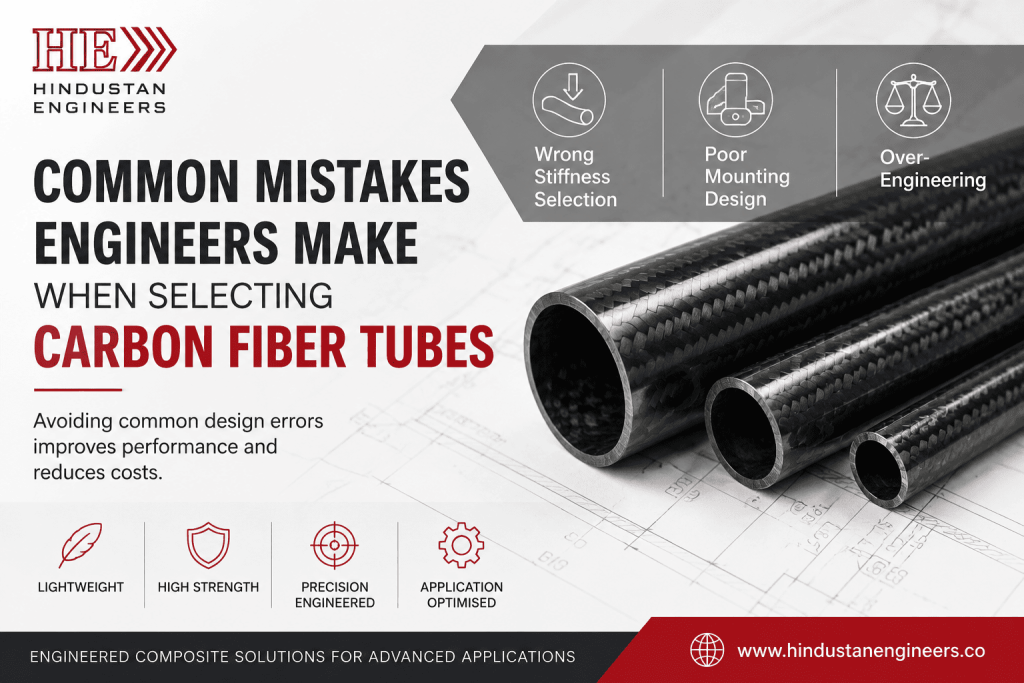
Common Mistakes Engineers Make When Selecting Carbon Fiber Tubes
The Right Carbon Fiber Tube Can Improve Performance. The Wrong One Can Compromise the Entire Design.
Carbon fiber tubes are often selected for one simple reason: they offer exceptional strength and stiffness without the weight penalty associated with conventional materials such as steel.
But here is where many engineering projects go wrong.
Choosing carbon fiber is only the first decision. Choosing the right carbon fiber tube is the real engineering challenge.
Two tubes may look almost identical in terms of diameter and surface finish while performing very differently under bending, torsion, vibration or repeated loading. The difference can come down to fiber orientation, wall thickness, manufacturing process, load direction and, importantly, how the tube is mounted into the final assembly.
At Hindustan Engineers, we work with carbon fiber composite applications across industrial machinery, robotics, automation, telescopic systems, UAV components, precision equipment and other weight-sensitive applications. Our experience has shown that many performance issues do not occur because carbon fiber is the wrong material.
They occur because the tube was selected using the wrong assumptions.
This Composite Design Guide highlights three of the most common mistakes engineers make during Carbon Fiber Tube Selection—wrong stiffness selection, poor mounting design and over-engineering—and explains how a more application-focused approach can improve performance while reducing unnecessary cost.
Mistake #1: Selecting a Tube Based Only on Diameter and Wall Thickness
One of the most common mistakes in Carbon Fiber Tube Selection is treating carbon fiber tubes like conventional metal tubes.
With steel or aluminium, engineers may primarily evaluate dimensions, wall thickness and material grade. Carbon fiber composites require a more detailed approach because their mechanical behaviour is strongly influenced by how the fibers are arranged.
Stiffness Is Not the Same as Strength
A tube can be strong enough to avoid breaking and still be unsuitable for the application because it deflects too much.
This distinction becomes especially important in applications such as:
- Robotic arms
- Pick-and-place systems
- Metrology equipment
- Camera and survey systems
- UAV structures
- Industrial automation
- Long-reach and telescopic applications
- Rotating shafts and rollers
In these applications, excessive flex can reduce positioning accuracy, create vibration, affect cycle times or increase fatigue on connected components.
The correct question is not simply:
“How strong does the tube need to be?”
A better engineering question is:
“How much bending, torsion and deflection can the complete system tolerate?”
Fiber Orientation Changes Performance
Carbon fiber is an anisotropic material, which means its properties can vary depending on fiber direction.
For example, fiber orientation can be optimised to support different requirements:
- Axial loading
- Bending stiffness
- Torsional performance
- Hoop strength
- Multi-directional loading
This is why manufacturing method matters.
At Hindustan Engineers, our carbon fiber tubes are manufactured using processes such as roll wrapping and filament winding, allowing the tube construction to be matched more closely with application requirements. Roll-wrapped tubes can offer excellent bending stiffness with low weight, while filament-wound constructions can be engineered around specific winding angles to address torsional and other loading requirements.
The key takeaway is simple:
Do not select a carbon fiber tube simply because the diameter looks right. Select it based on the load case, deflection requirement and direction of stress.
This is one of the most important Engineering Best Practices when designing with composites.
Mistake #2: Ignoring the Mounting and Interface Design
A perfectly engineered carbon fiber tube can still fail prematurely if the mounting system is poorly designed.
This is a mistake we frequently see when engineers replace a metal component with a carbon fiber alternative but retain exactly the same mounting concept.
Carbon fiber composites do not behave like isotropic metals. A localised clamp load, sharp fastener edge or excessive bolt compression can create stress concentrations that may damage the laminate.
Common Mounting Design Problems
Some of the most frequent issues include:
- Over-tightening clamps
- Drilling holes without considering laminate structure
- Applying concentrated loads to a small contact area
- Using sharp-edged metal brackets
- Ignoring galvanic interaction with conductive materials
- Creating stress concentrations near tube ends
- Assuming the tube can be machined and fastened exactly like aluminium
These issues can lead to cracking, delamination, crushing or premature fatigue.
Design the Interface, Not Just the Tube
The tube should always be considered as part of a complete assembly.
For example, depending on the application, engineers may need to consider:
- Bonded inserts
- Internal reinforcement
- Sleeves or bushings
- Larger load-distribution areas
- Purpose-designed clamps
- Appropriate end fittings
- Isolation between carbon fiber and certain metal components
For long or lightweight structures, mounting stiffness also matters.
A highly rigid carbon fiber tube connected to a flexible bracket will not deliver the performance the designer expects. The overall system is only as effective as its weakest structural interface.
This is why we encourage engineers to evaluate the complete application before finalising tube specifications. In many cases, a small design improvement at the mounting point can deliver greater performance benefits than simply increasing tube wall thickness.Mistake #3: Over-Engineering the Carbon Fiber Tube
Carbon fiber is a premium engineering material. That does not mean every application requires the thickest, stiffest or highest-performance tube available.
In fact, over-engineering is one of the easiest ways to increase project cost without delivering meaningful performance benefits.
A common reaction to uncertainty is to add more material:
“Let’s increase the wall thickness just to be safe.”
While this may increase certain performance characteristics, it can also introduce unnecessary cost and weight.
More Carbon Fiber Is Not Always Better
An oversized tube can:
- Increase material consumption
- Increase component cost
- Add unnecessary weight
- Make integration more difficult
- Increase inertia in moving systems
- Reduce the efficiency advantage of using composites
For robotic and automation applications, additional mass can have a direct impact on motors, actuators and energy consumption.
For telescopic or manually operated equipment, unnecessary weight can reduce manoeuvrability and increase operator fatigue.
The objective should not be to build the strongest possible tube.
The objective should be to build the right tube for the required performance level.
Start With the Actual Engineering Requirements
Before finalising the design, define:
- Maximum operating load
- Load direction
- Required factor of safety
- Allowable deflection
- Operating length and unsupported span
- Torsional requirements
- Dynamic or repeated loading
- Environmental exposure
- Weight limitations
- Mounting and interface requirements
A Better Approach to Carbon Fiber Tube Selection
The most effective approach is to treat the tube as an engineered composite component rather than a standard commodity.
At Hindustan Engineers, our approach begins with the application.
Step 1: Understand the Load Case
Identify whether the tube will primarily experience:
- Bending
- Compression
- Tension
- Torsion
- Vibration
- Repeated fatigue loading
- A combination of multiple loads
Step 2: Define the Performance Priority
Is the primary objective:
- Maximum stiffness?
- Minimum weight?
- Torsional strength?
- Dimensional stability?
- Fatigue resistance?
- Long service life?
The answer helps determine the appropriate tube design and manufacturing approach.
Step 3: Select the Right Manufacturing Process
Different applications may require different composite constructions.
Our roll-wrapped carbon fiber tubes are particularly suitable for applications requiring high bending stiffness and low weight, including robotics, telescoping systems and lightweight structural components.
Filament winding provides greater flexibility in fibre orientation and can be advantageous where torsional or application-specific loading requirements need to be addressed.
Step 4: Design the Mounting System Along With the Tube
Do not wait until the tube has been selected to think about clamps, inserts and end connections.
The mounting design should be part of the initial engineering discussion.
Step 5: Optimise Instead of Over-Specifying
The best design is not necessarily the thickest or most expensive.
It is the design that delivers the required stiffness, strength, durability and reliability with the lowest practical weight and material usage.Why Product Customisation Matters
Standard carbon fiber tubes are suitable for many applications. However, demanding engineering projects often require more than a catalogue dimension.
Depending on the application, factors such as diameter, wall thickness, fibre architecture, finish and manufacturing process can influence the final product’s performance.
At Hindustan Engineers, we manufacture carbon fiber composite products for applications where weight, stiffness, durability and dimensional stability are critical considerations. Our manufacturing capabilities include roll wrapping and filament winding, enabling us to support different carbon fiber tube configurations and engineering requirements.
Whether the application involves industrial automation, robotics, telescopic equipment, precision systems or specialised machinery, selecting the right composite solution can help improve both product performance and long-term value.
The Bottom Line: Better Selection Prevents Costly Design Problems
Most carbon fiber tube failures do not begin with the material itself.
They begin with an incomplete design process.
Selecting the wrong stiffness can lead to excessive deflection. Poor mounting can create stress concentrations. Over-engineering can increase cost and weight without improving real-world performance.
The solution is a more structured approach to Carbon Fiber Tube Selection.
Evaluate the complete load case. Understand stiffness requirements. Consider fibre orientation and manufacturing method. Design the mounting interface carefully. And optimise the tube around actual performance requirements instead of simply choosing the strongest available option.
That is what effective composite engineering is all about.
At Hindustan Engineers, we believe carbon fiber should not simply be used as a replacement for metal. It should be engineered to take advantage of what makes composites different.
The right tube is not the one with the most material. It is the one designed to deliver the right performance, at the right weight and the right cost.
Looking for the Right Carbon Fiber Tube for Your Application?
If your project requires a carbon fiber tube for industrial machinery, robotics, automation, telescopic equipment or another specialised application, our team can help you evaluate the right combination of dimensions, construction and performance requirements.
Talk to Hindustan Engineers about your application requirements and develop a carbon fiber tube solution engineered around the way your product actually performs.
FRP (Fiber Reinforced Plastic) and Carbon Fiber are advanced weight optimization materials that significantly reduce the mass of moving machinery components such as conveyor systems, robotic arms, and rotating tools. By replacing traditional metals, manufacturers achieve higher speed, lower energy consumption, improved fatigue life, and greater design flexibility. Lightweight machinery components made from FRP and Carbon Fiber enable better performance, reduced maintenance, and long-term operational efficiency across industrial automation and material handling systems.
Recent Post

Engineering Guide: Comparing Tensile Strength of Carbon Fiber vs Other Materials
In modern engineering, strength is no longer just about “how...
Read More
Why Carbon Fiber is Revolutionizing Industrial Manufacturing
In the fast-evolving world of industrial manufacturing, material innovation plays...
Read More
The Rise of FRP Composites in Aerospace & Rail Infrastructure
In the world of high-performance engineering, FRP composites (Fibre Reinforced...
Read More