Lightweight, High-Stiffness Carbon Fiber Solutions for Better Reach, Control and Operational Efficiency
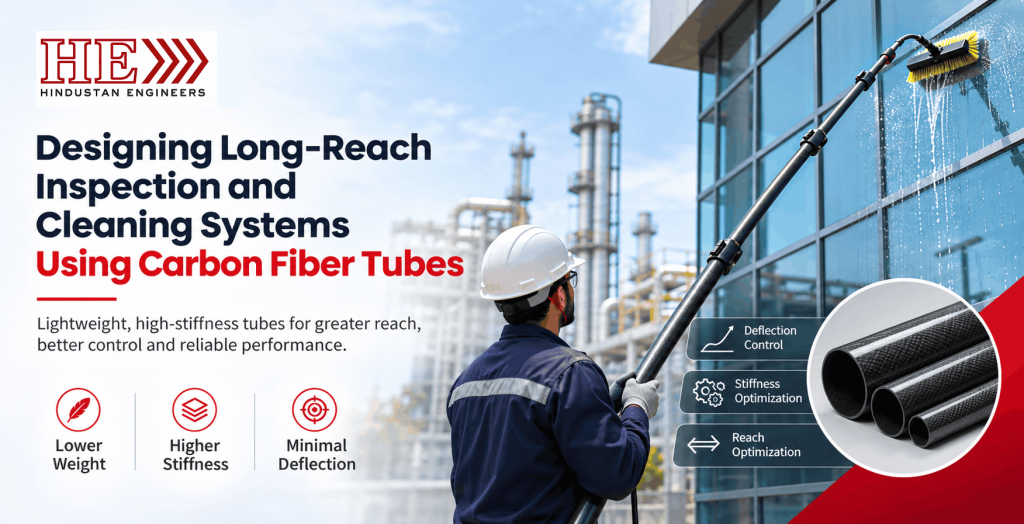
Inspecting elevated structures, cleaning hard-to-access surfaces and maintaining industrial equipment often require tools that can reach beyond the operator’s immediate working area. Whether it is inspecting industrial pipelines, cleaning solar panels, maintaining high-rise buildings or accessing overhead machinery, the performance of long-reach equipment depends heavily on the material used in its structural components.
Traditional metal poles and extension systems can become difficult to handle as their length increases. Their weight, flexibility and handling limitations may affect operator comfort, positioning accuracy and overall productivity.
This is where Long Reach Carbon Fiber Tubes offer a practical engineering advantage.
At Hindustan Engineers, we manufacture carbon fiber tubes and telescopic tube solutions designed for applications where lightweight construction, structural stiffness and reliable performance are essential. By combining the strength-to-weight advantages of carbon fiber composites with application-specific tube configurations, we help equipment manufacturers develop more manageable and efficient inspection and cleaning systems.
Let’s explore how carbon fiber tubes improve long-reach equipment design.
1. Why Material Selection Matters in Long-Reach Equipment Design
As the working length of an inspection or cleaning system increases, the structural demands on its supporting pole also increase.
A longer pole must support its own weight along with the weight of the attached equipment, such as inspection cameras, cleaning brushes, water-fed systems, sensors or other accessories.
Using conventional materials can introduce several challenges:
Increased equipment weight: Heavy extension poles can cause operator fatigue during prolonged operations.
Excessive deflection: Long poles may bend under their own weight or the load attached to their working end.
Reduced positioning accuracy: Uncontrolled movement can make it difficult to position inspection cameras and cleaning heads accurately.
Handling difficulties: Heavy equipment can become challenging to extend, retract and manoeuvre.
Environmental exposure: Outdoor and industrial applications may expose structural components to moisture, chemicals and changing weather conditions.
Carbon fiber-reinforced polymer (CFRP) tubes address several of these challenges through their combination of low density, high stiffness and corrosion resistance.
For long-reach equipment manufacturers, this creates an opportunity to design lighter structures without compromising the structural requirements of the application.
2. How Long Reach Carbon Fiber Tubes Improve Equipment Performance
Carbon fiber is particularly suitable for applications where reducing weight while maintaining structural rigidity is important.
Unlike conventional metal tubes, carbon fiber composites offer engineers the flexibility to select fiber orientation, tube construction and material configuration according to the required mechanical performance.
Some important advantages include:
High Strength-to-Weight Ratio
Reducing the weight of an extension pole makes it easier for operators to lift, position and manoeuvre the equipment. This becomes especially valuable when working with extended poles or carrying additional inspection accessories.
Improved Bending Stiffness
A properly designed carbon fiber tube can provide the bending stiffness required to support long-reach applications. This helps minimise unwanted movement and maintain better control of the working end.
Corrosion Resistance
Carbon fiber composite tubes do not rust like conventional steel. This makes them suitable for applications involving outdoor exposure, moisture and selected industrial environments. Compatibility with specific chemicals should always be evaluated against the resin system, fittings and operating conditions.
Design Flexibility
Carbon fiber tubes can be manufactured in different diameters, lengths, wall thicknesses and fiber configurations. This allows equipment manufacturers to select components based on the intended load, reach and operating conditions.
3. Deflection Control: Maintaining Stability at Extended Lengths
One of the biggest engineering challenges in designing long-reach inspection and cleaning equipment is controlling deflection.
When a pole extends over a considerable distance, even a small amount of bending near its base can result in noticeable movement at the working end.
For example, an inspection camera mounted at the end of an extended pole requires sufficient stability to capture clear images. Similarly, a cleaning brush or water-fed attachment needs controlled movement to maintain consistent contact with the target surface.
Several factors influence tube deflection:
Overall tube length.
Outer diameter and wall thickness.
Carbon fiber material properties.
Fiber orientation and manufacturing process.
Weight of the attached equipment.
Support conditions and connection design.
The bending stiffness of a tube depends on both its material properties and cross-sectional geometry. For a simplified beam model, bending stiffness is represented by:
Bending Stiffness = E × I
Where:
E = Young’s modulus of the material.
I = Second moment of area of the tube cross-section.
This means material selection alone does not determine performance. Tube diameter, wall thickness and structural configuration are equally important.
At Hindustan Engineers, our carbon fiber tube manufacturing capabilities allow customers to explore suitable tube configurations based on their application and structural requirements.
4. Stiffness and Reach Optimization: Finding the Right Balance
Longer reach does not automatically mean better equipment performance.
A pole that is too flexible may become difficult to control, while an unnecessarily heavy or oversized structure can reduce manoeuvrability.
The objective is to achieve an effective balance between reach, stiffness and weight.
For long-reach systems, engineers should consider:
Tube Diameter: Increasing the outer diameter can significantly improve bending stiffness, depending on the wall thickness and cross-sectional design.
Wall Thickness: The appropriate wall thickness helps provide the required structural capacity while controlling overall weight.
Fiber Orientation: Unidirectional and woven carbon fiber reinforcements provide different mechanical characteristics. The fiber arrangement should match the expected loading conditions.
Connection Strength: Telescopic joints, clamps and connecting sections must be designed to transfer loads effectively without introducing excessive movement.
Attachment Weight: Cameras, brushes, cleaning heads and other accessories should be included in the structural design calculations.
By considering these factors together, equipment manufacturers can develop long-reach systems that are easier to handle and more stable during operation.
5. Choosing the Right Carbon Fiber Tube Manufacturing Method
The manufacturing process plays an important role in determining the structural characteristics of carbon fiber tubes.
At Hindustan Engineers, we offer carbon fiber tube manufacturing through roll-wrapped and filament-wound processes.Roll-Wrapped Carbon Fiber Tubes
Roll-wrapped carbon fiber tubes are manufactured using multiple layers of carbon fiber fabric, including twill and plain-weave configurations. This construction is suitable for applications requiring a combination of low weight, bending stiffness and a refined surface finish. Key advantages include:- High bending stiffness for weight-sensitive applications.
- Availability of different fabric configurations.
- Glossy, matte and sanded finish options.
- Suitability for robotics, telescopic poles, rollers and UAV components.
Filament-Wound Carbon Fiber Tubes
Filament winding involves applying continuous carbon fiber yarn or rovings around a mandrel in controlled winding patterns. The winding angle can be selected according to the required structural performance. This process is particularly useful when designing components that must withstand specific loading conditions, including torsional forces. Key advantages include:- Flexible fiber winding configurations.
- Suitability for different tube sizes and lengths.
- Application-specific structural design.
- Potential for improved torsional performance through suitable fiber orientation.
6. Applications of Carbon Fiber Tubes in Inspection and Cleaning Equipment
The lightweight and rigid characteristics of carbon fiber make these tubes suitable for several long-reach applications.
Industrial Inspection Systems
Carbon fiber tubes can be used as structural support components for inspection cameras, visual monitoring equipment and remote-access tools. Their low weight helps operators position equipment in elevated or difficult-to-access locations.
Solar Panel Cleaning Systems
Long-reach carbon fiber poles can support cleaning brushes and water-fed attachments, helping operators access large solar panel installations while reducing the weight they need to handle.
High-Rise Building and Window Cleaning
Telescopic carbon fiber tubes provide an effective structural option for cleaning equipment that needs to reach elevated windows, façades and exterior surfaces.
Industrial Equipment Maintenance
Long-reach tubes can support maintenance accessories used for accessing overhead machinery, equipment housings and difficult-to-reach areas.
Agricultural and Outdoor Equipment
Carbon fiber telescopic poles can also be used in selected agricultural applications, including harvesting and maintenance equipment where lightweight extension systems are beneficial.
7. Why Choose Hindustan Engineers for Carbon Fiber Tube Solutions?
At Hindustan Engineers, we understand that every industrial application comes with different structural and operational requirements.
Our carbon fiber tube manufacturing capabilities focus on providing practical composite solutions for equipment manufacturers and industrial customers.
Our product capabilities include:
Roll-wrapped carbon fiber tubes using 3K plain and twill-weave fabrics.
Filament-wound carbon fiber tube solutions.
Different tube diameters and wall configurations.
Application-specific tube lengths and configurations.
Glossy, matte and sanded surface finishes.
Carbon fiber telescopic tube solutions for extended-reach applications.
Whether you are developing an inspection pole, industrial cleaning system or specialised extension equipment, selecting the right tube configuration can make a meaningful difference to overall equipment performance.
We work towards understanding your application requirements and identifying suitable carbon fiber tube solutions.
Conclusion: Build Longer-Reach Equipment with Better Control
The effectiveness of long-reach inspection and cleaning systems depends on more than just their overall length. Weight, stiffness, deflection control and structural stability all influence how efficiently the equipment performs.
Carbon fiber tubes provide equipment manufacturers with an opportunity to develop lightweight, rigid and application-specific extension systems that are easier to manoeuvre and more suitable for demanding operational environments.
At Hindustan Engineers, we manufacture carbon fiber tubes and telescopic solutions to support evolving industrial and commercial equipment requirements.
Looking to develop a lightweight, high-stiffness long-reach inspection or cleaning system?
Connect with Hindustan Engineers to discuss your carbon fiber tube requirements and explore a suitable solution for your application.
FRP (Fiber Reinforced Plastic) and Carbon Fiber are advanced weight optimization materials that significantly reduce the mass of moving machinery components such as conveyor systems, robotic arms, and rotating tools. By replacing traditional metals, manufacturers achieve higher speed, lower energy consumption, improved fatigue life, and greater design flexibility. Lightweight machinery components made from FRP and Carbon Fiber enable better performance, reduced maintenance, and long-term operational efficiency across industrial automation and material handling systems.
Recent Post
Carbon Fiber Sheet Retrofit: The Ultimate Solution for Structural Challenges
A significant percentage of structural failures are due to material...
Read More
10 Benefits of Using FRP Sheets in Chemical and Food Processing Industries
In industrial environments like chemical and food processing plants, material...
Read More
Molded Components for Custom Engineering Needs – Why Precision Matters
Molded Components for Custom Engineering Needs – Why Precision Matters...
Read More