
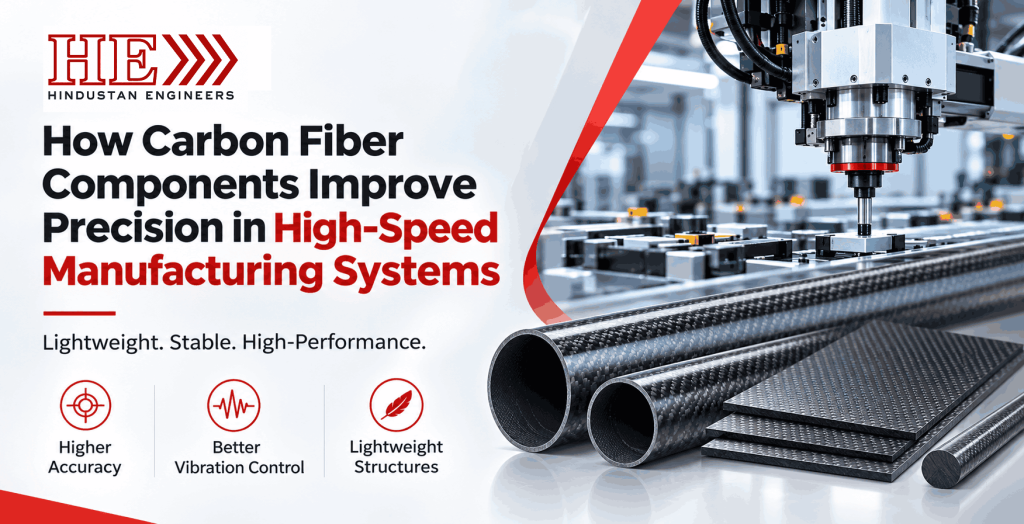
Discover how lightweight carbon fiber components help manufacturers improve positioning accuracy, control vibration, and achieve greater consistency in high-speed automation.
Introduction: When Manufacturing Speed Increases, Precision Becomes Critical
In modern manufacturing, producing more in less time is no longer enough. Every movement, every component, and every production cycle must deliver consistent accuracy.
Consider a high-speed robotic pick-and-place system operating thousands of times throughout a production shift. Even a small amount of vibration, structural deflection, or positioning error can affect product quality, increase rejection rates, and slow down the entire production process.
This is where the choice of materials makes a significant difference.
Traditional metal components offer strength and durability, but their weight can create challenges in applications that demand rapid acceleration, precise movement, and efficient energy consumption.
Carbon fiber components provide an alternative by combining low weight, high specific stiffness, and excellent dimensional stability under suitable operating conditions.
At Hindustan Engineers, we recognize the growing importance of advanced composite materials in modern industrial applications. Carbon fiber tubes, rods, sheets, and other engineered composite structures can play a valuable role in developing lightweight, reliable, and precision-focused manufacturing equipment.
Let’s explore how carbon fiber is helping engineers overcome some of the most common challenges in high-speed manufacturing.
1. Why Precision Matters in High-Speed Manufacturing
High-speed manufacturing systems rely on coordinated movements between mechanical structures, motors, sensors, robotic arms, and control systems.
As production speeds increase, maintaining consistent accuracy becomes more difficult.
Common challenges include:
Mechanical vibration: Repeated movement can create oscillations that affect positioning accuracy.
Structural deflection: Heavy or insufficiently stiff components may bend under dynamic loads.
Increased inertia: Moving heavier components requires greater force to accelerate and decelerate.
Thermal expansion: Temperature changes can affect component dimensions and alignment.
Positioning inconsistencies: Mechanical movement and residual vibration can introduce variations between production cycles.
These challenges are particularly important in electronics assembly, packaging machinery, robotic automation, precision inspection, and automated material handling.
Selecting the right Precision Manufacturing Components can help engineers address these problems at the design stage rather than relying entirely on adjustments after installation.
Carbon fiber composites are increasingly relevant because their mechanical properties can be tailored to specific structural and movement requirements.
2. Lightweight Carbon Fiber Structures Improve Positioning Accuracy
One of the most important advantages of carbon fiber composites is their high stiffness-to-weight ratio.
In a high-speed automation system, every additional kilogram on a moving axis increases the load on motors, bearings, guides, and other mechanical components.
Reducing this moving mass can improve system responsiveness.
How lighter components support precision
When properly designed, lightweight carbon fiber structures can:
Reduce the inertia of moving assemblies.
Allow faster acceleration and deceleration within actuator limits.
Reduce dynamic loads on supporting mechanisms.
Improve responsiveness during repeated positioning movements.
Help maintain structural stiffness without excessive component weight.
For example, consider an automated handling machine with a long horizontal arm.
A heavier arm may require a larger motor and experience greater inertial loading during rapid movements. Replacing a suitable metal structural member with an engineered carbon fiber tube can reduce moving mass while maintaining the required stiffness.
The result can be more responsive movement and improved repeatability, provided the entire mechanical system is correctly designed and calibrated.
Product application: Carbon fiber tubes and rods
Carbon fiber tubes and rods are particularly useful for lightweight structural applications.
Potential uses include robotic arms, automated handling structures, positioning assemblies, lightweight supports, and machine mechanisms.
Their combination of low weight and directional stiffness makes them valuable where both movement speed and structural stability matter.
3. Better Vibration Control for Consistent Manufacturing Accuracy
How carbon fiber helps manage vibration
Carbon fiber composites offer useful vibration-control characteristics because their stiffness, mass, and damping behavior can be engineered through material selection and laminate design. Compared with some conventional metallic structures, appropriately designed composite components may provide improved vibration damping in particular operating conditions. However, vibration performance depends on the fiber orientation, resin system, geometry, mounting arrangement, and excitation frequency.Industrial applications
Robotic pick-and-place systems Lightweight composite arms can reduce moving inertia and help limit unwanted dynamic movement during repeated pick-and-place cycles. Automated inspection equipment Stable composite support structures can help maintain sensor or camera positioning, improving the consistency of inspection measurements. High-speed packaging machines Carbon fiber rollers and structural members can reduce rotating or reciprocating mass, supporting smoother operation at higher speeds. Precision assembly systems Properly engineered composite structures can help control vibration and maintain alignment during repetitive manufacturing operations. By considering vibration behavior early in equipment design, manufacturers can reduce settling-time challenges and improve operational consistency.4. Improving Dimensional Stability in Precision Manufacturing
Why dimensional stability matters
In precision manufacturing, even minor dimensional changes can affect:-
Robotic tool positioning.
-
Alignment of machine components.
-
Repeatability of automated inspection.
-
Accuracy of precision assembly operations.
-
Consistency across extended production cycles.
5. Carbon Fiber Components for High-Speed Automation Applications
Carbon Fiber Tubes for Lightweight Automation Structures
Carbon Fiber Sheets for Precision Support Structures
Carbon Fiber Telescopic Structures
Custom Carbon Fiber Components
Standard components may not always meet the exact requirements of specialized manufacturing equipment. Our composite engineering capabilities allow us to discuss application-specific requirements, including component dimensions, geometry, stiffness, and operating conditions. For OEMs and machine builders, choosing the right composite design can make a significant difference in overall equipment performance.6. How Carbon Fiber Can Improve Manufacturing Efficiency
The benefits of carbon fiber extend beyond individual components.
When properly integrated into a machine, lightweight composite structures can influence the performance of the complete automation system.
Faster, more responsive motion
Reducing moving mass can help automated equipment accelerate and decelerate more efficiently, subject to motor capacity and control-system limitations.
Improved production consistency
Stiff, dimensionally stable structures can reduce unwanted movement and help maintain more consistent positioning during repetitive operations.
Reduced mechanical loading
Lower inertia can reduce acceleration-related forces acting on bearings, guides, drives, and supporting structures.
Potential energy savings
Moving lighter components may require less energy during repeated acceleration cycles. Actual savings depend on the machine design, duty cycle, and drive system.
Greater design flexibility
Carbon fiber composites allow engineers to tailor material properties for specific requirements rather than relying exclusively on conventional metallic structures.
For manufacturers investing in High-Speed Automation, these advantages can support better equipment performance and more efficient production.
7. Choosing the Right Carbon Fiber Component for Your Manufacturing System
Although carbon fiber offers several advantages, selecting the right component requires more than simply replacing metal with composite material.
Engineers should evaluate the operating requirements before making a material decision.
Important considerations include:
Load conditions: Understand bending, compression, torsion, and fatigue loads.
Stiffness requirements: Select suitable tube geometry, wall thickness, and fiber orientation.
Operating speed: Evaluate dynamic loads, vibration frequencies, and acceleration profiles.
Environmental conditions: Consider temperature, moisture, chemicals, and other exposure factors.
Dimensional requirements: Define tolerances, alignment needs, and acceptable deflection.
Connection design: Evaluate joints, fasteners, inserts, and mounting interfaces.
For example, a carbon fiber tube designed for bending stiffness may not provide the same torsional performance as a tube engineered with different fiber orientations.
Similarly, reducing component weight does not automatically eliminate vibration. The complete system must be evaluated for natural frequencies, damping, and structural rigidity.
At Hindustan Engineers, we believe effective composite selection starts with understanding the customer’s application and engineering requirements.
8. Why Choose Hindustan Engineers for Carbon Fiber Components?
Manufacturing companies need more than lightweight materials. They need dependable components that meet the practical demands of their equipment.
With over four decades of experience in composite engineering, Hindustan Engineers specializes in developing and manufacturing FRP and carbon fiber composite components for industrial and commercial applications.
Our product portfolio includes carbon fiber tubes, sheets, telescopic structures, and other composite products designed for a variety of engineering requirements.
We focus on helping customers identify appropriate composite solutions based on application needs, mechanical performance, and manufacturing considerations.
Whether you are developing a new automation system, redesigning a lightweight structure, or exploring alternatives to conventional metal components, our team can discuss your requirements and available manufacturing options.
Conclusion: Precision Starts with the Right Materials
As manufacturing systems become faster and more automated, the importance of lightweight, stable, and reliable components continues to grow.
Carbon fiber composites offer a valuable combination of low weight, high specific stiffness, customizable mechanical properties, and potential vibration-control benefits.
From robotic structures and positioning assemblies to lightweight supports and precision fixtures, these materials can help engineers design more responsive and efficient manufacturing systems.
However, the greatest benefits come from selecting and engineering each component for its intended application.
At Hindustan Engineers, we are committed to supporting industries with carbon fiber and FRP composite solutions that address real engineering challenges.
Because in high-speed manufacturing, precision is not simply about moving faster. It is about achieving the right movement, consistently, every time.
Looking to Improve Precision in Your Manufacturing Equipment?
Explore lightweight carbon fiber solutions from Hindustan Engineers.
Whether you need carbon fiber tubes, composite sheets, or application-specific components, our team can help you explore suitable options for your industrial requirements.
Hindustan Engineers — Carbon Fiber & FRP Composite Solutions
FRP (Fiber Reinforced Plastic) and Carbon Fiber are advanced weight optimization materials that significantly reduce the mass of moving machinery components such as conveyor systems, robotic arms, and rotating tools. By replacing traditional metals, manufacturers achieve higher speed, lower energy consumption, improved fatigue life, and greater design flexibility. Lightweight machinery components made from FRP and Carbon Fiber enable better performance, reduced maintenance, and long-term operational efficiency across industrial automation and material handling systems.
Recent Post
How Carbon Fiber Composites Improve Machine Performance and Reduce Downtime
How Carbon Fiber Composites Improve Machine Performance and Reduce Downtime...
Read More
How to Choose Between FRP Tubes vs Carbon Fiber Tubes for Your Application
How to Choose Between FRP Tubes vs Carbon Fiber Tubes...
Read More
How Carbon Fiber Composites Are Transforming OEM Component Design
At Hindustan Engineers, we understand that every OEM (Original Equipment...
Read More