
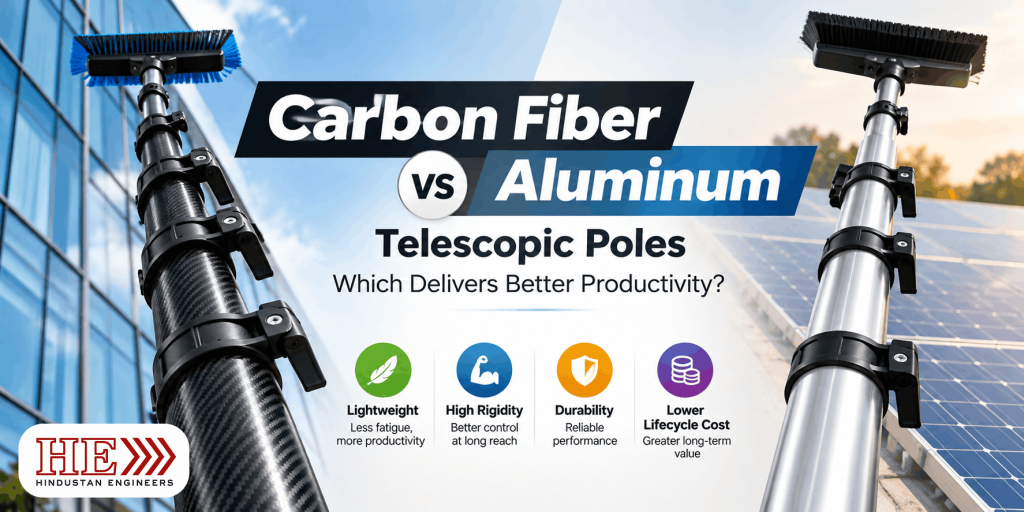
Carbon Fiber vs Aluminum Telescopic Poles: Which Delivers Better Productivity?
When a telescopic pole needs to reach 20, 30, or even 60 feet, the material used to build it can directly affect how efficiently the job gets done.
A pole may look like a simple extension tool, but its weight, stiffness, durability, handling characteristics, and locking system can influence operator fatigue, working speed, safety, transportation, and long-term operating cost.
This is where the Carbon Fiber vs Aluminum debate becomes important.
Aluminum telescopic poles have been widely used because they are relatively lightweight, easy to manufacture, and familiar across many industries. However, carbon fiber composites offer a different performance proposition: significantly lower weight combined with high stiffness, strength, corrosion resistance, and application-specific engineering possibilities.
For high-reach applications where the operator must hold, extend, move, and control the pole repeatedly, the right material is not simply the one with the lowest purchase price.
It is the material that delivers the best productivity over its working life.
At Hindustan Engineers, we manufacture carbon fiber telescopic tubes designed for demanding applications where low weight, reliable reach, structural performance, and ease of handling matter.
So, in a Telescopic Pole Comparison, which material makes more sense—carbon fiber or aluminum?
Let’s look at the engineering factors that matter most.
Carbon Fiber vs Aluminum: The Basic Difference
Aluminum is a lightweight metal with good strength, relatively easy fabrication, and proven industrial use. It remains a practical option for many general-purpose telescopic applications.
Carbon fiber, on the other hand, is a composite material consisting of carbon fibers embedded in a resin matrix. The fibers provide the primary structural reinforcement, while the resin binds the structure together and transfers loads between the fibers.
The biggest advantage is the strength-to-weight and stiffness-to-weight ratio that can be achieved through appropriate composite design.
For telescopic poles, this difference becomes particularly valuable as the pole gets longer.
A long pole creates a greater handling challenge. As length increases, even a moderate difference in mass can become noticeable to the operator.
This means that material selection can directly influence productivity.
1. Weight: The First Productivity Advantage
Weight is one of the most important factors in any high-reach pole.
Consider an operator cleaning a high ceiling, maintaining solar panels, washing windows, harvesting coconuts or areca nuts, or using a camera pole for an extended period. The operator is not simply carrying the pole. They are continuously:- Lifting it
- Extending it
- Holding it at an angle
- Moving it horizontally
- Controlling the working end
- Adjusting the pole length
- Repositioning it repeatedly
Why lower weight matters
A lighter pole can help:- Reduce operator fatigue
- Improve maneuverability
- Increase working duration
- Make overhead work easier
- Improve transportation and storage
- Reduce physical effort during repeated operations
- Allow better control at extended lengths
2. Rigidity: Reach Is Not Enough
A telescopic pole needs to do more than simply extend.
It needs to remain controllable at full or near-full extension.
Imagine a 30-foot pole supporting a cleaning head, camera, brush, vacuum attachment, harvesting tool, or another accessory.
If the pole flexes excessively, the operator may have difficulty controlling the working end.
Excessive movement can reduce accuracy and require additional corrections.
This is where stiffness becomes critical.
Carbon fiber composites can be engineered for high stiffness while keeping structural weight low. The fiber orientation, tube construction, diameter, wall thickness, resin system, and manufacturing method can all be selected according to the application.
The objective is not simply to make a carbon fiber tube.
The objective is to create the right balance between:
Weight + stiffness + strength + flexibility + durability.
For high-reach applications, this balance can translate into better control and easier operation.
3. Telescopic Pole Comparison: Carbon Fiber vs Aluminum
| Performance Factor | Carbon Fiber Telescopic Pole | Aluminum Telescopic Pole |
|---|---|---|
| Weight | Very low | Low to moderate |
| Strength-to-weight ratio | Excellent | Good |
| Stiffness-to-weight ratio | Excellent | Moderate to good |
| Operator fatigue | Lower potential | Can increase with extended use |
| Corrosion resistance | Excellent | Good, depending on alloy and surface treatment |
| Long-reach handling | Excellent | Application dependent |
| Outdoor suitability | Excellent with appropriate design | Good with suitable protection |
| Electrical insulation | Naturally non-conductive | Electrically conductive |
| Customization | Highly designable | Good |
| Initial cost | Generally higher | Generally lower |
| Long-term productivity potential | High | Application dependent |
The important point is that aluminum is not a poor material.
In fact, aluminum can be an excellent choice when initial cost, general-purpose use, or specific mechanical requirements are the primary considerations.
But when low mass, extended reach, operator comfort, rigidity, and long-duration productivity become priorities, carbon fiber becomes increasingly attractive.
4. Productivity Is More Than Speed
Productivity is often misunderstood as simply completing a task faster.
In industrial operations, productivity is better understood as: More useful output with less time, effort, downtime, and resource consumption. A lightweight telescopic pole can contribute to productivity in several ways.Faster setup
A lighter pole can be easier to transport, assemble, extend, and position.Reduced fatigue
When workers experience less physical strain, they may be able to maintain consistent performance for longer periods.Better maneuverability
Lower mass at the operator’s hands can make long poles easier to control.Easier transportation
Long telescopic poles can be collapsed into compact sections, simplifying movement between work locations.Better access
High-reach poles allow workers to access elevated areas from ground level, reducing the need for ladders, platforms, or other access equipment in suitable applications. These benefits can add up over hundreds or thousands of working hours.5. Corrosion Resistance for Outdoor and Industrial Applications
Telescopic poles are frequently exposed to demanding environments.
They may encounter:
Water
Humidity
Cleaning chemicals
Dust
Outdoor weather
Agricultural environments
Industrial contaminants
Frequent washing
Aluminum does not rust like steel, but it can still experience corrosion depending on the environment, alloy, surface condition, and exposure.
Carbon fiber composite structures offer excellent corrosion resistance and do not rust.
This makes carbon fiber particularly attractive for applications involving water, outdoor environments, cleaning operations, agriculture, and other situations where long-term exposure can affect conventional materials.
However, the complete product should always be evaluated—not just the tube material. Clamps, fittings, joints, coatings, end connections, and other components also influence overall durability.
6. Lifecycle Cost: Don't Compare Only the Purchase Price
One of the biggest mistakes when selecting a telescopic pole is looking only at the initial purchase price.
Aluminum may provide a lower upfront cost.
Carbon fiber may require a higher initial investment.
But the real question should be:
What does the pole cost to operate over its useful life?
A lifecycle evaluation should consider:
Purchase Cost + Labour Impact + Maintenance + Replacement + Downtime + Transportation + Productivity
For example, if a lighter pole reduces operator fatigue and enables a team to work more efficiently, the productivity benefit can potentially outweigh the difference in initial purchase price.
Similarly, if corrosion resistance and durable composite construction reduce replacement requirements in a demanding environment, the long-term value can improve further.
Therefore, carbon fiber should not be evaluated simply as a “premium material.”
It should be evaluated as a productivity-focused engineering solution.
7. Where Carbon Fiber Telescopic Poles Make the Most Sense
Carbon fiber becomes especially valuable when the application combines long reach + frequent handling + low weight + stiffness.
Typical applications include:High-Reach Cleaning
Carbon fiber telescopic poles can be used for cleaning high ceilings, roofs, windows, ducts, industrial structures, and other difficult-to-access areas.Solar Panel Cleaning
Large solar installations require regular maintenance. Lightweight poles can help operators cover large areas while reducing physical effort.Window Cleaning
Long-reach window cleaning requires a combination of low weight, rigidity, and precise control.Agriculture
Telescopic carbon fiber poles can support harvesting applications such as areca and coconut harvesting, where extended reach and maneuverability are important.Camera and Inspection Equipment
Camera poles benefit from low weight because the operator must maintain control and stability while positioning equipment at height.Industrial Maintenance
High-reach maintenance tools can use carbon fiber tubes where reduced mass, corrosion resistance, and structural performance are important. Hindustan Engineers manufactures carbon fiber telescopic tubes for applications ranging from 20 feet to 60 feet, with designs developed around the intended use and required reach.8. Why One Pole Design Doesn't Fit Every Application
There is no universal “best” telescopic pole.
The correct design depends on:
Required working length
Collapsed length
Tube diameter
Wall thickness
Required stiffness
Working load
Accessories attached at the end
Operating environment
Frequency of use
Locking mechanism
Transportation requirements
Storage requirements
For example, a camera pole may prioritize low weight and stability, while an industrial vacuum cleaning pole may require a different balance of stiffness, diameter, connection design, and durability.
This is why application-specific composite engineering is important.
At Hindustan Engineers, carbon fiber telescopic tubes can be developed around specific application requirements rather than treating every customer requirement as a standard-size product.
Carbon Fiber vs Aluminum: Which One Should You Choose?
The answer depends on what you value most.
Choose aluminum when:
Initial purchase cost is the dominant consideration
The pole is used for shorter durations
Weight is not a major constraint
The application is relatively simple
Standard metal construction meets the performance requirement
Choose carbon fiber when:
Low weight is critical
The pole must reach significant heights
Operators use it for extended periods
Reduced fatigue is important
Rigidity at extended length matters
The pole is frequently transported
Corrosion resistance is important
Productivity and lifecycle value matter more than lowest initial cost
For professional and industrial users, the decision should therefore move beyond:
“Which material is cheaper?”
and toward:
“Which material helps our team work more efficiently?”
The Hindustan Engineers Approach to Carbon Fiber Telescopic Poles
At Hindustan Engineers, we view carbon fiber as an engineering material—not simply a replacement for metal.
Our experience in composite manufacturing enables us to develop carbon fiber tubes and telescopic solutions around real application requirements.
Our telescopic carbon fiber products are designed with a focus on:
Lightweight construction
High strength-to-weight performance
Structural rigidity
Corrosion resistance
Long service life
Easy handling
Application-specific configurations
Practical transportation and storage
Our telescopic tube range supports applications such as window cleaning, solar-panel cleaning, swimming-pool maintenance, camera poles, agricultural harvesting, high-ceiling cleaning, and other high-reach requirements.
With decades of experience in composite engineering and manufacturing, Hindustan Engineers combines material knowledge with application-focused product development.
Final Verdict: Productivity Favors the Right Material
The Carbon Fiber vs Aluminum debate should not be reduced to strength or price alone.
For telescopic poles, the real performance equation is:
Lower Weight + Higher Rigidity + Better Handling + Corrosion Resistance + Long Service Life = Higher Productivity Potential
Aluminum remains a practical and cost-effective material for many applications.
But when the job involves long reach, frequent movement, overhead operation, repeated handling, and demanding working conditions, carbon fiber can provide a significant engineering advantage.
The best telescopic pole is not necessarily the cheapest one.
It is the one that helps your team reach farther, work longer, handle easier, and achieve more with less physical effort.
If your application requires a lightweight, high-performance telescopic solution, Hindustan Engineers can help you evaluate the right carbon fiber tube construction, dimensions, reach, and configuration for your specific requirement.
Looking for a lightweight telescopic pole for industrial cleaning, solar maintenance, agriculture, inspection, or another high-reach application? Talk to Hindustan Engineers about a carbon fiber telescopic solution designed for your application.
FRP (Fiber Reinforced Plastic) and Carbon Fiber are advanced weight optimization materials that significantly reduce the mass of moving machinery components such as conveyor systems, robotic arms, and rotating tools. By replacing traditional metals, manufacturers achieve higher speed, lower energy consumption, improved fatigue life, and greater design flexibility. Lightweight machinery components made from FRP and Carbon Fiber enable better performance, reduced maintenance, and long-term operational efficiency across industrial automation and material handling systems.
Recent Post
The Rise of FRP Composites in Aerospace & Rail Infrastructure
In the world of high-performance engineering, FRP composites (Fibre Reinforced...
Read More
Carbon Fiber: The Ultimate Guide to Benefits, Applications, and Composites
Carbon fiber, a marvel of modern engineering, has revolutionized industries...
Read More
How Weather-Resistant Are Carbon Fiber and FRP in Outdoor Applications
Come Rain or Shine: Weatherproof Your Equipment with Composites When...
Read More