
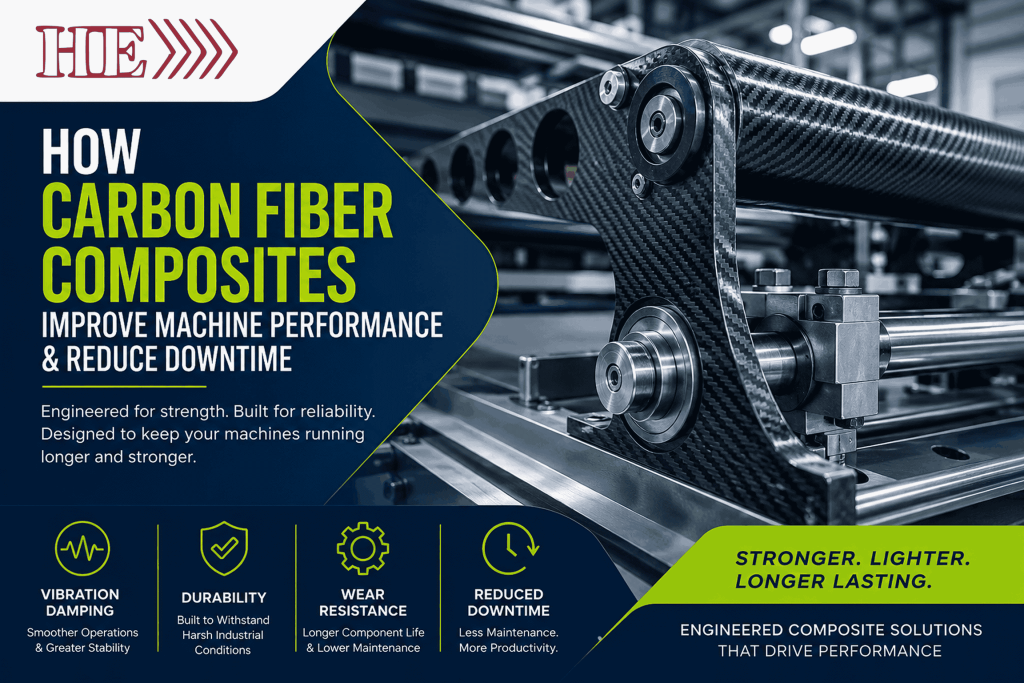
How Carbon Fiber Composites Improve Machine Performance and Reduce Downtime
Every Hour of Downtime Costs More Than You Think
In today’s competitive manufacturing environment, machine uptime is directly linked to productivity, profitability, and customer satisfaction. Whether you’re operating CNC machines, textile equipment, packaging systems, automation lines, printing machines, or high-speed industrial equipment, even a few hours of unexpected downtime can lead to production delays, increased maintenance costs, and missed delivery commitments.
This is why manufacturers are moving beyond conventional metal components and investing in Carbon Fiber Composites that improve equipment efficiency while significantly reducing maintenance requirements.
At Hindustan Engineers, we design and manufacture precision-engineered Industrial Composites and carbon fiber components that help industries achieve higher Machine Performance, longer service life, and reliable operation even under demanding industrial conditions. With decades of expertise in composite engineering, we provide customized solutions for industries requiring lightweight, durable, and high-performance components.
Why Traditional Metal Components Create Performance Challenges
Steel and aluminum have served industries for decades, but modern production environments demand higher speeds, tighter tolerances, and continuous operation.
Common issues associated with conventional metal parts include:
- Increased machine vibration
- Higher rotational inertia
- Component wear
- Corrosion in harsh environments
- Frequent maintenance shutdowns
- Energy loss due to heavier moving parts
As production speeds increase, these limitations become even more apparent.
This is where Carbon Fiber Composites provide a measurable performance advantage.
What Makes Carbon Fiber Composites Different?
Carbon fiber composites combine high-strength carbon fibers with advanced resin systems to create components that are both lightweight and exceptionally strong.
Unlike traditional materials, these engineered composites offer:
- High strength-to-weight ratio
- Excellent fatigue resistance
- Superior dimensional stability
- Outstanding corrosion resistance
- Low thermal expansion
- Long operational lifespan
These properties make them ideal for dynamic industrial applications where precision and reliability are essential.
1. Reduced Machine Vibration for Greater Stability
One of the biggest contributors to machine wear is excessive vibration.
Continuous vibration can lead to:
- Bearing failures
- Shaft misalignment
- Fastener loosening
- Reduced machining accuracy
- Increased noise
- Higher maintenance frequency
Carbon fiber composites naturally absorb and dampen vibration better than many conventional materials.
Benefits include:
- Improved machining precision
- Better surface finish
- Reduced stress on moving assemblies
- Lower bearing wear
- Extended equipment lifespan
For high-speed rotating systems, vibration damping directly contributes to improved Machine Performance and operational consistency.
2. Lightweight Components Improve Machine Efficiency
Weight plays a critical role in industrial equipment.
Heavier moving parts require:
- More motor power
- Higher energy consumption
- Greater acceleration forces
- Increased wear on bearings and drive systems
Carbon fiber composites are significantly lighter than steel while maintaining exceptional structural strength.
The result:
- Faster machine acceleration
- Reduced motor load
- Lower energy consumption
- Improved cycle times
- Increased production throughput
For automation systems, robotic equipment, textile machinery, and packaging lines, lighter components translate directly into higher productivity.
3. Superior Wear Resistance Means Longer Service Life
Industrial equipment operates under constant mechanical stress.
Repeated movement gradually causes:
- Surface wear
- Mechanical fatigue
- Component deformation
- Frequent replacement cycles
High-quality Industrial Composites are engineered for exceptional wear resistance.
Compared with traditional materials, carbon fiber components maintain their structural integrity for much longer, reducing the need for frequent replacements.
Longer-lasting components mean:
- Reduced maintenance costs
- Fewer spare parts
- Lower inventory requirements
- Increased equipment availability
4. Corrosion Resistance for Harsh Industrial Environments
Many manufacturing facilities operate under challenging conditions involving:
- Chemicals
- Moisture
- Salt exposure
- Industrial cleaning agents
- Humidity
- Outdoor installations
Unlike steel, carbon fiber composites do not rust and are highly resistant to corrosion.
This makes them ideal for industries such as:
- Chemical processing
- Food processing
- Marine equipment
- Textile manufacturing
- Industrial automation
- Material handling systems
Corrosion resistance helps eliminate premature component failure while extending maintenance intervals.
5. Improved Fatigue Resistance in Continuous Operations
Industrial machines often run 24/7.
Repeated loading and unloading cycles can eventually weaken conventional metal parts through fatigue.
Carbon fiber composites offer exceptional fatigue resistance, enabling components to withstand millions of operational cycles without significant degradation.
This reliability is especially valuable for:
- Rollers
- Rotating shafts
- Structural machine members
- Vacuum system components
- Automation equipment
- Motion control systems
The result is fewer unexpected breakdowns and more predictable maintenance schedules.
6. Enhanced Precision Through Dimensional Stability
Temperature fluctuations often cause metal components to expand or contract.
This can affect:
- Machine alignment
- Assembly tolerances
- Positioning accuracy
- Product quality
Carbon fiber composites have a very low coefficient of thermal expansion, helping maintain dimensional accuracy across varying operating conditions.
For precision manufacturing, this means:
- Better repeatability
- Consistent product quality
- Reduced calibration frequency
- Improved process control
How Carbon Fiber Composites Reduce Downtime
Downtime rarely happens because of one major failure.
Instead, it usually results from repeated small issues such as vibration, wear, corrosion, and component fatigue.
By addressing these root causes, carbon fiber composites help reduce maintenance interruptions.
Key downtime reduction benefits include:
- Longer component life
- Reduced preventive maintenance
- Fewer emergency repairs
- Improved machine reliability
- Lower replacement frequency
- Higher production uptime
For manufacturers operating multiple production lines, these improvements can generate substantial long-term cost savings.
Applications Across Modern Industries
Carbon fiber composite solutions are increasingly used in:
- Industrial machinery
- Textile machines
- Vacuum pump systems
- Automation equipment
- Packaging machines
- Medical equipment
- Aerospace components
- Defense applications
- Electrical insulation systems
- Robotics
- Material handling equipment
At Hindustan Engineers, we manufacture a wide range of advanced composite solutions including:
- Carbon Fiber Sheets
- Carbon Fiber Tubes
- Carbon Fiber Telescopic Tubes
- Vacuum Cleaning Poles
- Carbon Fiber Vane Plates
- FRP Composite Components
- Molded Composite Parts
- Electrical Insulation Components
- Custom Engineered Industrial Composite Solutions
Every component is developed with a focus on lightweight construction, durability, precision, and application-specific performance to meet demanding industrial requirements.
Why Choose Hindustan Engineers?
With over four decades of experience in composite engineering, Hindustan Engineers specializes in designing and manufacturing high-performance composite solutions for industries including electrical, textile, chemical, automotive, defense, aviation, and agriculture. Our expertise spans FRP and carbon fiber products engineered for reliability, precision, and long service life.
We work closely with OEMs and industrial customers to develop customized carbon fiber components that help improve machine efficiency, reduce maintenance, and support long-term operational performance.
Whether you need standard products or application-specific engineered solutions, our team is committed to delivering composites that meet the highest quality standards.
Conclusion
As industries continue to demand higher productivity and lower operating costs, upgrading machine components has become an effective strategy for improving overall equipment efficiency.
Carbon Fiber Composites provide the perfect balance of lightweight strength, vibration damping, durability, wear resistance, and corrosion protection. These advantages translate into better Machine Performance, lower maintenance costs, and significantly reduced downtime.
At Hindustan Engineers, we combine decades of composite manufacturing expertise with advanced engineering capabilities to deliver Industrial Composites that help businesses operate more efficiently and competitively.
If you’re looking to optimize your machinery with high-performance carbon fiber solutions, our team is ready to help you identify the right composite components for your application.
FRP (Fiber Reinforced Plastic) and Carbon Fiber are advanced weight optimization materials that significantly reduce the mass of moving machinery components such as conveyor systems, robotic arms, and rotating tools. By replacing traditional metals, manufacturers achieve higher speed, lower energy consumption, improved fatigue life, and greater design flexibility. Lightweight machinery components made from FRP and Carbon Fiber enable better performance, reduced maintenance, and long-term operational efficiency across industrial automation and material handling systems.
Recent Post
Comparing Vane Materials: Carbon Vanes, FRP Vanes, and Carbon Fiber Vanes – Which is Best for Your Industry?
When selecting vane materials for industrial applications such as compressors,...
Read More
Top 7 Engineering Challenges Solved by Using Advanced Composites
Top 7 Engineering Challenges Solved by Using Advanced Composites In...
Read More
Why Carbon Fiber is Revolutionizing Industrial Manufacturing
In the fast-evolving world of industrial manufacturing, material innovation plays...
Read More