
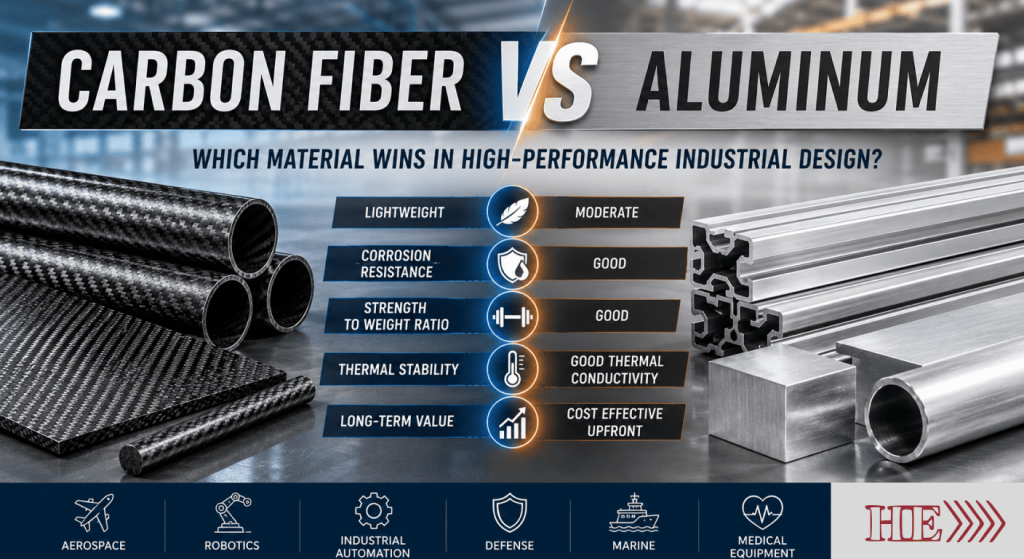
Carbon Fiber vs Aluminum: The Ultimate Material Showdown for Modern Engineering Applications
When designing products for demanding industrial environments, material selection is often the difference between average performance and engineering excellence. Whether it’s aerospace components, automation systems, robotics, industrial machinery, defense equipment, medical devices, or advanced manufacturing applications, engineers constantly face one critical question:
Should we choose carbon fiber or aluminum?
For decades, aluminum has been the preferred lightweight metal due to its excellent machinability, corrosion resistance, and cost-effectiveness. However, with the rise of advanced composites, carbon fiber has emerged as a revolutionary alternative, offering exceptional strength-to-weight ratios and unmatched performance characteristics.
At Hindustan Engineers, we work closely with industries that require high-performance materials capable of delivering durability, precision, and long-term operational efficiency. This article provides a technical comparison of carbon fiber vs aluminum across the most important decision-making parameters: weight, corrosion resistance, strength, and thermal performance.
Let’s find out which material truly wins in high-performance industrial design.
Understanding the Two Materials
What is Carbon Fiber?
Carbon fiber is a composite material made from ultra-thin carbon filaments embedded within a resin matrix. The resulting structure combines exceptional strength with extremely low weight, making it one of the most advanced engineering materials available today.
Hindustan Engineers manufactures and supplies precision-engineered carbon fiber products including:
- Carbon Fiber Tubes
- Carbon Fiber Sheets
- Carbon Fiber Rods
- Carbon Fiber Structural Components
- Custom Composite Solutions
These products are widely used in industrial automation, robotics, aerospace, defense, electrical systems, and specialized engineering applications.
What is Aluminum?
Aluminum is a lightweight metal known for its versatility, corrosion resistance, and ease of fabrication. It has traditionally been used in structural frameworks, transportation systems, machinery parts, and industrial equipment.
While aluminum remains an excellent engineering material, increasing performance demands are pushing many industries toward advanced composite alternatives.
Round 1: Weight Comparison
Winner: Carbon Fiber
One of the biggest advantages of carbon fiber is its extremely low density.
Typical Density Comparison
| Material | Density |
|---|---|
| Carbon Fiber Composite | 1.5–1.8 g/cm³ |
| Aluminum | 2.7 g/cm³ |
This means carbon fiber can be approximately 30% to 50% lighter than aluminum while maintaining comparable or superior structural performance.
Why Weight Matters
Reducing weight provides significant benefits:
- Faster moving machinery
- Reduced energy consumption
- Improved robotic performance
- Lower transportation costs
- Increased payload capacity
- Enhanced system efficiency
For industries where every kilogram matters, carbon fiber offers a significant competitive advantage.
Example Applications
- Robotic arms
- UAV structures
- Automation equipment
- Telescopic poles
- Aerospace components
- High-speed industrial systems
A lighter component often translates into lower operational costs and improved productivity over the life of the equipment.
Round 2: Corrosion Resistance
Winner: Carbon Fiber
Industrial environments frequently expose materials to:
- Moisture
- Chemicals
- Saltwater
- Humidity
- Industrial pollutants
Although aluminum naturally forms an oxide layer that protects against corrosion, it can still experience:
- Pitting corrosion
- Galvanic corrosion
- Surface degradation in aggressive environments
Carbon fiber composites, on the other hand, do not rust and are highly resistant to environmental degradation.
Benefits of Carbon Fiber in Corrosive Environments
✔ No oxidation ✔ No rust formation ✔ Excellent chemical resistance ✔ Lower maintenance requirements ✔ Longer service life
This makes carbon fiber particularly attractive for:
- Marine applications
- Chemical processing industries
- Outdoor industrial installations
- Coastal infrastructure
- Water treatment systems
When lifecycle costs are considered, carbon fiber often delivers greater long-term value despite a higher initial investment.
Round 3: Strength Comparison
Winner: Carbon Fiber
Many engineers incorrectly assume metal is always stronger than composites.
In reality, carbon fiber offers one of the highest strength-to-weight ratios available in modern engineering.
Tensile Strength Comparison
| Material | Tensile Strength |
| Carbon Fiber Composite | Up to 7,000 MPa |
| Aluminum Alloys | 200–600 MPa |
While exact performance depends on fiber orientation and manufacturing methods, carbon fiber consistently delivers superior strength relative to its weight.
Why Strength-to-Weight Ratio Matters
Instead of asking:
“Which material is stronger?”
The better question is:
“Which material provides more strength for less weight?”
This is where carbon fiber dominates.
Benefits
- Reduced structural mass
- Higher stiffness
- Lower deflection
- Improved precision
- Better vibration damping
Applications requiring dimensional stability and precision often benefit significantly from carbon fiber structures.
Typical Industries
- Aerospace
- Defense
- Semiconductor manufacturing
- Precision automation
- Industrial robotics
- Scientific instruments
Round 4: Thermal Resistance
Winner: Depends on the Application
This category is more nuanced.
Aluminum Advantages
Aluminum is an excellent thermal conductor.
It quickly transfers heat throughout the structure, making it ideal for:
- Heat sinks
- Cooling systems
- Electronic enclosures
- Thermal management applications
Carbon Fiber Advantages
Carbon fiber behaves differently.
Depending on fiber orientation and composite design, carbon fiber offers:
- Lower thermal expansion
- Dimensional stability
- Better resistance to thermal distortion
Why This Matters
Precision industrial systems often require components that maintain their shape despite temperature fluctuations.
Carbon fiber exhibits a much lower coefficient of thermal expansion compared to aluminum.
Benefits include:
- Improved accuracy
- Reduced warping
- Better repeatability
- Enhanced system precision
Verdict
Choose:
Aluminum when heat dissipation is the priority.
Choose Carbon Fiber when dimensional stability and structural performance are critical.Lifecycle Cost Considerations
Many buyers focus solely on purchase price.
However, true industrial value comes from evaluating:
- Maintenance costs
- Downtime reduction
- Energy savings
- Product lifespan
- Performance efficiency
Although carbon fiber components generally cost more upfront, they often provide:
- Longer operational life
- Lower maintenance requirements
- Reduced replacement frequency
- Improved productivity
Over the long term, these benefits can significantly outweigh the initial investment.
Carbon Fiber vs Aluminum: Final Scorecard
| Performance Factor | Winner |
| Weight | Carbon Fiber |
| Corrosion Resistance | Carbon Fiber |
| Strength-to-Weight Ratio | Carbon Fiber |
| Vibration Damping | Carbon Fiber |
| Dimensional Stability | Carbon Fiber |
| Heat Conductivity | Aluminum |
| Initial Cost | Aluminum |
| Long-Term Value | Carbon Fiber |
Final Thoughts
For traditional industrial applications where budget is the primary concern, aluminum remains a reliable and practical choice.
However, for organizations seeking next-generation performance, improved efficiency, and superior engineering capabilities, carbon fiber clearly emerges as the preferred solution.
Its combination of lightweight construction, exceptional strength, corrosion resistance, and dimensional stability makes it one of the most powerful materials available for modern industrial design.
At Hindustan Engineers, we help manufacturers, OEMs, automation companies, and engineering firms leverage advanced carbon fiber solutions that improve performance while reducing operational limitations.
As industrial systems become faster, smarter, and more demanding, the future increasingly belongs to advanced composite materials—and carbon fiber is leading that transformation.
Looking for High-Performance Carbon Fiber Components?
Hindustan Engineers offers precision-engineered:
- Carbon Fiber Tubes
- Carbon Fiber Sheets
- Carbon Fiber Rods
- Custom Composite Components
- Industrial Structural Solutions
Our team works with industries requiring lightweight, high-strength, and corrosion-resistant materials designed for the next generation of engineering innovation.
FRP (Fiber Reinforced Plastic) and Carbon Fiber are advanced weight optimization materials that significantly reduce the mass of moving machinery components such as conveyor systems, robotic arms, and rotating tools. By replacing traditional metals, manufacturers achieve higher speed, lower energy consumption, improved fatigue life, and greater design flexibility. Lightweight machinery components made from FRP and Carbon Fiber enable better performance, reduced maintenance, and long-term operational efficiency across industrial automation and material handling systems.
Recent Post
How Carbon Fiber Composites Improve Machine Performance and Reduce Downtime
How Carbon Fiber Composites Improve Machine Performance and Reduce Downtime...
Read More
Composites Tube Market Analysis: 2024-2030 Trends, Forecast, and Competition
Composites tubes, also known as FRP tubes or fiber-reinforced plastic...
Read More
Innovations in FRP Manufacturing: Pultrusion vs Hand Lay-Up Explained
Innovations in FRP Manufacturing: Pultrusion vs Hand Lay-Up Explained The...
Read More