
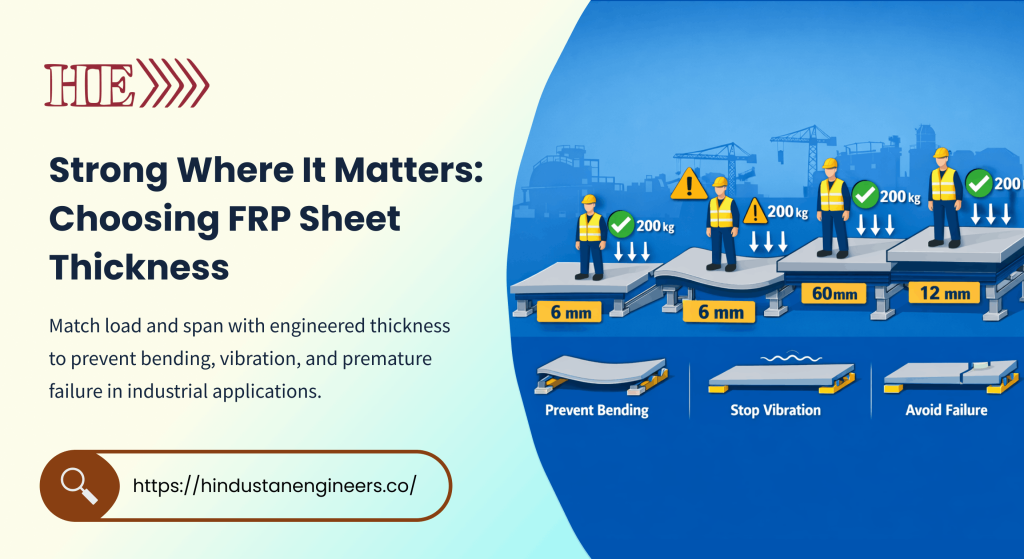

Strong Where It Matters_ Choosing FRP Sheet Thickness - HindustanEngineers

Selecting the Right FRP Sheet Thickness for Industrial Load Requirements

When an industrial platform cracks, a walkway bends, or a machine base starts vibrating — the issue is rarely the material.

It’s the thickness selection.

FRP (Fiber Reinforced Polymer) sheets are engineered to outperform steel in corrosion resistance and aluminum in weight efficiency. But unlike metals, FRP performance depends heavily on correct thickness vs load calculation. A 6 mm sheet and a 12 mm sheet made from the same composite can behave like two completely different structural materials.

At Hindustan Engineers, we often meet clients who chose FRP expecting long-term durability — but the failure occurred because the sheet was under-specified or over-specified. Both cost money. One fails early, the other wastes budget.

This guide explains how to select the correct load-bearing FRP sheet thickness scientifically — not by guesswork.

Why FRP Thickness Matters More Than Material Grade

Steel strength depends primarily on grade.
FRP strength depends on structure + fiber orientation + thickness + load span.

FRP works like a sandwich beam:

  • Fibers carry tension

  • Resin distributes load

  • Thickness controls stiffness

So when load increases, FRP doesn’t just need stronger fiber — it needs greater moment of inertia, which comes from thickness.

Rule:

In FRP, stiffness increases exponentially with thickness — not linearly.

Doubling thickness can increase bending resistance by 6–8x.

Step 1: Load Calculations (The First Engineering Check)

Before choosing thickness, determine the type of load.

1. Static Load

Permanent installations
Examples:

  • Machine base plates

  • Electrical panel mounting boards

  • Chemical tank covers

2. Dynamic Load

Moving or repeated stress
Examples:

  • Walkways

  • Platforms

  • Conveyor supports

3. Impact Load

Sudden force
Examples:

  • Dropped tools

  • Material handling areas


Basic Industrial Load Formula

Uniform Load (UDL):

Load=kg/m2

Point Load:

Load=kgatcenteroredge

Now calculate span:

Span=Distancebetweensupports

The same FRP sheet may perform perfectly at 300 mm span but fail at 900 mm span.

So thickness selection is always:
Load + Span = Thickness

Step 2: Understanding Flexural Strength

The most important property for load-bearing FRP sheets is:

Flexural Strength

Resistance to bending before failure

Flexural Modulus

Resistance to bending deformation


How Thickness Affects Bending

Bending deflection is calculated as:

Deflection∝Load×Span4Elasticity×Thickness3

Meaning:

Small thickness changes dramatically reduce bending.

A 10 mm sheet can deflect almost 70% less than an 8 mm sheet under the same load.

This is why selecting thickness based on weight capacity alone is wrong.
Industrial safety depends on deflection limits, not just breakage limits.

Step 3: FRP Sheet Thickness Recommendations by Application

Below is a practical FRP sheet thickness guide used by our engineering team.

Electrical & Insulation Panels

Application Recommended Thickness
Control panel backing 3 – 5 mm
Busbar barriers 4 – 6 mm
Switchgear partitions 6 – 8 mm

Why: Minimal bending, primarily insulation requirement.


Wall Cladding & Chemical Protection

Application Thickness
Chemical plant wall lining 3 – 4 mm
Acid resistant panels 4 – 6 mm
Tank outer protection 6 – 8 mm

Focus: Corrosion resistance, not load bearing.


Machine Mounting & Structural Supports

Application Thickness
Motor base mounting 8 – 10 mm
Pump support plates 10 – 12 mm
Heavy equipment foundation 12 – 20 mm

Focus: Vibration resistance + stiffness


Walkways, Platforms & Grating Base

Span Load Thickness
300 mm 200 kg 6 mm
600 mm 300 kg 10 mm
900 mm 400 kg 12–15 mm
1200 mm 500 kg 18–25 mm

This is where most selection mistakes happen.
The span drives thickness more than the load.


Heavy Industrial Load Areas

Application Thickness
Forklift zones 20 – 30 mm
Material handling platforms 18 – 25 mm
Impact resistant flooring 25 – 40 mm

Common Selection Mistakes (Costly Ones)

1. Copying Metal Thickness

FRP ≠ Steel
FRP needs different engineering calculation.

2. Choosing by Weight Capacity Only

Deflection causes fatigue failure long before breaking load.

3. Ignoring Support Distance

A perfect sheet fails due to long unsupported span.

4. Overdesigning

Too thick = unnecessary cost & machining difficulty.

Engineering Thumb Rule (Quick Decision Guide)

If your requirement isFocus on
Electrical insulationResin type
Structural mountingThickness
WalkwaySpan calculation
Chemical resistanceSurface veil
Heavy loadFlexural modulus

Why Industries Prefer Custom-Engineered FRP Sheets Today

Modern factories want materials that are:

  • Corrosion proof

  • Non-conductive

  • Lightweight

  • Maintenance free

FRP sheets satisfy all — but only when thickness is engineered.

That’s why we don’t sell “standard sheets.”
We recommend application-specific load-bearing FRP sheets designed based on working conditions.

How Hindustan Engineers Helps You Select the Right Thickness

Instead of trial-and-error replacement, our process is:

  1. Load & span assessment

  2. Environment analysis

  3. Flexural requirement calculation

  4. Fiber orientation selection

  5. Custom sheet manufacturing

This prevents:

  • Premature bending

  • Vibration damage

  • Fastener loosening

  • Structural fatigue

Final Thought

FRP sheets are not just plastic panels — they are structural composites.

Choosing the correct thickness turns FRP from a protective material into a load-carrying engineering component.

The real cost of FRP is not per sheet — it is per year of service life.

Select thickness scientifically, and FRP lasts decades.

FRP (Fiber Reinforced Plastic) and Carbon Fiber are advanced weight optimization materials that significantly reduce the mass of moving machinery components such as conveyor systems, robotic arms, and rotating tools. By replacing traditional metals, manufacturers achieve higher speed, lower energy consumption, improved fatigue life, and greater design flexibility. Lightweight machinery components made from FRP and Carbon Fiber enable better performance, reduced maintenance, and long-term operational efficiency across industrial automation and material handling systems.

Recent Post