
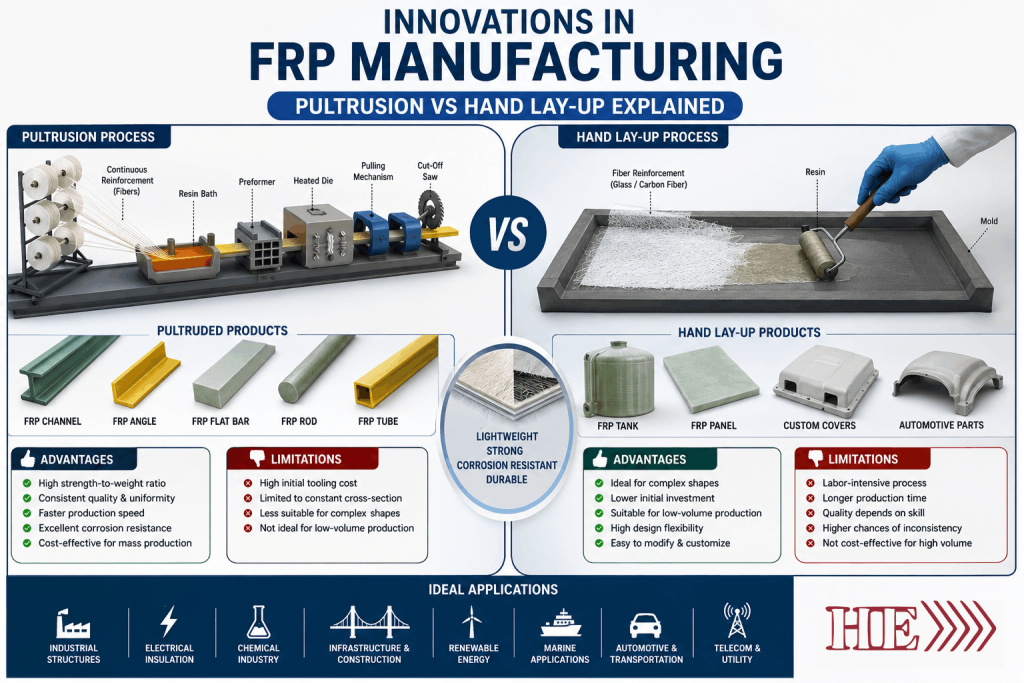
Innovations in FRP Manufacturing: Pultrusion vs Hand Lay-Up Explained
The future of industrial manufacturing is rapidly shifting toward lightweight, corrosion-resistant, and high-strength composite materials — and FRP (Fiber Reinforced Plastic) is leading this transformation across industries. From electrical insulation systems and structural components to carbon fiber tubes, composite profiles, industrial panels, and custom-engineered parts, FRP manufacturing has become the backbone of modern engineering innovation.
At Hindustan Engineers, we continuously work with advanced composite manufacturing technologies to deliver durable, precision-engineered FRP and carbon fiber products for industrial applications. One of the most common questions asked by industrial buyers, OEMs, and engineering teams is:
Which FRP manufacturing process is better — Pultrusion or Hand Lay-Up?
The answer depends on product type, production volume, customization needs, mechanical performance, and project cost. In this blog, we explain the complete difference between Pultrusion vs Hand Lay-Up, their advantages, limitations, cost analysis, production efficiency, and ideal applications.
Understanding the FRP Manufacturing Process
The FRP manufacturing process involves combining reinforcing fibers such as glass fiber, carbon fiber, or aramid with a polymer resin matrix to create lightweight yet extremely strong composite materials.
Modern FRP manufacturing is widely used in:
- Industrial structures
- Electrical insulation systems
- Aerospace components
- Automotive parts
- Chemical processing equipment
- Telecom and utility sectors
- Construction and infrastructure
- Renewable energy systems
Among various FRP production methods, Pultrusion and Hand Lay-Up remain two of the most widely adopted manufacturing techniques.
What is Pultrusion in FRP Manufacturing?
Pultrusion is a continuous automated FRP manufacturing process used to produce constant cross-section composite profiles with high precision and structural strength.
In this process, continuous fiber reinforcements are pulled through resin baths and heated dies to form rigid composite shapes.
Common Pultruded FRP Products
At Hindustan Engineers, pultrusion-based manufacturing is ideal for products such as:
- FRP rods
- FRP channels
- FRP angles
- FRP flat bars
- Composite structural profiles
- Pultruded tubes
- Electrical insulation profiles
- Carbon fiber reinforced sections
Advantages of Pultrusion
1. High Strength-to-Weight Ratio
Pultruded products offer exceptional mechanical strength while remaining lightweight, making them suitable for heavy-duty industrial environments.
2. Consistent Product Quality
Since pultrusion is an automated continuous process, it delivers highly uniform dimensions and repeatable quality.
3. Faster Production Speed
Pultrusion supports large-scale manufacturing with minimal manual intervention, reducing production time significantly.
4. Excellent Corrosion Resistance
Pultruded FRP profiles are highly resistant to moisture, chemicals, UV exposure, and harsh industrial environments.
5. Low Long-Term Production Cost
Although tooling investment is higher initially, mass production becomes highly cost-effective over time.
Limitations of Pultrusion
While pultrusion is extremely efficient, it also has some limitations:
- Suitable mainly for constant cross-section profiles
- High initial tooling and die cost
- Limited flexibility for complex custom geometries
- Less suitable for low-volume production
What is Hand Lay-Up in FRP Manufacturing?
Hand Lay-Up is one of the oldest and most versatile FRP manufacturing methods. In this process, reinforcing fibers are manually placed into molds and layered with resin using rollers or brushes.
This method is widely used for custom-designed composite parts and low-to-medium production volumes.
Common Hand Lay-Up FRP Products
Hand lay-up is commonly used for manufacturing:
- FRP panels
- Industrial covers
- Customized composite enclosures
- Tanks and vessels
- Automotive body parts
- Architectural FRP components
- Insulation products
- Prototype composite products
At Hindustan Engineers, hand lay-up manufacturing supports highly customized engineering applications where flexibility and design complexity are critical.
Advantages of Hand Lay-Up
1. Ideal for Custom Shapes
Hand lay-up enables the production of highly complex and customized geometries.
2. Lower Initial Investment
Compared to pultrusion, tooling and setup costs are significantly lower.
3. Suitable for Low-Volume Production
This process is ideal for prototype development and specialized industrial requirements.
4. Design Flexibility
Manufacturers can easily modify thickness, reinforcement orientation, and material combinations.
Limitations of Hand Lay-Up
Despite its flexibility, hand lay-up also presents challenges:
- Labor-intensive manufacturing
- Longer production time
- Higher chances of dimensional inconsistency
- Quality depends heavily on operator expertise
- Not ideal for high-volume production
Pultrusion vs Hand Lay-Up: Key Differences
| Factor | Pultrusion | Hand Lay-Up |
|---|---|---|
| Manufacturing Type | Automated Continuous Process | Manual Layering Process |
| Production Speed | High | Moderate to Slow |
| Initial Tooling Cost | High | Low |
| Product Consistency | Excellent | Operator Dependent |
| Customization Flexibility | Limited | High |
| Ideal Production Volume | High Volume | Low to Medium Volume |
| Shape Complexity | Simple Constant Profiles | Complex Shapes |
| Labor Requirement | Low | High |
| Mechanical Strength | Very High | Moderate to High |
| Surface Finish | Uniform | Variable |
Cost & Time Analysis: Which Process is More Economical?
Pultrusion Cost Analysis
Pultrusion requires:
- Dedicated tooling dies
- Automated machinery
- Initial setup investment
However, for bulk industrial production, the per-unit cost becomes significantly lower due to automation and speed.
Best For:
- Mass production
- Standardized FRP profiles
- Long production runs
Hand Lay-Up Cost Analysis
Hand lay-up requires:
- Lower tooling investment
- Skilled labor
- More production time
For custom projects and smaller quantities, hand lay-up is often the more economical solution.
Best For:
- Custom engineering projects
- Prototype manufacturing
- Low-volume industrial requirements
Which FRP Manufacturing Process is Better?
The ideal choice depends entirely on your industrial application.
Choose Pultrusion If You Need:
- High-volume production
- Consistent profile dimensions
- Structural FRP components
- Faster manufacturing cycles
- Lower long-term production cost
- High mechanical strength
Choose Hand Lay-Up If You Need:
- Customized product design
- Complex geometries
- Low production quantities
- Prototype development
- Flexible engineering modifications
Innovations Driving Modern FRP Manufacturing
The FRP industry is rapidly evolving with advancements such as:
- AI-assisted composite design
- High-performance resin systems
- Carbon fiber hybrid composites
- Automated fiber alignment
- Vacuum-assisted resin systems
- Precision curing technologies
- Lightweight structural engineering
At Hindustan Engineers, we focus on integrating modern composite engineering practices with industrial-grade manufacturing standards to deliver reliable FRP and carbon fiber solutions for multiple sectors.
Our expertise includes:
- FRP composite products
- Carbon fiber tubes
- Structural composite components
- Electrical insulation products
- Engineering plastic solutions
- Customized industrial composite manufacturing
Final Thoughts
As industries demand stronger, lighter, and corrosion-resistant materials, choosing the right FRP manufacturing process becomes essential for product performance and cost optimization.
When comparing Pultrusion vs Hand Lay-Up, there is no universal winner. Both technologies serve different industrial purposes.
- Pultrusion delivers speed, consistency, and scalability.
- Hand lay-up offers flexibility, customization, and design freedom.
The right solution depends on your product requirements, production scale, performance expectations, and engineering goals.
At Hindustan Engineers, we help industries identify and manufacture the most suitable FRP and composite solutions using advanced engineering expertise and precision manufacturing processes.
FRP (Fiber Reinforced Plastic) and Carbon Fiber are advanced weight optimization materials that significantly reduce the mass of moving machinery components such as conveyor systems, robotic arms, and rotating tools. By replacing traditional metals, manufacturers achieve higher speed, lower energy consumption, improved fatigue life, and greater design flexibility. Lightweight machinery components made from FRP and Carbon Fiber enable better performance, reduced maintenance, and long-term operational efficiency across industrial automation and material handling systems.
Recent Post

Carbon Fiber and FRP in Green Construction – What Architects Are Choosing Today
In today’s fast-evolving construction landscape, sustainability is no longer a...
Read More
Why Leading OEMs Are Replacing Metal Parts with Carbon Fiber Components in 2026
Carbon Fiber vs Aluminum: The Ultimate Material Showdown for Modern...
Read More
FRP and Carbon Fiber Tubes: Manufacturing Process and Key Applications
Fiber Reinforced Polymer (FRP) and carbon fiber composite tubes have...
Read More