
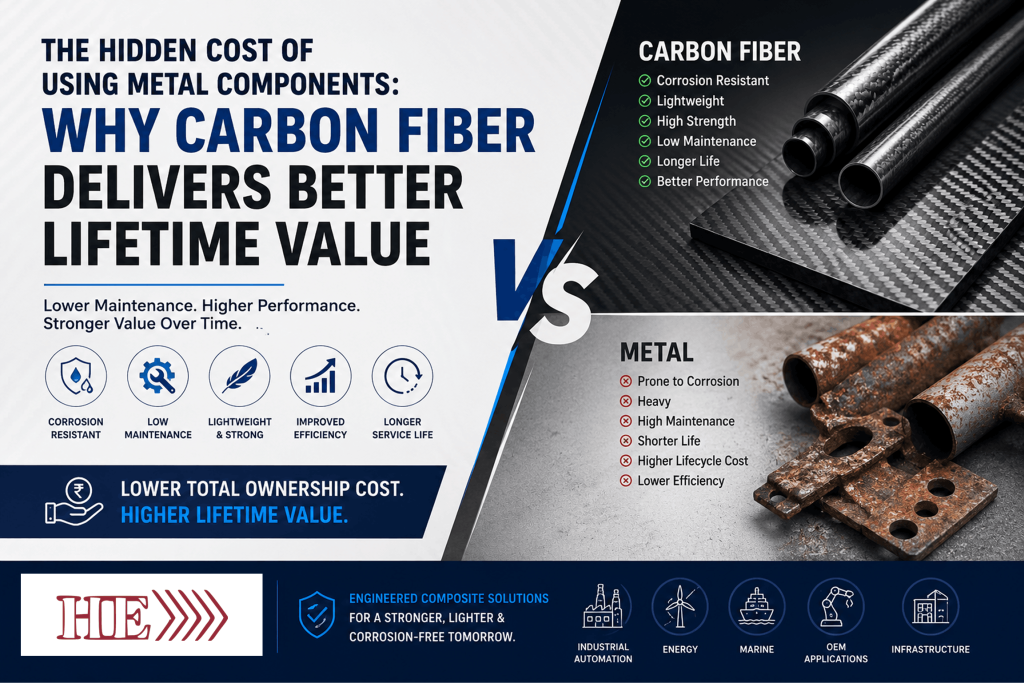
The Hidden Cost of Using Metal Components: Why Carbon Fiber Delivers Better Lifetime Value
Is Your Metal Component Actually Costing More Than You Think?
When selecting materials for industrial equipment, OEM products, automation systems, or structural applications, most purchasing decisions are still driven by one factor—the initial purchase price. While metal components such as steel and aluminum appear economical upfront, they often introduce hidden expenses that significantly increase the overall cost of ownership throughout their lifecycle.
Frequent maintenance, corrosion, unexpected downtime, transportation costs, replacement cycles, and productivity losses all contribute to expenses that are rarely considered during procurement.
At Hindustan Engineers, we help industries rethink material selection by delivering advanced Carbon Fiber Composite solutions engineered for long-term performance. Although carbon fiber typically involves a higher initial investment, it consistently delivers superior lifetime value through exceptional durability, lightweight performance, corrosion resistance, and reduced maintenance requirements.
If your organization is evaluating Carbon Fiber vs Metal for industrial applications, understanding the total cost of ownership (TCO) is far more valuable than comparing purchase prices alone.
Understanding the True Cost of Metal Components
Metal has been the traditional choice across industries for decades. However, today’s demanding operating environments expose several limitations that directly impact operational costs.
Many businesses only evaluate the purchase price while overlooking expenses such as:
- Corrosion prevention
- Surface coating and repainting
- Frequent inspections
- Maintenance shutdowns
- Heavy transportation costs
- Equipment wear due to excessive weight
- Premature replacement
- Higher energy consumption
These recurring expenses accumulate year after year, making metal significantly more expensive over its operational lifespan.
This is where an effective Industrial Material Comparison becomes essential.
Carbon Fiber vs Metal: Looking Beyond the Purchase Price
Rather than asking:
“Which material is cheaper today?”
The better question is:
“Which material delivers the lowest lifetime operating cost?”
Carbon fiber composites are specifically engineered to solve many of the challenges associated with traditional metals.
Compared to conventional steel or aluminum, carbon fiber offers:
- Exceptional strength-to-weight ratio
- Outstanding corrosion resistance
- Long operational life
- Minimal maintenance
- Dimensional stability
- Fatigue resistance
- Improved equipment efficiency
The result is lower ownership costs over many years of operation.
Hidden Cost #1: Corrosion Can Become Your Biggest Expense
One of the largest hidden expenses associated with metal components is corrosion.
Industries operating in:
- Marine environments
- Chemical plants
- Offshore facilities
- Food processing
- Wastewater treatment
- Outdoor infrastructure
continuously battle rust and oxidation.
Metal components often require:
- Protective coatings
- Galvanizing
- Painting
- Rust treatment
- Replacement due to structural degradation
Every maintenance cycle increases labor costs and production downtime.
Carbon fiber composites, on the other hand, naturally resist:
- Moisture
- Saltwater
- Industrial chemicals
- UV exposure
- Humidity
- Corrosive environments
This makes them one of the most reliable Corrosion Resistant Materials available for modern industrial applications.
For companies seeking uninterrupted operations, corrosion-resistant materials provide substantial long-term savings.
Hidden Cost #2: Maintenance Expenses Never Stop
Metal systems require routine servicing throughout their service life.
Typical maintenance activities include:
- Welding repairs
- Surface refinishing
- Rust removal
- Structural inspections
- Bolt replacements
- Reinforcement work
Each maintenance event results in:
- Labor expenses
- Equipment downtime
- Lost production
- Inventory costs
Carbon fiber significantly minimizes these maintenance requirements because it does not rust, warp, or degrade like traditional metals under normal operating conditions.
Lower maintenance translates directly into:
- Reduced operational expenses
- Higher equipment availability
- Longer service intervals
- Improved productivity
Hidden Cost #3: Heavy Components Reduce Operational Efficiency
Weight plays a major role in industrial productivity.
Heavier metal parts create additional stress on:
- Motors
- Bearings
- Hydraulic systems
- Drive assemblies
- Moving equipment
This increases:
- Energy consumption
- Mechanical wear
- Maintenance frequency
- Equipment replacement costs
Carbon fiber is substantially lighter than steel while maintaining exceptional structural strength.
The lightweight advantage delivers measurable improvements across industries by enabling:
- Faster machine movement
- Lower energy consumption
- Easier installation
- Improved operator safety
- Better system efficiency
For industries focused on productivity, reducing weight directly improves operational performance.
Hidden Cost #4: Downtime Is More Expensive Than the Component Itself
A failed metal component rarely impacts only replacement costs.
Unexpected failures can result in:
- Production stoppages
- Delayed deliveries
- Missed project deadlines
- Increased labor costs
- Customer dissatisfaction
Carbon fiber’s excellent fatigue resistance helps components maintain structural integrity over extended operating cycles.
Its superior durability allows businesses to minimize unexpected maintenance events and maximize production uptime.
When production continuity is critical, material reliability becomes a competitive advantage.
Hidden Cost #5: Transportation and Installation Costs
Large metal assemblies increase logistics expenses because of their weight.
Heavier materials require:
- Larger lifting equipment
- Higher freight costs
- More labor during installation
- Additional structural support
Carbon fiber composites dramatically reduce transportation and installation complexity.
Their lightweight construction enables:
- Easier handling
- Faster assembly
- Lower shipping costs
- Reduced installation time
These savings become particularly valuable in large industrial projects where transportation costs represent a significant portion of the overall budget.
Industrial Material Comparison: Carbon Fiber vs Metal
| Performance Factor | Carbon Fiber | Traditional Metal |
|---|---|---|
| Weight | Extremely Lightweight | Heavy |
| Strength-to-Weight Ratio | Excellent | Moderate |
| Corrosion Resistance | Outstanding | Requires Protection |
| Maintenance Requirements | Very Low | High |
| Fatigue Resistance | Excellent | Moderate |
| Service Life | Longer | Shorter in Harsh Environments |
| Transportation Cost | Lower | Higher |
| Installation Time | Faster | Longer |
| Lifetime Ownership Cost | Lower | Higher |
Although the initial investment for carbon fiber components may be higher, the reduced maintenance, lower operating expenses, and extended service life often result in a significantly lower total cost of ownership.
Applications Where Carbon Fiber Creates Maximum Value
Carbon fiber composites are increasingly replacing traditional metal components across numerous industries, including:
- Industrial Automation
- OEM Equipment Manufacturing
- Aerospace
- Automotive
- Wind Energy
- Robotics
- Electrical Insulation Systems
- Material Handling Equipment
- Telescopic Tubes
- Precision Engineering
- Marine Applications
- Industrial Cleaning Equipment
- Structural Reinforcement Systems
These industries benefit from higher efficiency, lower maintenance costs, and longer equipment life.
Why Hindustan Engineers?
At Hindustan Engineers, we manufacture high-performance carbon fiber composite solutions that help industries move beyond the limitations of conventional materials.
Our product portfolio includes:
- Carbon Fiber Sheets
- Carbon Fiber Tubes
- Telescopic Carbon Fiber Tubes
- Carbon Fiber Profiles
- Custom Carbon Fiber Components
- FRP Composite Products
- Industrial Composite Solutions
Every solution is engineered to deliver:
- Exceptional durability
- Lightweight performance
- Corrosion resistance
- High structural strength
- Long operational life
- Reduced maintenance costs
- Improved productivity
Whether you’re upgrading existing equipment or developing next-generation industrial products, our engineering team works closely with you to deliver composite solutions optimized for your specific application.
Final Thoughts
When evaluating industrial materials, focusing solely on purchase price can lead to expensive long-term consequences.
A proper Carbon Fiber vs Metal comparison reveals that the true cost of a component extends far beyond its initial investment. Corrosion, maintenance, downtime, transportation, and energy consumption all contribute to the overall ownership cost.
Carbon fiber composites address these challenges by offering exceptional durability, lightweight construction, superior corrosion resistance, and outstanding lifecycle performance. While the upfront investment may be higher, the long-term savings often outweigh the initial cost many times over.
If your goal is to improve operational efficiency, reduce maintenance expenses, and maximize equipment lifespan, carbon fiber is more than just an alternative—it is a strategic investment in long-term industrial performance.
Partner with Hindustan Engineers to discover engineered carbon fiber composite solutions designed to deliver lasting value, reliability, and performance for demanding industrial applications.
FRP (Fiber Reinforced Plastic) and Carbon Fiber are advanced weight optimization materials that significantly reduce the mass of moving machinery components such as conveyor systems, robotic arms, and rotating tools. By replacing traditional metals, manufacturers achieve higher speed, lower energy consumption, improved fatigue life, and greater design flexibility. Lightweight machinery components made from FRP and Carbon Fiber enable better performance, reduced maintenance, and long-term operational efficiency across industrial automation and material handling systems.
Recent Post
Top Carbon Fiber Sheet Suppliers: What to Look for When Choosing the Best Provider
Selecting the right carbon fiber sheet supplier is crucial for...
Read More
Top 7 Engineering Challenges Solved by Using Advanced Composites
Top 7 Engineering Challenges Solved by Using Advanced Composites In...
Read More
Carbon Fiber Reinforcement in Industrial Automation Equipment: Emerging Trends
Carbon Fiber Reinforcement in Industrial Automation Equipment: Emerging Trends When...
Read More