
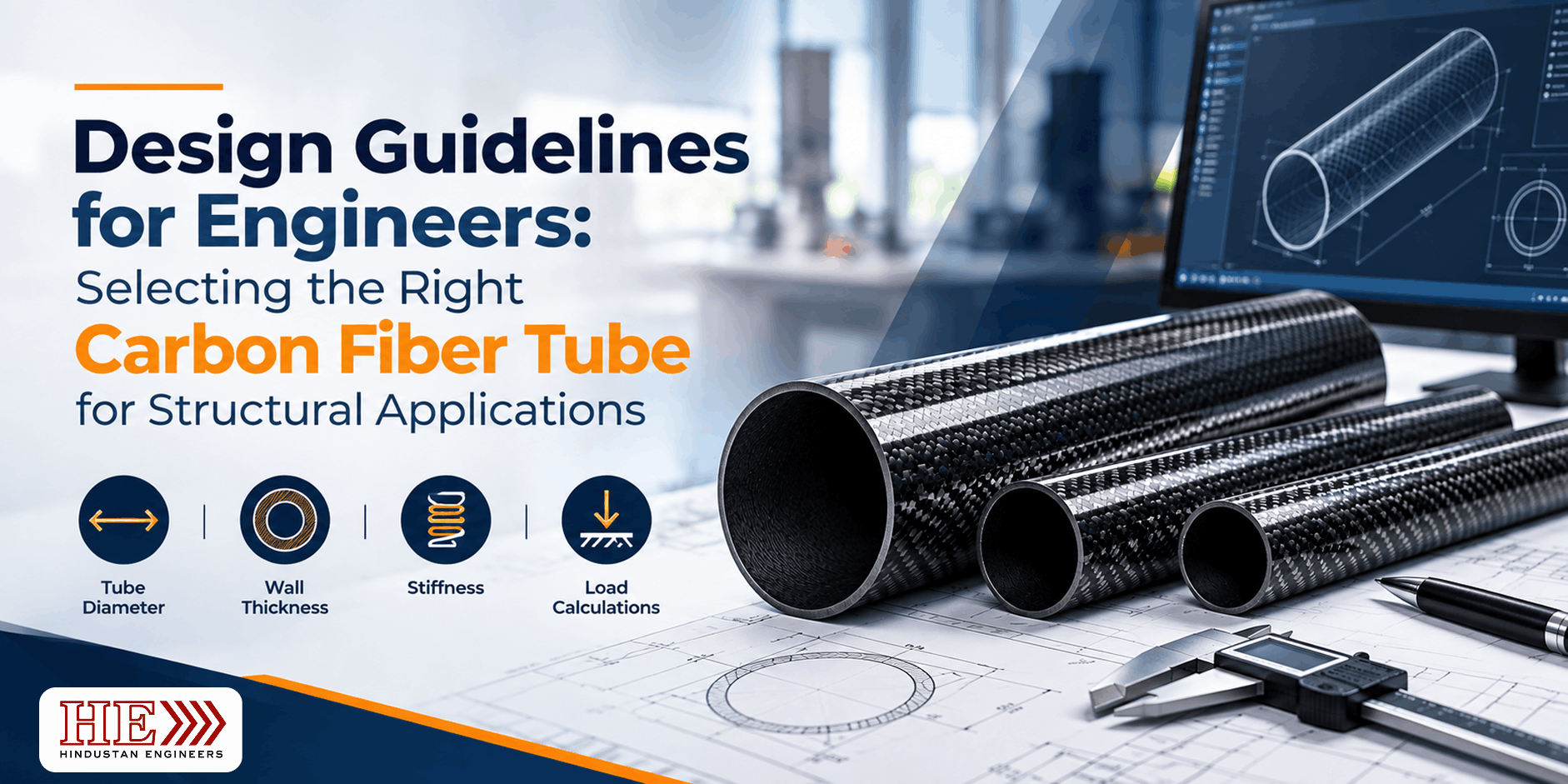
Design Guidelines for Engineers: Selecting the Right Carbon Fiber Tube for Structural Applications
The right carbon fiber tube is not simply the lightest option—it is the one engineered to deliver the required stiffness, strength, stability, and reliability under the actual operating conditions.
For engineers designing robotics, industrial automation equipment, UAVs, precision machinery, telescopic systems, lightweight structures, or other performance-critical components, material selection can directly influence the overall performance of the product.
Carbon fiber tubes have become increasingly attractive for structural applications because they combine high strength-to-weight ratio, stiffness, fatigue resistance, corrosion resistance, and dimensional stability. However, selecting a tube based only on its outside diameter or appearance can result in excessive deflection, unnecessary weight, higher costs, or even premature structural failure.
At Hindustan Engineers, we manufacture carbon fiber tubes using roll-wrapping and filament-winding processes, enabling engineers to select tube constructions according to application-specific requirements such as bending stiffness, torsional loading, dimensions, weight, and operating conditions.
So, how should engineers approach Carbon Fiber Tube Design for structural applications?
Let’s look at the key parameters that should be evaluated before selecting the right Structural Carbon Fiber Tube.
1. Start With the Actual Structural Load
The first step in carbon fiber tube selection is understanding how the tube will be loaded.
A tube may experience one or several types of loads:
- Axial tension
- Axial compression
- Bending
- Torsion
- Shear
- Impact
- Vibration
- Repeated or fatigue loading
- Combined loading
A tube designed primarily for axial tension may require a different fiber architecture from one designed primarily for bending or torsion.
For example, a robotic arm may experience significant bending loads as the arm extends and retracts, while a drive shaft may be dominated by torsional loading. A UAV arm may need to balance bending stiffness, vibration resistance, and low weight.
Therefore, engineers should define the maximum operating load, load direction, unsupported length, allowable deflection, duty cycle, and required factor of safety before selecting a tube.
The objective is not simply to select the strongest tube available. The objective is to select a tube that delivers the required performance for the actual load case.
2. Tube Diameter: A Critical Design Parameter
Tube diameter has a significant effect on structural performance.
For bending applications, increasing the outer diameter can substantially improve the tube’s resistance to bending without necessarily requiring a proportional increase in material.
This is because the geometry of a tube strongly influences its second moment of area, which affects bending stiffness.
For a hollow circular section:
I = π/64 × (D⁴ − d⁴)
Where:
- I = second moment of area
- D = outside diameter
- d = inside diameter
The equation demonstrates why diameter deserves careful consideration during Carbon Fiber Tube Design.
A relatively small increase in outside diameter can produce a significant increase in bending stiffness because diameter is raised to the fourth power in the equation.
For this reason, engineers should not automatically increase wall thickness when greater stiffness is required. Depending on the application, increasing the diameter while optimising the wall thickness may provide a more weight-efficient structural solution.
At Hindustan Engineers, our roll-wrapped carbon fiber tubes are available for small- to medium-diameter applications, including approximately 8 mm to 100 mm diameters and lengths up to 1.5 metres, depending on the construction and application requirements.
3. Wall Thickness: Balance Strength, Stiffness and Weight
Wall thickness is another major consideration when selecting a Structural Carbon Fiber Tube.
Increasing wall thickness generally increases the cross-sectional area and can improve structural capacity. However, simply specifying the thickest available wall is not always the most efficient engineering solution.
An excessively thick tube can:
- Increase component weight
- Increase material consumption
- Increase manufacturing cost
- Increase inertia in moving systems
- Make assembly more difficult
- Reduce some of the weight-saving benefits of carbon fiber
For lightweight engineering applications, the objective should be to achieve the required performance with the minimum practical material.
This is particularly important in robotics, automation and UAV applications, where every additional gram can affect acceleration, energy consumption, payload capacity or overall system dynamics.
Wall thickness should therefore be selected after considering:
- Maximum load
- Unsupported tube length
- Required stiffness
- Buckling risk
- Impact conditions
- Fatigue requirements
- Mounting configuration
- Environmental exposure
- Required safety factor
The correct wall thickness is application-dependent—not simply a catalogue decision.
4. Stiffness Matters as Much as Strength
One of the most important principles in composite tube design is that strength and stiffness are not the same thing.
A tube may have sufficient strength to carry a particular load but still deflect too much for the application.
For precision equipment, robotics, metrology systems and long-reach structures, excessive deflection can affect positioning accuracy and overall system performance.
For a simple beam-like tube under bending, engineers may use:
δ = FL³ / 48EI
for a simplified simply supported beam with a central point load, where:
- δ = deflection
- F = applied load
- L = unsupported length
- E = effective elastic modulus
- I = second moment of area
This equation highlights an important design relationship: length has a very strong influence on deflection.
Therefore, when a carbon fiber tube is becoming too flexible, increasing wall thickness is not necessarily the only solution. Engineers should also evaluate:
- Tube diameter
- Fiber orientation
- Laminate construction
- Unsupported length
- End constraints
- Mounting configuration
- Required modulus
At Hindustan Engineers, our carbon fiber tube constructions can be selected according to application requirements. Roll-wrapped tubes using combinations of twill and unidirectional carbon fiber fabrics are suited to applications where bending stiffness and low weight are important, while filament winding provides flexibility in fiber orientation for applications involving torsional and other loading requirements.
5. Consider Fiber Orientation—Not Just the Tube Dimensions
One of the major differences between carbon fiber composites and conventional metals is that carbon fiber is anisotropic.
In simple terms, the mechanical behaviour of a carbon fiber composite depends strongly on the direction in which the fibers are arranged.
This makes fiber orientation a critical part of Carbon Fiber Tube Design.
For example:
- Longitudinal fibers can contribute strongly to axial strength and stiffness.
- Different fiber orientations can be introduced to support off-axis loading.
- Winding angles can be adjusted for applications requiring torsional performance.
- Multi-directional reinforcement can help address combined loading conditions.
This is one reason why two carbon fiber tubes with similar dimensions may perform differently under the same load.
Engineers should therefore ask not only:
“What diameter and wall thickness do I need?”
but also:
“How is the fiber architecture designed for my load case?”
That question can make a significant difference when selecting composite tubes for demanding structural applications.
6. Choose the Appropriate Manufacturing Process
The manufacturing process directly influences the construction and performance of composite tubes.
At Hindustan Engineers, two key processes are used for carbon fiber tube manufacturing:
Roll-Wrapped Carbon Fiber Tubes
Roll wrapping involves building the tube using multiple layers of carbon fiber material around a mandrel.
This construction can be particularly useful where engineers require:
- High bending stiffness
- Low weight
- Controlled tube dimensions
- Lightweight structural performance
Hindustan Engineers offers roll-wrapped carbon fiber tubes using 3K carbon fiber twill and plain-weave options, with finish choices such as glossy, matte, and sanded surfaces.
These tubes can be suitable for applications including robotics, telescoping systems, rollers and UAV components.
Filament-Wound Carbon Fiber Tubes
Filament winding uses continuous fibers or rovings wound around a rotating mandrel.
One of the key advantages of this process is the ability to control the fiber winding angle.
This makes filament winding particularly useful when the tube needs to address torsional loading or application-specific structural requirements.
It can also support a broader range of tube sizes, lengths and configurations depending on the application.
The manufacturing process should therefore be selected based on the structural requirement—not simply on the preferred manufacturing method.
7. Don't Ignore Buckling in Compression Applications
If a carbon fiber tube is subjected to compression, engineers should evaluate buckling, especially when the tube is long and slender.
A tube may have sufficient material strength to withstand the applied compressive force but still become unstable because of buckling.
Factors that influence buckling include:
- Tube length
- Diameter
- Wall thickness
- End conditions
- Material stiffness
- Load eccentricity
- Manufacturing tolerances
- Imperfections in the tube
For long structural members, engineers should therefore evaluate both material failure and structural stability.
This is particularly relevant for lightweight structural components where designers intentionally use thin walls to minimise weight.
8. Evaluate the Operating Environment
A carbon fiber tube should never be selected solely from mechanical requirements.
The operating environment also matters.
Engineers should consider exposure to:
- Moisture
- Chemicals
- UV radiation
- Temperature variation
- Abrasion
- Impact
- Outdoor conditions
- Repeated vibration
- Corrosive environments
Carbon fiber composites offer excellent resistance to corrosion compared with conventional metallic components, making them useful in applications where rust and corrosion are concerns. Hindustan Engineers’ carbon fiber tube applications include industrial machinery, robotics, UAVs, metrology, surveying, cleaning equipment, high-performance vehicles and marine-related applications.
However, the complete composite system should be evaluated for the actual operating environment, including the resin system, surface finish, joints, inserts and other components.
9. Design the Tube and Mounting System Together
A high-performance carbon fiber tube can still underperform if the mounting system is poorly designed.
This is particularly important when replacing an aluminium or steel tube with carbon fiber while keeping the same brackets, clamps or fastening arrangement.
Engineers should evaluate:
- Clamp pressure
- Fastener loads
- Hole locations
- Contact area
- Localised loading
- Inserts
- Bonded joints
- End fittings
- Stress concentrations
Where concentrated loads are applied, the load should be distributed appropriately to avoid local crushing or damage to the composite structure.
The tube should therefore be treated as part of the complete assembly—not as an isolated component.
10. A Practical Carbon Fiber Tube Load-Calculation Approach
Before requesting a custom tube, engineers can prepare a basic load specification.
For example, consider a tube used as a cantilever structure.
The design inputs may include:
Tube length: 1,000 mm
Applied load: 100 N
Load position: Tube end
Maximum allowable deflection: 5 mm
Primary loading: Bending
Required safety factor: Application dependent
The engineering team can then evaluate the required bending stiffness using:
EI
where:
- E represents the effective material stiffness.
- I represents the tube’s geometric stiffness.
The design can then be iterated by changing:
- Outer diameter
- Inner diameter
- Wall thickness
- Fiber architecture
- Fiber orientation
- Unsupported length
- End constraints
This approach is more effective than simply selecting a tube based on nominal dimensions.
For final structural designs, engineers should use appropriate composite design methods, verified material data, appropriate safety factors and application-specific testing.
11. Carbon Fiber Tube Selection Checklist
Before finalising your Structural Carbon Fiber Tube, review the following:
Structural Requirements
- What is the maximum load?
- Is the load tensile, compressive, bending, torsional or combined?
- Is the loading static, dynamic or cyclic?
- What safety factor is required?
Geometry
- What outer diameter is required?
- What wall thickness is appropriate?
- What is the unsupported length?
- What end conditions are present?
Performance
- What is the allowable deflection?
- Is high bending stiffness required?
- Is torsional stiffness important?
- Is minimum weight a critical objective?
Environment
- Will the tube operate outdoors?
- Will it be exposed to moisture or chemicals?
- What temperature range is expected?
- Is UV or abrasion resistance required?
Manufacturing
- Is roll wrapping appropriate?
- Would filament winding better suit the load case?
- Is a standard tube sufficient?
- Is a custom diameter, length, wall thickness or construction required?
Integration
- How will the tube be mounted?
- Are clamps, inserts or bonded connections required?
- Where will concentrated loads enter the tube?
- Are there potential stress concentrations?
Why Work With Hindustan Engineers for Carbon Fiber Tubes?
At Hindustan Engineers, we approach carbon fiber tubes as engineered composite components, not simply as lightweight replacements for conventional tubes.
Our experience in FRP and carbon fiber composite manufacturing allows us to support applications where strength, stiffness, weight reduction, dimensional stability and durability are important. We manufacture carbon fiber tubes using roll-wrapping and filament-winding processes and support applications across industrial machinery, robotics, UAVs, automation, metrology, telescopic systems and other specialised engineering requirements.
Depending on the application, we can work with requirements involving:
- Custom tube dimensions
- Different wall thicknesses
- Carbon fiber fabric constructions
- Roll-wrapped tubes
- Filament-wound tubes
- Different surface finishes
- Application-specific structural requirements
The goal is simple: develop the right composite tube around the actual engineering requirement.
Final Thoughts
Selecting a carbon fiber tube for a structural application should never be reduced to choosing a diameter from a catalogue.
The right solution depends on the relationship between load, diameter, wall thickness, stiffness, fiber orientation, manufacturing process, environmental conditions and mounting design.
For engineers, the most effective approach is to start with the application and work backward toward the tube specification.
Define the load. Calculate the required stiffness. Evaluate deflection and buckling. Consider the operating environment. Select the appropriate fiber architecture and manufacturing process. Then optimise the tube for the required performance and weight.
At Hindustan Engineers, we help engineers move from a basic material requirement to a more application-focused carbon fiber composite tube solution.
Looking for the right carbon fiber tube for your structural application?
Share your required diameter, length, wall thickness, load, operating conditions and application details with the Hindustan Engineers team. We can help evaluate the appropriate carbon fiber tube configuration for your engineering requirement.
FRP (Fiber Reinforced Plastic) and Carbon Fiber are advanced weight optimization materials that significantly reduce the mass of moving machinery components such as conveyor systems, robotic arms, and rotating tools. By replacing traditional metals, manufacturers achieve higher speed, lower energy consumption, improved fatigue life, and greater design flexibility. Lightweight machinery components made from FRP and Carbon Fiber enable better performance, reduced maintenance, and long-term operational efficiency across industrial automation and material handling systems.
Recent Post
Beyond the Basics: How to Select the Best Carbon Fiber Tube for Your Application
Carbon fiber tubes have revolutionized industries ranging from aerospace to...
Read More
Why Leading OEMs Are Replacing Metal Parts with Carbon Fiber Components in 2026
Carbon Fiber vs Aluminum: The Ultimate Material Showdown for Modern...
Read More
How to Choose Between FRP Tubes vs Carbon Fiber Tubes for Your Application
How to Choose Between FRP Tubes vs Carbon Fiber Tubes...
Read More