How to Choose Between FRP Tubes vs Carbon Fiber Tubes for Your Application
When selecting the right composite tube material for your project, the decision often comes down to FRP tubes vs carbon fiber tubes. Both materials are known for their exceptional strength-to-weight ratio, durability, and corrosion resistance — but each brings unique advantages depending on your application’s priorities such as cost, load-bearing needs, environmental exposure, and overall performance expectations.
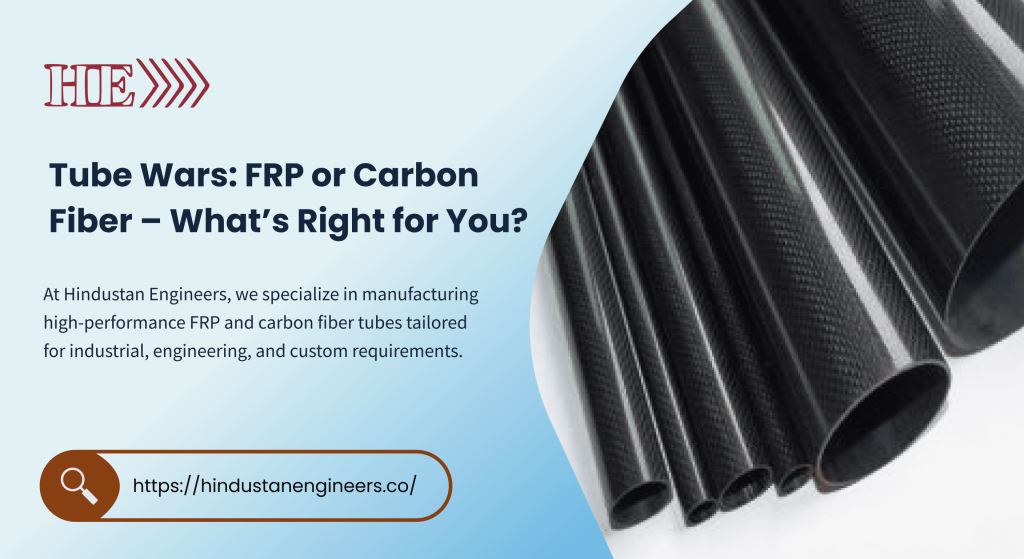
At Hindustan Engineers, we specialize in manufacturing high-performance FRP and carbon fiber tubes tailored for industrial, engineering, and custom requirements. With years of experience in advanced composites, we understand how crucial the right material choice can be — not just for efficiency, but for safety, longevity, and cost optimization.
Let’s dive deep into a detailed tube material comparison to help you make an informed decision.
1. Material Composition and Core Differences
FRP (Fiberglass Reinforced Plastic) is composed of glass fibers embedded in a polymer resin matrix. It’s lightweight, corrosion-resistant, and cost-effective — making it ideal for structural and industrial applications where high strength and insulation properties are key.
Carbon fiber, on the other hand, is made of extremely thin strands of carbon atoms bonded together and coated with a resin system. It’s significantly lighter and stronger than fiberglass, with a sleek, aesthetic finish often favored in aerospace, motorsport, and high-performance equipment.
In simple terms:
FRP = Cost-efficient durability and good performance.
Carbon Fiber = Premium performance with unmatched stiffness and weight savings.
2. Cost Comparison: Balancing Budget and Performance
When comparing FRP tubes vs carbon fiber tubes, cost is often the first consideration.
FRP Tubes: The manufacturing process of fiberglass tubes is more economical. The raw materials are less expensive, and the fabrication process is simpler, making FRP the go-to choice for industries where budget and volume production are key — such as chemical handling systems, cable trays, and structural reinforcements.
Carbon Fiber Tubes: These are more expensive due to the cost of carbon fibers and precision manufacturing techniques like pultrusion or filament winding. However, they deliver unmatched mechanical performance and weight savings that justify the investment in sectors where efficiency and lightweight strength are mission-critical — such as automation, robotics, and high-end engineering systems.
In short:
If cost control is a priority — FRP wins.
If performance and lightweight efficiency are non-negotiable — carbon fiber is worth the investment.
3. Weight and Strength: The Performance Trade-off
One of the most notable differences in this tube material comparison is the ratio between weight and load-bearing capacity.
FRP Tubes: These are significantly lighter than metals like steel or aluminum, but still heavier compared to carbon fiber. They provide excellent tensile and compressive strength and can support substantial loads in static applications.
Carbon Fiber Tubes: These are roughly 40% lighter than FRP and five times stronger than steel (by weight). Their stiffness and rigidity make them ideal for dynamic and precision applications such as aerospace, drone arms, camera rigs, and telescopic poles — where minimal flex and high torsional strength are crucial.
Bottom line:
If your project demands high stiffness-to-weight ratio and superior tensile strength — go for carbon fiber.
If your project prioritizes stability, reliability, and cost-efficiency — FRP will serve you well.
4. Environmental Resistance and Durability
Both FRP and carbon fiber tubes excel in harsh environments, but their resistance profiles differ slightly:
FRP Tubes: Known for outstanding corrosion, moisture, and UV resistance, FRP performs exceptionally well in marine, electrical, and chemical applications. Its non-conductive nature and insulation properties make it ideal for outdoor or chemical exposure environments.
Carbon Fiber Tubes: While carbon fiber is resistant to corrosion and temperature extremes, it is electrically conductive and can be sensitive to galvanic corrosion when in contact with metals. However, when properly finished or coated, it performs exceptionally well in demanding industrial and high-performance settings.
For outdoor, marine, or chemical environments — FRP is your robust choice.
For high-temperature, precision, and lightweight applications — carbon fiber is unmatched.
5. Use Case Comparison: Finding the Perfect Fit
| Application Type | Ideal Choice | Reason |
|---|---|---|
| Structural & Civil Engineering | FRP Tubes | Cost-effective, corrosion-resistant, and non-conductive |
| Marine & Chemical Industry | FRP Tubes | Withstands harsh weather and corrosive agents |
| Aerospace & Automotive | Carbon Fiber Tubes | High stiffness and lightweight for fuel and performance efficiency |
| Industrial Automation & Robotics | Carbon Fiber Tubes | Minimal flex and precise load handling |
| Telescopic Tools & Cleaning Poles | Carbon Fiber Tubes | Lightweight and high rigidity for easy handling |
| Electrical Insulation Applications | FRP Tubes | Non-conductive and thermally stable |
At Hindustan Engineers, our product range includes customizable FRP tubes and carbon fiber tubes available in multiple sizes, thicknesses, and finishes — ensuring the ideal balance of performance and affordability for your unique needs.
6. Making the Right Choice: FRP or Carbon Fiber?
Choosing between FRP tubes vs carbon fiber tubes ultimately depends on your project’s specific performance requirements:
✅ Choose FRP Tubes if you need:
A cost-effective, corrosion-resistant material
Electrical insulation and chemical stability
Strong and durable support for general industrial use
✅ Choose Carbon Fiber Tubes if you need:
Lightweight performance with high stiffness
Aesthetic finish with advanced mechanical strength
Precision and dynamic performance for motion-based systems
Both materials are engineered to last, and at Hindustan Engineers, we help you strike the perfect balance between performance, weight, cost, and durability.
Final Thoughts
The choice between FRP and carbon fiber tubes is not just about materials — it’s about understanding your application’s priorities. Whether it’s cost control, corrosion resistance, or lightweight performance, Hindustan Engineers delivers high-quality composite tubes that meet and exceed industrial standards.
Our team works closely with you to design and manufacture custom FRP and carbon fiber solutions for your unique engineering challenges.
Ready to find the right composite solution for your project?
Contact Hindustan Engineers today to discuss your requirements and get expert guidance on selecting the best tube material for your application.
Recent Post
Why Telescopic Cleaning Poles Are the Best Solution for High-Reach Cleaning?
Cleaning hard-to-reach surfaces has always been a challenge for professionals...
Read MoreEngineering Guide: Comparing Tensile Strength of Carbon Fiber vs Other Materials
In modern engineering, strength is no longer just about “how...
Read MoreWhen Metals Fail, Composites Prevail in Chemical Plants
FRP & Carbon Fiber in Chemical Plants: Corrosion Resistance in...
Read More