
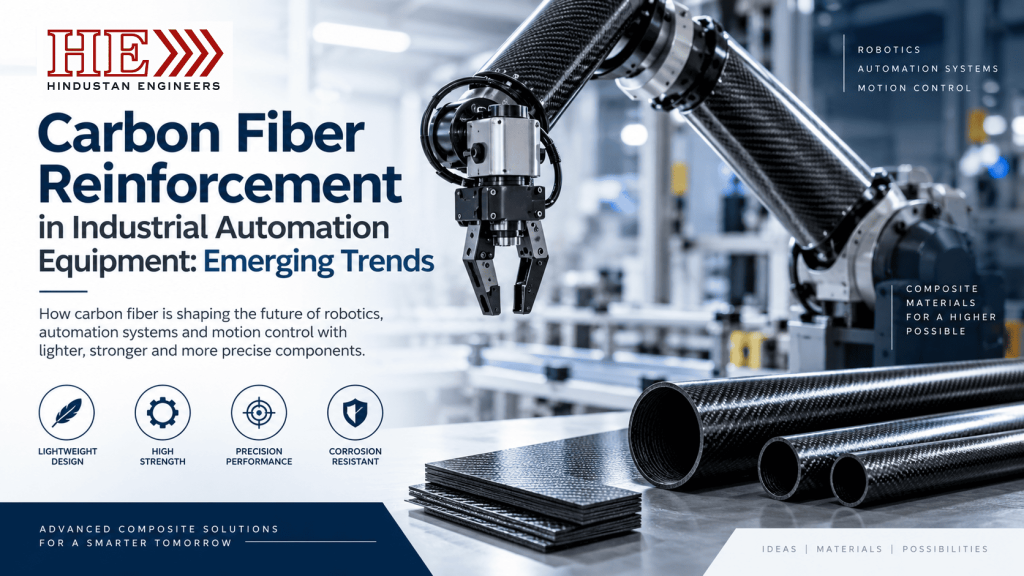
Carbon Fiber Reinforcement in Industrial Automation Equipment: Emerging Trends
When every millisecond, gram and micron matters, the material used in an automation system can become a performance advantage.
Industrial automation is moving toward faster motion, higher precision, longer operating cycles and increasingly compact equipment. As manufacturers push robotic arms, pick-and-place systems, linear mechanisms and automated inspection equipment to perform faster and more accurately, traditional metal components are not always the ideal solution.
This is where carbon fiber reinforcement is gaining momentum.
At Hindustan Engineers, we see carbon fiber composites as more than an alternative to conventional materials. Properly engineered carbon fiber components can help automation manufacturers reduce moving mass, improve stiffness-to-weight performance and develop components suited to demanding motion-control applications.
Our experience in manufacturing carbon fiber composite components—including carbon fiber tubes, sheets, telescopic tubes and custom-engineered components—allows us to approach automation applications from a practical engineering perspective rather than simply treating carbon fiber as a premium material.
Why Carbon Fiber Is Becoming Important in Industrial Automation
Automation equipment is essentially a continuous motion system.
Robotic arms accelerate and decelerate repeatedly. Linear systems move components at high speeds. Pick-and-place mechanisms perform thousands of cycles. Automated inspection systems require stable positioning. Even small amounts of unwanted vibration or structural deflection can affect overall machine performance.
This creates an important engineering challenge:
How can manufacturers make moving components lighter without compromising rigidity and structural performance?
Carbon fiber reinforced composites provide an attractive answer.
Carbon fiber composites offer a high strength-to-weight ratio and can be engineered for specific structural requirements. At Hindustan Engineers, our carbon fiber composite range includes tubes and sheets that can be adapted for different industrial applications. Our carbon fiber composite tubes, for example, are manufactured using processes including roll wrapping and filament winding, depending on the required application.
For automation designers, this opens up opportunities to rethink components that have traditionally been manufactured from steel or aluminium.
1. Lightweight Robotics Components for Faster Motion
One of the most promising applications of Carbon Fiber Automation is robotics.
In a robotic system, every moving component contributes to the total moving mass. Reducing the mass of an arm, support tube, extension member or structural element can potentially reduce the load placed on motors and drive systems.
This becomes particularly relevant in:
- Robotic arms and extensions
- Pick-and-place equipment
- Automated inspection systems
- End-of-arm tooling structures
- Linear motion assemblies
- Lightweight gantry systems
- Telescopic robotic mechanisms
- Automated handling equipment
Carbon fiber tubes are particularly interesting for these applications because their tubular geometry provides an efficient structural form while keeping weight low.
For example, a carbon fiber tube can be considered for robotic links, support structures, extension mechanisms and other components where stiffness and low mass are important.
The objective is not simply to replace a metal tube with a carbon fiber tube.
The real objective is to engineer a lighter and more responsive automation system.
2. Carbon Fiber and Motion Control: Stability Matters
Speed alone does not define a high-performance automation system.
The machine must also stop accurately.
Imagine a robotic mechanism moving rapidly toward a target position. If the structural member flexes or vibrates excessively during acceleration and deceleration, the system may require additional settling time before the next operation.
That is where the stiffness characteristics of carbon fiber composites become valuable.
By selecting the appropriate fibre orientation, laminate construction, geometry and manufacturing process, carbon fiber components can be engineered around specific structural requirements.
Our carbon fiber sheets, for instance, can be customized in terms of thickness, dimensions, surface treatment and fibre orientation to accommodate different mechanical and structural requirements.
For motion-control applications, this flexibility in design can help engineers develop components around the actual load path instead of relying solely on standard material shapes.
3. Carbon Fiber Tubes for Automation Structures
Among the most practical Industrial Automation Materials, carbon fiber tubes have significant potential.
Their applications can extend beyond robotics into machine-building and automated equipment.
Depending on the design, carbon fiber tubes may be considered for:
Structural members:
Used where a lightweight tubular structure is required.
Extension mechanisms:
Useful for applications where long reach needs to be combined with reduced weight.
Robot arms:
Suitable for selected robotic structures where weight and stiffness are critical design parameters.
Inspection equipment:
Can be incorporated into lightweight structures supporting cameras, sensors and measurement systems.
Automation frames and supports:
Can be considered where reduced structural mass and corrosion resistance are important.
At Hindustan Engineers, we manufacture carbon fiber tubes and telescopic tubes with customization available for application-specific requirements. Our existing product capabilities include roll-wrapped and filament-wound carbon fiber tubes.
4. The Rise of Custom-Engineered Carbon Fiber Components
One of the biggest trends we expect to see in industrial automation is a shift from standard components toward application-specific composite engineering.
Automation manufacturers rarely have identical requirements.
One machine may require a lightweight robotic extension. Another may need a rigid support structure. A third may require a custom sheet or plate with a particular fibre orientation.
This is why customization becomes important.
Rather than selecting carbon fiber solely based on appearance or material specification, engineers should evaluate:
- Required load capacity
- Component geometry
- Fibre orientation
- Stiffness requirements
- Operating environment
- Temperature exposure
- Vibration levels
- Mounting method
- Machining requirements
- Production volume
Our manufacturing capabilities include filament winding, roll wrapping, grinding, machining, drilling and other production processes that support the development of composite components for industrial requirements.
This enables us to work toward a component that fits the machine—not simply a material that happens to fit the component.
5. Carbon Fiber Sheets for Precision Structures
Carbon fiber reinforcement is not limited to tubular components.
Carbon fiber sheets and plates can also play a role in automation equipment where lightweight, rigid flat structures are required.
Potential applications include:
- Mounting plates
- Structural panels
- Robotic brackets
- Sensor mounting structures
- Machine covers
- Lightweight tooling
- Fixtures
- Support plates
- Precision equipment components
The ability to customize thickness, dimensions and fibre orientation makes composite sheets particularly useful when engineers are trying to balance weight, rigidity and structural requirements.
For automation equipment manufacturers, this can create new design possibilities that are difficult to achieve economically with conventional materials.
6. Corrosion Resistance and Long-Term Industrial Performance
Automation equipment is not always operated in clean, dry environments.
Manufacturing facilities can expose components to moisture, chemicals, dust, oils and other environmental factors.
Carbon fiber composites can offer advantages in environments where corrosion resistance is important. This can be particularly relevant when reducing maintenance requirements is part of the equipment design objective.
However, composite performance is dependent on the complete material system and manufacturing process. Fibre type, resin system, laminate design, joints and surface protection all need to be considered.
For this reason, we recommend evaluating carbon fiber components based on the complete application, rather than simply comparing the raw material against steel or aluminium.
7. The Future: Lighter, Faster and Smarter Automation
The next generation of automation equipment will increasingly focus on efficiency at the component level.
Sensors are becoming smarter. Motors are becoming more efficient. Control systems are becoming faster. Robotics are becoming more capable.
The mechanical structure supporting these systems must evolve as well.
This is where we see an important future for carbon fiber reinforcement.
The trend is moving toward:
Lightweight robotic structures → faster acceleration → improved motion efficiency → reduced mechanical loading → higher productivity potential.
At the same time, advanced composite manufacturing is making it increasingly practical to produce customized tubes, sheets, rods, profiles and complex components for specific engineering requirements.
The result is a shift from simply asking:
“Can we manufacture this component from carbon fiber?”
to a more valuable engineering question:
“Can carbon fiber help us design a better automation system?”
Carbon Fiber Automation: From Material Selection to Engineering Advantage
At Hindustan Engineers, we believe the future of carbon fiber in automation will be driven by application-focused engineering.
Our capabilities in carbon fiber tubes, sheets, telescopic tubes and custom composite components allow us to support manufacturers looking to explore lightweight composite solutions for industrial equipment.
For robotics, motion control and automation systems, the opportunity is clear: reduce unnecessary mass, engineer stiffness where it matters and create components around the actual requirements of the machine.
Carbon fiber is therefore moving beyond its traditional applications.
It is becoming an increasingly relevant material for the next generation of robotics components and industrial automation materials.
Looking to Integrate Carbon Fiber into Your Automation Equipment?
Whether you are developing a robotic arm, automation mechanism, lightweight structural assembly, inspection system or custom motion-control equipment, choosing the right composite construction is critical.
At Hindustan Engineers, we develop and manufacture carbon fiber composite components based on application requirements, including customized tubes, sheets and other engineered solutions.
If your automation system needs to be lighter, stiffer and more performance-focused, let’s explore what carbon fiber can do for your next design.
FRP (Fiber Reinforced Plastic) and Carbon Fiber are advanced weight optimization materials that significantly reduce the mass of moving machinery components such as conveyor systems, robotic arms, and rotating tools. By replacing traditional metals, manufacturers achieve higher speed, lower energy consumption, improved fatigue life, and greater design flexibility. Lightweight machinery components made from FRP and Carbon Fiber enable better performance, reduced maintenance, and long-term operational efficiency across industrial automation and material handling systems.
Recent Post
Beyond the Basics: How to Select the Best Carbon Fiber Tube for Your Application
Carbon fiber tubes have revolutionized industries ranging from aerospace to...
Read More
Carbon Fiber Manufacturing Innovations That Are Reshaping Industrial Engineering
Carbon Fiber Manufacturing Innovations That Are Reshaping Industrial Engineering Carbon...
Read More
How Carbon Fiber Tubes Are Revolutionizing Lightweight Engineering Applications?
In today’s rapidly evolving engineering landscape, the demand for lightweight,...
Read More