
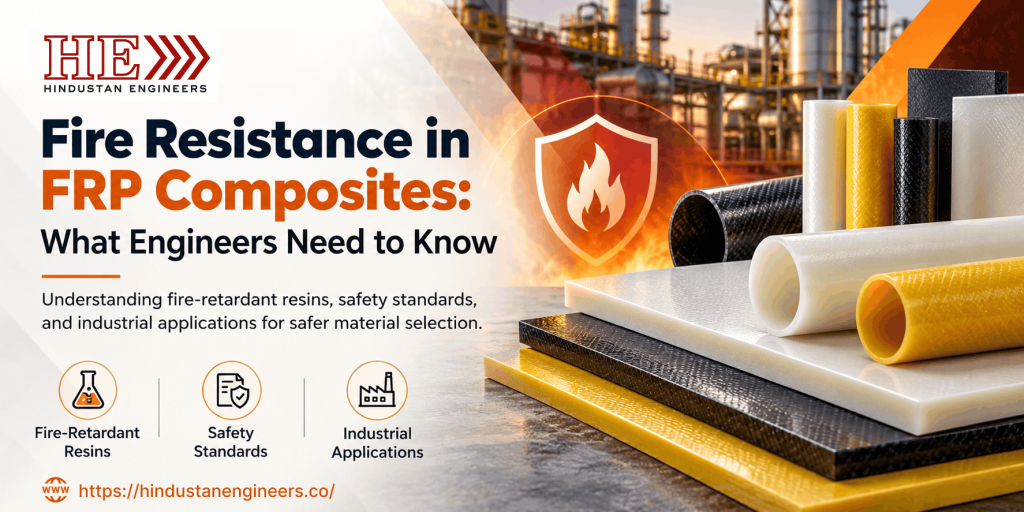
Fire Resistance in FRP Composites: What Engineers Need to Know
Understanding fire-retardant resins, safety standards, and industrial applications for safer material selection
When selecting materials for industrial equipment, electrical systems, or demanding operating environments, strength and durability are only part of the equation. Fire performance is equally important, particularly in applications where heat exposure, electrical faults, or accidental ignition can affect equipment reliability and workplace safety.
Fire Resistant FRP (Fibre-Reinforced Polymer) composites offer engineers a way to combine lightweight construction, mechanical strength, electrical insulation, and application-specific fire-retardant properties. However, not all FRP materials respond to fire in the same way. Their performance depends on the reinforcement, resin system, manufacturing process, component design, and applicable safety requirements.
At Hindustan Engineers, we manufacture FRP and carbon fibre composite components for industrial and commercial applications. Our product range includes FRP sheets, tubes, firework tubes, vane plates, and customised moulded components. Understanding the relationship between material selection and fire performance helps engineers identify the right composite solution for their requirements.
What Are FRP Composites, and Why Does Fire Resistance Matter?
FRP composites are engineered materials made by combining reinforcing fibres, such as glass fibre, with a polymer resin matrix. The fibres provide structural reinforcement, while the resin binds the fibres together and helps transfer loads throughout the component.
Depending on the formulation and design, FRP materials can offer a useful combination of strength, low weight, corrosion resistance, dimensional stability, and electrical insulation.
However, conventional FRP is not automatically fireproof. When exposed to high temperatures, the polymer resin can soften, decompose, release smoke, or lose its ability to transfer loads effectively. The fibres may remain intact at temperatures where the resin matrix has already deteriorated, but this does not mean the complete component retains its original strength.
For engineers working with industrial safety materials, the objective is to select a composite that delivers the required mechanical and electrical performance while meeting the fire-performance criteria of its intended application.
Understanding Fire-Resistant FRP: Fire Resistance vs. Fire Retardancy
Although these terms are often used interchangeably, they describe different performance characteristics.
Fire retardancy refers to a material’s ability to slow ignition, reduce flame spread, or limit burning under specified test conditions. Fire-retardant formulations are designed to improve a material’s response when exposed to a flame.
Fire resistance, in a stricter engineering context, refers to the ability of a material or complete assembly to maintain specified functions for a defined period under fire exposure. Depending on the application, these functions may include structural stability, integrity, or insulation.
A fire-retardant FRP component is therefore not necessarily capable of maintaining its load-bearing capacity during a prolonged fire.
Engineers should evaluate the complete component rather than relying on a resin description alone. Fibre type, resin chemistry, laminate thickness, surface coatings, joints, and manufacturing quality can all influence the final performance.
The Role of Fire-Retardant Resins in FRP Composites
The resin system is one of the most important factors affecting the fire behaviour of FRP composites. It influences how the material responds to heat, flame exposure, smoke generation, and changes in mechanical properties.
1. Fire-Retardant Polyester and Vinyl Ester Resins
Specially formulated polyester and vinyl ester resins can be used to manufacture FRP components requiring improved flame-retardant characteristics. The appropriate formulation depends on the operating environment, chemical exposure, processing method, and required fire classification. These resin systems may be suitable for selected industrial panels, enclosures, covers, and equipment components when supported by the necessary performance data.2. Fire-Retardant Epoxy Resins
Epoxy resins are widely used in high-performance composites because of their bonding characteristics, mechanical properties, and electrical insulation potential. Special fire-retardant epoxy formulations can be selected when improved fire performance is required alongside structural or electrical requirements. However, ordinary epoxy resin should not automatically be considered fire-rated. The finished laminate must be assessed against the relevant test criteria.3. Fire-Retardant Additives and Fillers
Certain additives and mineral fillers can improve the fire behaviour of polymer systems. For example, aluminium trihydroxide may help reduce flammability and suppress smoke in suitable formulations. The addition of fire-retardant ingredients can also affect viscosity, processing, weight, strength, and other mechanical properties. Material selection should therefore balance fire performance with the component’s engineering requirements. Engineering takeaway: Choosing a fire-retardant resin is an important starting point, but the resin alone does not establish the fire rating of a finished FRP component.Key Fire-Safety Standards Engineers Should Know
Selecting Fire Resistant FRP requires an understanding of the standards relevant to the end application. Different tests measure different aspects of fire performance, so their results should not be treated as interchangeable.
UL 94: Evaluates the flammability of plastic materials under specified laboratory conditions, including vertical and horizontal burning tests.
ASTM E84: Measures surface-burning characteristics, including flame spread and smoke development, under a defined test method.
ASTM E1354: Uses a cone calorimeter to evaluate heat-release rate and other combustion characteristics under specified conditions.
EN 45545: Addresses fire protection requirements for railway vehicles and is relevant to materials and components used in that sector.
These standards serve different purposes. Passing one test does not automatically demonstrate compliance with another standard or establish that a component is suitable for every fire-risk environment.
Before approving a material, engineers should confirm the required test method, acceptance criteria, product configuration, thickness, and supporting test documentation. Where applicable, project specifications and local building, electrical, transport, or industrial safety regulations must also be considered.
Industrial Applications of Fire-Resistant FRP Composites
Fire-retardant FRP materials can be useful across several industrial sectors, provided the selected grade is appropriate for the application and its fire-performance requirements.
Electrical Equipment and Insulation Systems
Glass-fibre-reinforced epoxy laminates are used in electrical insulation applications because of their mechanical and dielectric properties. FRP sheets and related components may be suitable for selected insulation barriers, support parts, and electrical equipment assemblies. Where fire performance is critical, engineers should verify the exact laminate grade, electrical requirements, and relevant flammability documentation. A general-purpose insulation grade should not be assumed to meet every fire-safety specification.Industrial Machinery and Equipment Components
FRP components can be considered for selected covers, supports, housings, and machine parts where weight reduction, insulation, and corrosion resistance are important. The resin system, temperature limits, mechanical loads, and exposure to potential ignition sources should be evaluated before specifying a component.Chemical and Process Industries
In selected chemical-processing environments, FRP can offer advantages where corrosion resistance and low weight are important. Fire performance must be assessed separately, taking account of the process chemicals, operating temperatures, and potential fire hazards.Specialised Tubes and Custom Components
FRP tubes, moulded parts, and specialised components can be designed for specific industrial requirements. Fire-retardant formulations may be appropriate where supported by the required technical specifications. For example, Hindustan Engineers manufactures FRP firework tubes using fire-retardant resin formulations for their intended specialised application. The appropriate material specification depends on the design, operating conditions, and required performance.How Engineers Can Select the Right FRP Material
Before choosing an FRP component for a safety-critical application, consider the following factors:
Define the fire-performance requirement: Determine whether the project requires reduced flame spread, a particular flammability classification, limited smoke generation, or a fire-rated assembly.
Identify the operating environment: Assess expected temperatures, electrical exposure, chemicals, moisture, vibration, and mechanical loads.
Select the reinforcement and resin together: Evaluate the complete composite system rather than treating the fibre or resin as an independent indicator of fire performance.
Review test reports and technical data: Confirm that the documentation applies to the relevant material grade, thickness, manufacturing process, and intended use.
Consider manufacturing consistency: Fibre distribution, resin curing, laminate quality, and dimensional accuracy can influence the performance and reliability of the finished component.
Validate the finished design: Where required, test the actual component or assembly under the applicable acceptance criteria before production approval.
A structured selection process helps engineers avoid material mismatches and supports more reliable, application-specific decisions.
Why Choose Hindustan Engineers for FRP Composite Components?
At Hindustan Engineers, we focus on manufacturing FRP and carbon fibre composite components for industrial and commercial applications. Our product range includes FRP sheets, tubes, vane plates, firework tubes, threaded rods and nuts, and moulded components.
We also support customised component requirements based on engineering drawings and application needs. This enables customers to discuss material selection, dimensions, manufacturing considerations, and intended operating conditions before finalising a specification.
For projects requiring fire-retardant FRP, the correct approach is to establish the required performance criteria first and then evaluate the appropriate resin system and finished component against those requirements. Fire ratings, certifications, and compliance should be confirmed through product-specific technical documentation rather than assumed from a general material description.
Conclusion: Make Fire Performance Part of Your Material Selection
Fire performance should be considered at the beginning of the engineering design process, not as an afterthought. The right FRP composite can help meet mechanical, electrical, weight, and environmental requirements while delivering the fire behaviour appropriate to its intended use.
Understanding fire-retardant resins, relevant safety standards, and application-specific limitations allows engineers to make informed material decisions and reduce avoidable specification risks.
At Hindustan Engineers, we help industrial customers explore FRP and carbon fibre composite components for their engineering requirements. Whether you need FRP sheets, tubes, insulation components, or customised moulded parts, our team can discuss your application and help identify the appropriate manufacturing and material considerations.
Looking for FRP composite components for your next industrial project?
Contact Hindustan Engineers to discuss your application, material requirements, and customised component needs.
Explore our products: https://hindustanengineers.co/frp-composite/
FRP (Fiber Reinforced Plastic) and Carbon Fiber are advanced weight optimization materials that significantly reduce the mass of moving machinery components such as conveyor systems, robotic arms, and rotating tools. By replacing traditional metals, manufacturers achieve higher speed, lower energy consumption, improved fatigue life, and greater design flexibility. Lightweight machinery components made from FRP and Carbon Fiber enable better performance, reduced maintenance, and long-term operational efficiency across industrial automation and material handling systems.
Recent Post
10 Benefits of Using FRP Sheets in Chemical and Food Processing Industries
In industrial environments like chemical and food processing plants, material...
Read More
Selecting the Right Carbon Fiber Sheet: Grades, Thickness & Uses
Carbon fiber sheets have become a staple in high-performance industrial...
Read More
How Carbon Fiber Composites Are Transforming OEM Component Design
At Hindustan Engineers, we understand that every OEM (Original Equipment...
Read More