Carbon fiber sheets have become a staple in high-performance industrial applications due to their unmatched strength-to-weight ratio, dimensional stability, and corrosion resistance. But not all carbon fiber sheets are created equal. Depending on your use case—whether you’re developing lightweight tools, robust structural panels, or precision molds—the grade and thickness of the carbon fiber sheet you choose can make a significant difference.
At Hindustan Engineers, a trusted carbon fiber sheet manufacturer, we provide a wide range of carbon fiber sheets customized for your project requirements. This blog will help you decode the grades, thicknesses, and applications of carbon fiber sheets so you can make an informed, performance-driven decision.
Key Factors in Selecting the Right Carbon Fiber Sheet
When choosing a carbon fiber sheet for any application, especially for industrial tooling or custom panels, consider the following:
1. Grade of Carbon Fiber Sheet
Carbon fiber sheets come in various grades based on fiber type, weave style, and resin system.
Standard Modulus (SM): Commonly used in automotive parts, sports equipment, and general-purpose tools. Offers a great balance of stiffness and cost.
Intermediate Modulus (IM): Offers higher stiffness and is ideal for structural parts that demand better mechanical performance.
High Modulus (HM): Used in aerospace, high-end industrial tools, and applications that require ultra-lightweight strength.
Hindustan Engineers offers high-tolerance carbon fiber sheet grades that cater to these segments with precise fiber alignment and low void content.
2. Fiber Orientation and Weave Pattern
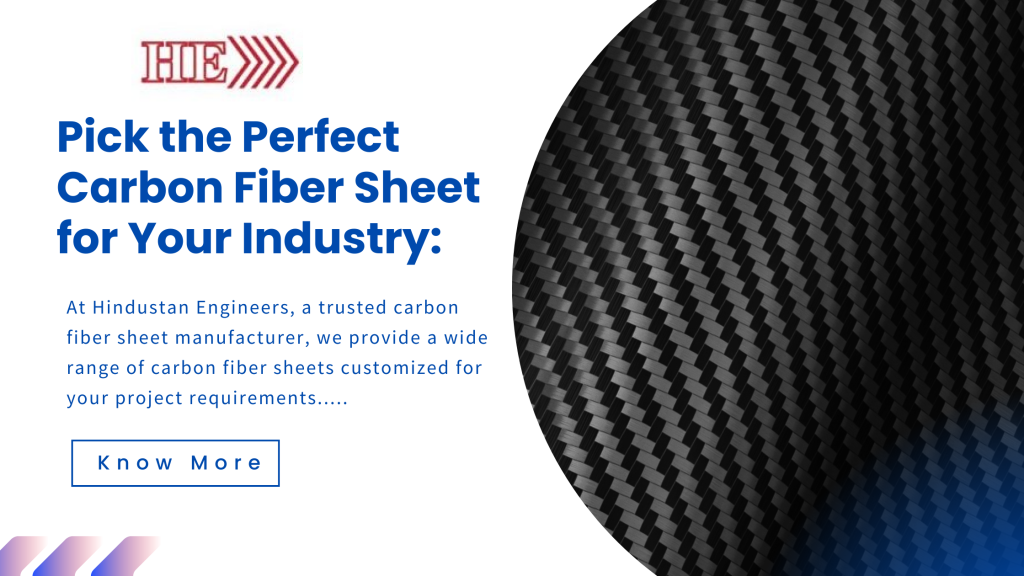
The weave pattern of a carbon fiber sheet affects its mechanical characteristics.
Unidirectional (UD): Strongest in one direction, perfect for applications needing directional strength—like robotic arms or tool holders.
Plain Weave: Balanced and symmetrical; ideal for cosmetic panels or parts with multi-directional loads.
Twill Weave: Offers better drapability and aesthetic appeal; commonly used in both tools and design-intensive products.
3. Thickness Selection
Carbon fiber sheets are available in thicknesses ranging from 0.2mm to 10mm and beyond.
<1mm sheets: Best for decorative overlays or lightweight drone parts.
1mm to 3mm sheets: Ideal for precision tools, brackets, and electronic housing.
3mm to 5mm sheets: Suited for load-bearing structures, robotics, and molds.
>5mm sheets: Recommended for high-stress industrial panels and tooling plates.
At Hindustan Engineers, our carbon fiber sheets for tools are manufactured with consistent thickness tolerance and flatness, ensuring machinability and structural integrity.
Custom vs Standard Carbon Fiber Sheets
When deciding between standard and custom carbon fiber sheets, consider your design complexity, production volume, and performance requirements.
Standard Sheets:
Lower cost and faster delivery
Available in predefined sizes, grades, and weaves
Ideal for generic applications like reinforcement plates, prototype tools, or panels
Custom Sheets:
Tailored to thickness, fiber orientation, resin type, and dimensions
Preferred for applications where performance cannot be compromised—e.g., vacuum tool molds, jigs, or precision parts
Enables integration of other materials like aramid or foam cores
Hindustan Engineers provides both standard and custom-engineered carbon fiber sheets using epoxy or high-temperature resins. Our precision-cutting and CNC machining capabilities ensure every sheet fits your project perfectly.
Use Cases: Where the Right Sheet Matters Most
Here are some industries and scenarios where selecting the right carbon fiber sheet grade and thickness is crucial:
Tooling & Fixtures
Carbon fiber sheets are increasingly replacing metals in industrial tools and jigs. Lightweight sheets reduce operator fatigue, while dimensional stability ensures accurate machining.
Recommended Grade & Thickness:
Grade: Standard or Intermediate Modulus
Thickness: 2mm–5mm twill weave or UD
Molds & Prototyping
For high-temperature composite molding or vacuum-forming, carbon fiber molds offer faster cycle times and longevity compared to metal molds.
Recommended Grade & Thickness:
Grade: High Modulus with epoxy resin
Thickness: 3mm–6mm
Lightweight Structural Panels
Used in robotics, aerospace interiors, automotive dashboards, and even medical device panels, these sheets reduce weight while maintaining strength.
Recommended Grade & Thickness:
Grade: Intermediate Modulus, UD or twill
Thickness: 1mm–3mm
Electronics & Instrument Housing
Carbon fiber provides electromagnetic shielding and thermal resistance, making it suitable for electronic enclosures.
Recommended Grade & Thickness:
Grade: Standard Modulus
Thickness: 1mm–2mm, plain weave
Why Choose Hindustan Engineers?
With a deep legacy in composite manufacturing, Hindustan Engineers stands out as a trusted carbon fiber sheet manufacturer for industrial clients across India. Our solutions offer:
-
Consistent Quality Control: Each sheet undergoes strict tolerance checks for thickness, flatness, and resin infusion.
-
Advanced Machining Capabilities: CNC cutting and lamination services to meet complex geometries.
-
Material Expertise: We help you choose the right combination of resin system, fiber orientation, and surface finish.
We also offer technical consulting to help businesses match the right material with their end-use application—whether it’s lightweight robotics or heavy-duty molds.
Final Thoughts
Selecting the right carbon fiber sheet grade, thickness, and weave is more than just a technical decision—it’s a strategic one. It determines the performance, reliability, and lifespan of your tools, molds, and structural components.
At Hindustan Engineers, we’re here to simplify that decision with engineered solutions, precision manufacturing, and dependable support. Reach out to us today to explore the best-fit carbon fiber sheets for your industry-specific application.
Recent Post
Your Carbon Fiber Supplier Checklist
When it comes to buying carbon fiber sheets, the quality...
Read More10 Benefits of Using FRP Sheets in Chemical and Food Processing Industries
In industrial environments like chemical and food processing plants, material...
Read MoreHow to Identify High-Quality Carbon Fiber Sheets: 6 Key Parameters
How to Identify High-Quality Carbon Fiber Sheets: 6 Key Parameters...
Read More