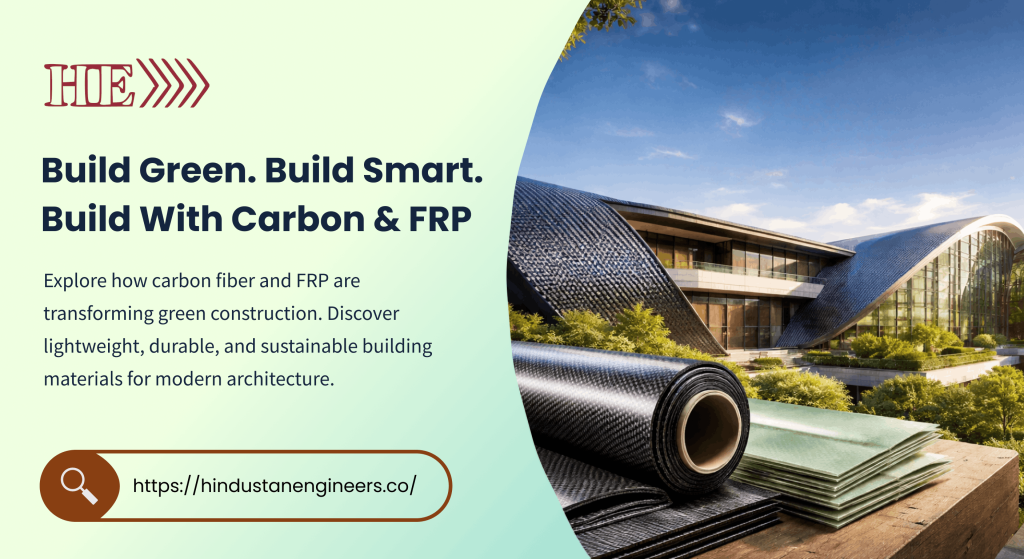

In today’s fast-evolving construction landscape, sustainability is no longer a “good-to-have” — it’s a non-negotiable priority. Architects, structural engineers, and developers are actively seeking green building materials that not only reduce environmental impact but also enhance durability, flexibility, and long-term cost efficiency.
That’s where Carbon Fiber Reinforced Polymer (CFRP) and Fiber Reinforced Plastic (FRP) are transforming modern architecture.
At Hindustan Engineers, we’re seeing a clear shift: forward-thinking architects are moving beyond traditional steel and concrete — embracing FRP in construction and carbon fiber architecture to build the next generation of sustainable structures.
Why Green Construction Is Shifting Toward Composites
Green construction focuses on:
- Reduced carbon footprint
- Energy-efficient materials
- Long lifecycle with minimal maintenance
- Recyclability and resource efficiency
Traditional materials like steel and concrete, while strong, come with limitations:
- High embodied carbon
- Susceptibility to corrosion
- Heavy weight impacting transportation and structural load
FRP and carbon fiber composites solve all of these challenges — and more.
Applications: Where Carbon Fiber & FRP Are Used in Modern Construction
1. Panels & Facades – Lightweight Meets Aesthetic Freedom
Architectural panels made from FRP and carbon fiber are rapidly replacing conventional cladding systems.
Why architects prefer them:
- Extremely lightweight → reduces structural load
- High design flexibility → complex geometries & modern aesthetics
- Corrosion-resistant → ideal for coastal & industrial environments
- UV and weather resistant
At Hindustan Engineers, our custom FRP panels and carbon fiber sheets empower architects to design visually striking yet sustainable facades.
2. Roofing Systems – Durable, Weather-Resistant & Energy Efficient
Roofing plays a critical role in energy efficiency and building longevity.
FRP roofing solutions offer:
- High strength-to-weight ratio
- Thermal insulation benefits
- Resistance to chemicals, moisture, and UV exposure
- Longer lifecycle with minimal maintenance
Carbon fiber structural reinforcements in roofing also enable large-span, column-free designs, giving architects more creative freedom.
3. Structural Supports & Reinforcements – Strength Without the Weight
From bridges to commercial buildings, FRP rebars, carbon fiber laminates, and composite supports are revolutionizing structural engineering.
Key benefits:
- 5x stronger than steel (in strength-to-weight ratio)
- Non-corrosive → ideal for harsh environments
- Reduced maintenance costs
- Easy installation due to lightweight nature
Hindustan Engineers specializes in precision-engineered composite components, ensuring superior performance even in demanding structural applications.
Lightweight Advantage: A Game-Changer for Seismic Zones
One of the most critical advantages of carbon fiber architecture is its lightweight nature.
In earthquake-prone regions:
- Lower building weight = reduced seismic forces
- Higher flexibility = better energy absorption
- Faster installation = reduced construction time
FRP and carbon fiber materials significantly improve structural resilience, making them the preferred choice for:
- High-rise buildings
- Bridges
- Retrofitting older structures
For architects designing in seismic zones, composites are not just an option — they are a strategic advantage.
Sustainability & Green Building Certifications
Green building certifications like:
- LEED (Leadership in Energy and Environmental Design)
- IGBC (Indian Green Building Council)
…are driving material innovation.
How FRP & Carbon Fiber contribute:
- Lower transportation emissions (due to lightweight)
- Long lifespan → reduced material replacement
- Minimal maintenance → lower lifecycle cost
- Reduced waste during installation
At Hindustan Engineers, we design our composite solutions to align with global sustainability standards, helping projects achieve green certifications faster.
Why Architects Are Choosing Hindustan Engineers
We don’t just manufacture composites — we engineer future-ready construction solutions.
What sets us apart:
✔ Custom-designed FRP and carbon fiber components
✔ High-precision manufacturing with consistent quality
✔ Expertise across industrial and architectural applications
✔ Scalable production for large infrastructure projects
✔ Focus on sustainability-driven innovation
From carbon fiber sheets, tubes, and molded components to FRP panels and structural parts, our solutions are tailored to meet modern architectural demands.
The Real Advantage: Strength-to-Weight Ratio
The real engineering advantage lies here.
Carbon fiber doesn’t just compete—it redefines performance metrics.
Why Strength-to-Weight Matters:
- Reduces energy consumption
- Enhances mobility and efficiency
- Enables innovative designs
- Minimizes structural stress
At Hindustan Engineers, we engineer solutions where every gram matters—without compromising strength.
The Future of Green Construction Is Composite-Driven
The construction industry is undergoing a material revolution.
Architects today are not just designing buildings — they are shaping sustainable ecosystems.
And the materials they choose matter.
FRP in construction and carbon fiber architecture are no longer niche innovations — they are becoming the foundation of green building materials worldwide.
Final Thought
If your next project demands:
- Sustainability
- Structural efficiency
- Design flexibility
- Long-term cost savings
Then it’s time to move beyond traditional materials.
Choose composites. Choose innovation. Choose Hindustan Engineers.
FRP (Fiber Reinforced Plastic) and Carbon Fiber are advanced weight optimization materials that significantly reduce the mass of moving machinery components such as conveyor systems, robotic arms, and rotating tools. By replacing traditional metals, manufacturers achieve higher speed, lower energy consumption, improved fatigue life, and greater design flexibility. Lightweight machinery components made from FRP and Carbon Fiber enable better performance, reduced maintenance, and long-term operational efficiency across industrial automation and material handling systems.
Recent Post
How Carbon Fiber Tubes Are Revolutionizing Lightweight Engineering Applications?
In today’s rapidly evolving engineering landscape, the demand for lightweight,...
Read MoreSelecting the Right Carbon Fiber Sheet: Grades, Thickness & Uses
Carbon fiber sheets have become a staple in high-performance industrial...
Read MoreFRP and Carbon Fiber Tubes: Manufacturing Process and Key Applications
Fiber Reinforced Polymer (FRP) and carbon fiber composite tubes have...
Read More