
The Real Challenge: Managing High-Value Composite Inventory
When you invest in high-performance materials like FRP sheets, carbon fiber tubes, molded composite components, and structural profiles, you’re not just buying inventory—you’re securing long-term performance, durability, and precision engineering.
But here’s the truth most bulk buyers overlook:
👉 Improper storage and handling can silently degrade composite materials—impacting strength, finish, and lifecycle.
At Hindustan Engineers, we’ve worked closely with industrial buyers across sectors—from infrastructure to manufacturing—and we’ve seen how smart inventory management of FRP and carbon composites can directly impact ROI.
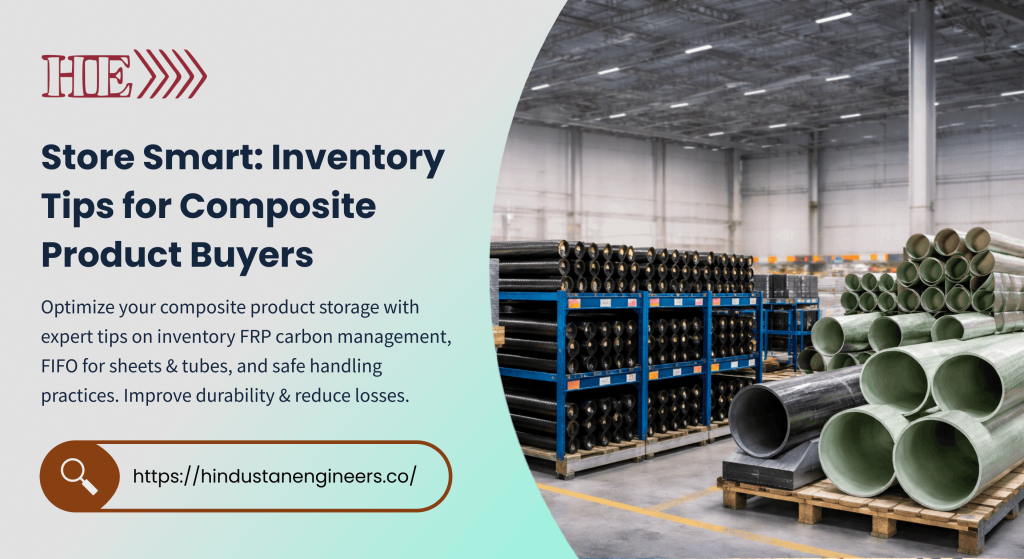
This guide will walk you through practical, field-tested strategies to optimize composite product storage, inventory FRP carbon systems, FIFO usage, and handling practices.
Understanding Composite Sensitivity (Why Inventory Matters)
Composite materials like Fiber Reinforced Polymers (FRP) and carbon fiber composites are engineered for high strength-to-weight ratio, corrosion resistance, and durability.
However, they are also sensitive to:
- UV exposure
- Moisture ingress
- Temperature fluctuations
- Mechanical stress during handling
For example, prolonged exposure to UV light or moisture can degrade FRP surfaces and reduce performance over time.
👉 This is why inventory management is not just logistics—it’s material protection.
1. Storage Guidelines for Composite Products
Controlled Environment is Non-Negotiable
For bulk storage of composite products, maintaining a stable environment is critical:
- Temperature Control: Store in cool, stable conditions to prevent resin degradation
- Humidity Control: Keep relative humidity moderate (around 50%) to avoid moisture absorption
- Avoid UV Exposure: Direct sunlight can cause surface degradation in FRP materials
👉 Best Practice: Use covered warehouses or indoor racking systems for all composite stock.
Proper Packaging & Sealing
- Always store sheets, tubes, and molded parts in sealed or protective packaging
- Use protective films or wraps to prevent dust and contamination
- Airtight packaging is especially important for resin-rich materials
👉 At Hindustan Engineers, we recommend original packaging retention until final use for maximum material integrity.
Structured Storage for Different Formats
Composite Sheets:
- Store flat on even surfaces
- Avoid stacking beyond recommended limits
- Use separators to prevent surface scratches
Carbon Fiber Tubes & Rods:
- Store horizontally on racks with proper support
- Avoid point loading or bending stress
Molded Components:
- Use cushioned pallets
- Avoid stacking irregular shapes directly
👉 Improper stacking can lead to micro-cracks or deformation, affecting performance.
2. FIFO Strategy for Sheets & Tubes (Critical for Bulk Buyers)
Why FIFO Matters in Composite Inventory
Unlike metals, composite materials can have aging factors due to environmental exposure.
FIFO (First In, First Out) ensures:
- Older stock is used first
- Material performance consistency
- Reduced risk of degradation
How to Implement FIFO Effectively
1. Batch Labeling
- Assign batch numbers and arrival dates
- Use barcode or ERP-based tracking systems
2. Visual Zoning
- Separate inventory zones by date
- Clearly mark “old stock first” areas
3. Digital Inventory Monitoring
- Track storage duration
- Set alerts for aging stock
👉 Modern systems even track exposure time and conditions for advanced composite materials.
FIFO for Sheets vs Tubes
| Material Type | FIFO Priority |
|---|---|
| FRP Sheets | High (surface exposure risk) |
| Carbon Tubes | Medium (structural integrity focus) |
| Prepreg Materials | Very High (time-sensitive) |
3. Handling Tips to Prevent Damage
Handle Like Precision Material (Not Metal)
Composite products may look rigid—but they require careful handling:
- Avoid dropping or impact
- Prevent dragging across rough surfaces
- Use padded supports during movement
👉 Aggressive handling can cause invisible internal damage or delamination.
Use Proper Equipment
For bulk movement:
- Use forklifts with padded forks
- Employ vacuum or suction-based lifting systems for delicate sheets
- Use custom racks for long tubes
Advanced facilities even use specialized gripping systems for safe composite handling.
Avoid Contamination
- Always handle with clean gloves
- Prevent oil, dust, or chemical exposure
- Maintain clean storage and processing zones
👉 Even minor contamination can impact bonding, coating, or finishing processes.
4. Smart Inventory Practices for Bulk Buyers
Optimize Stock Levels
- Avoid overstocking—composites are high-value materials
- Maintain buffer stock based on project cycles
Periodic Inspection
- Check for surface cracks, discoloration, or warping
- Inspect packaging integrity
- Monitor environmental conditions
Categorize by Application
Segment inventory based on usage:
- Structural applications
- Electrical insulation components
- Industrial equipment parts
👉 This ensures faster retrieval and reduces handling damage.
5. Why Inventory Excellence = Cost Efficiency
Poor inventory practices lead to:
- Material wastage
- Performance failures
- Increased replacement costs
On the other hand, optimized composite product storage and inventory FRP carbon management delivers:
✔ Longer material lifespan
✔ Consistent product quality
✔ Reduced operational losses
✔ Better project timelines
Final Thoughts: Build a Future-Ready Composite Inventory System
At Hindustan Engineers, we believe that the true value of composites lies not just in their engineering—but in how they are stored, handled, and managed.
Bulk buyers who implement:
- Controlled storage systems
- FIFO-based inventory
- Safe handling practices
…gain a significant competitive advantage in both cost and performance.
Ready to Optimize Your Composite Inventory?
Whether you’re managing FRP sheets, carbon fiber tubes, or custom composite components, adopting these best practices will ensure you get the maximum return from every unit stored.
Because in composites—
👉 Performance begins long before installation. It starts in your inventory.
FRP (Fiber Reinforced Plastic) and Carbon Fiber are advanced weight optimization materials that significantly reduce the mass of moving machinery components such as conveyor systems, robotic arms, and rotating tools. By replacing traditional metals, manufacturers achieve higher speed, lower energy consumption, improved fatigue life, and greater design flexibility. Lightweight machinery components made from FRP and Carbon Fiber enable better performance, reduced maintenance, and long-term operational efficiency across industrial automation and material handling systems.
Recent Post
How to Extend the Life of Telescopic Tubes Used in Industrial Environments
How to Extend the Life of Telescopic Tubes Used in...
Read MoreHow to Choose Between FRP Tubes vs Carbon Fiber Tubes for Your Application
How to Choose Between FRP Tubes vs Carbon Fiber Tubes...
Read MoreAdvanced Manufacturing of Vane Plates for Industrial Equipment
In the world of high-performance industrial equipment, where precision, efficiency,...
Read More