How FRP and Carbon Fiber Help in Weight Optimization for Moving Machinery

In modern industrial environments, weight is no longer just a mechanical parameter—it’s a performance limiter. As machinery becomes faster, smarter, and more automated, excess weight silently eats into efficiency, energy consumption, precision, and lifespan.

At Hindustan Engineers, we work closely with OEMs, plant heads, and design engineers who face the same challenge every day:
How do you make moving machinery lighter without compromising strength, durability, or safety?

The answer increasingly lies in advanced composite materials—specifically FRP (Fiber Reinforced Plastic) and Carbon Fiber. These materials are redefining weight optimization materials for industrial motion systems and enabling a new generation of light machinery components built for speed, endurance, and energy efficiency.

Why Weight Optimization Matters in Moving Machinery

Moving machinery components—unlike static structures—must overcome inertia continuously. Every additional kilogram directly impacts:

    • Motor load and power consumption

    • Acceleration and deceleration time

    • Wear on bearings, shafts, and joints

    • Vibration, noise, and alignment accuracy

    • Overall machine life and maintenance cycles

Traditional materials like steel and aluminum have served industry well, but they come with inherent weight penalties. FRP and Carbon Fiber offer a step-change, not an incremental improvement.

FRP & Carbon Fiber: The Core of Modern Weight Optimization Materials

FRP (Fiber Reinforced Plastic)

FRP combines glass fibers with engineered resins to deliver:

    • High strength-to-weight ratio

    • Excellent corrosion and chemical resistance

    • Electrical insulation properties

    • Design flexibility for complex shapes

FRP is ideal for medium-load moving components where durability, environmental resistance, and cost-efficiency matter.

Carbon Fiber Composites

Carbon Fiber represents the premium tier of light machinery components, offering:

    • Up to 70% weight reduction compared to steel

    • Exceptional stiffness and tensile strength

    • Minimal thermal expansion

    • Outstanding fatigue resistance

For high-speed, high-precision motion systems, Carbon Fiber is often the material of choice.

Application Focus: Where Weight Optimization Delivers Maximum Impact

1. Conveyor Belts & Material Handling Systems

Conveyors operate continuously—often 24/7. Replacing traditional rollers, frames, or support arms with FRP or Carbon Fiber components results in:

  • Reduced drive motor load

  • Lower energy consumption

  • Faster start-stop cycles

  • Less belt wear and alignment issues

Carbon Fiber rollers, for example, reduce rotational inertia significantly, enabling smoother motion at higher speeds.

2. Robotic Arms & Linear Motion Assemblies

In automation and robotics, every gram counts. Lighter arms mean:

  • Faster cycle times

  • Higher payload-to-weight ratio

  • Improved positional accuracy

  • Reduced stress on actuators and joints

Carbon Fiber arms and FRP structural elements help machines move faster without increasing motor size or power draw—a critical advantage in modern smart factories.

3. Rotating Tools, Shafts & High-Speed Assemblies

Rotational components suffer most from excess mass. Using Carbon Fiber or FRP enables:

  • Higher RPM capability

  • Reduced vibration and dynamic imbalance

  • Lower bearing wear

  • Safer high-speed operation

Carbon Fiber shafts, in particular, excel in applications where torsional stiffness and low inertia must coexist.

Performance Gains That Go Beyond Weight Reduction

Switching to FRP and Carbon Fiber doesn’t just make machinery lighter—it changes the entire performance profile.

Measurable Gains Include:

  • Energy savings: Lower power consumption across operating cycles

  • Higher throughput: Faster motion without mechanical strain

  • Extended service life: Reduced fatigue and wear on connected parts

  • Improved safety: Lower stored kinetic energy in rotating systems

  • Design freedom: Complex geometries impossible with metal

For many customers, these benefits translate into ROI within months, not years.

Real-World Case Examples (Industry Use Scenarios)

Case 1: Conveyor System Optimization

An industrial processing unit replaced metal rollers with Carbon Fiber composite rollers.
Outcome:

  • ~40% reduction in roller weight

  • Noticeable reduction in motor amperage

  • Lower vibration and noise

  • Extended belt and bearing life

Case 2: Automation Arm Upgrade

A high-speed automation line adopted Carbon Fiber structural members for its moving arms.
Outcome:

  • Faster cycle times without motor upgrade

  • Improved positional accuracy

  • Reduced downtime due to mechanical stress

Case 3: Rotating Shaft Replacement

A rotating tool assembly transitioned from steel to Carbon Fiber composite shafts.
Outcome:

  • Increased operating RPM

  • Reduced bearing failures

  • Enhanced operational safety

Why Hindustan Engineers for Composite-Based Weight Optimization

At Hindustan Engineers, we don’t just supply materials—we engineer solutions. Our expertise spans:

  • FRP components for industrial motion systems

  • Carbon Fiber tubes, shafts, and structural elements

  • Custom-designed lightweight machinery components

  • Application-specific material selection and fabrication

We collaborate closely with design and maintenance teams to ensure material science aligns with mechanical reality.

The Future: Lightweight Machinery Is the New Industrial Standard

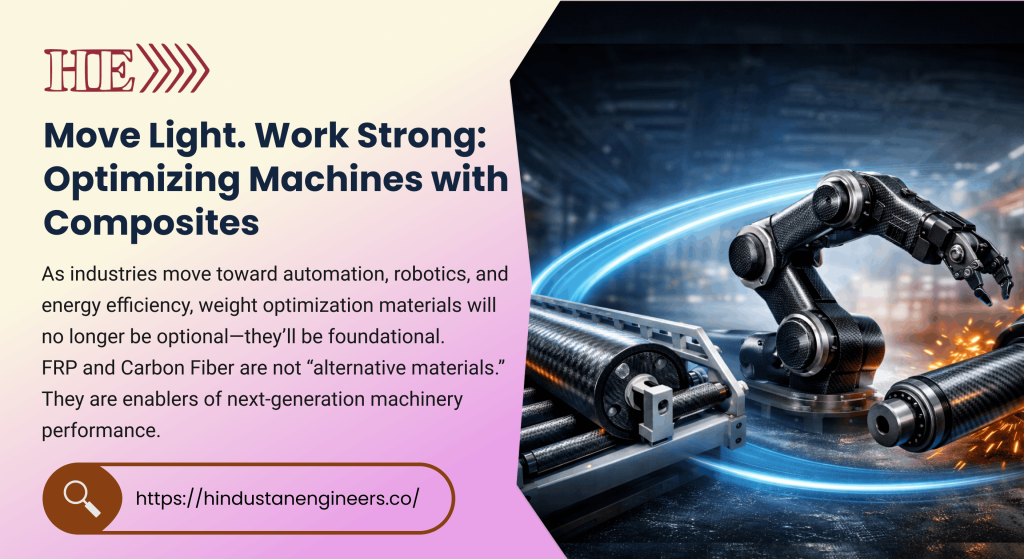
As industries move toward automation, robotics, and energy efficiency, weight optimization materials will no longer be optional—they’ll be foundational.

FRP and Carbon Fiber are not “alternative materials.”
They are enablers of next-generation machinery performance.

If your machinery moves, rotates, accelerates, or decelerates—there is a weight optimization opportunity waiting to be unlocked.

FRP (Fiber Reinforced Plastic) and Carbon Fiber are advanced weight optimization materials that significantly reduce the mass of moving machinery components such as conveyor systems, robotic arms, and rotating tools. By replacing traditional metals, manufacturers achieve higher speed, lower energy consumption, improved fatigue life, and greater design flexibility. Lightweight machinery components made from FRP and Carbon Fiber enable better performance, reduced maintenance, and long-term operational efficiency across industrial automation and material handling systems.

Recent Post