
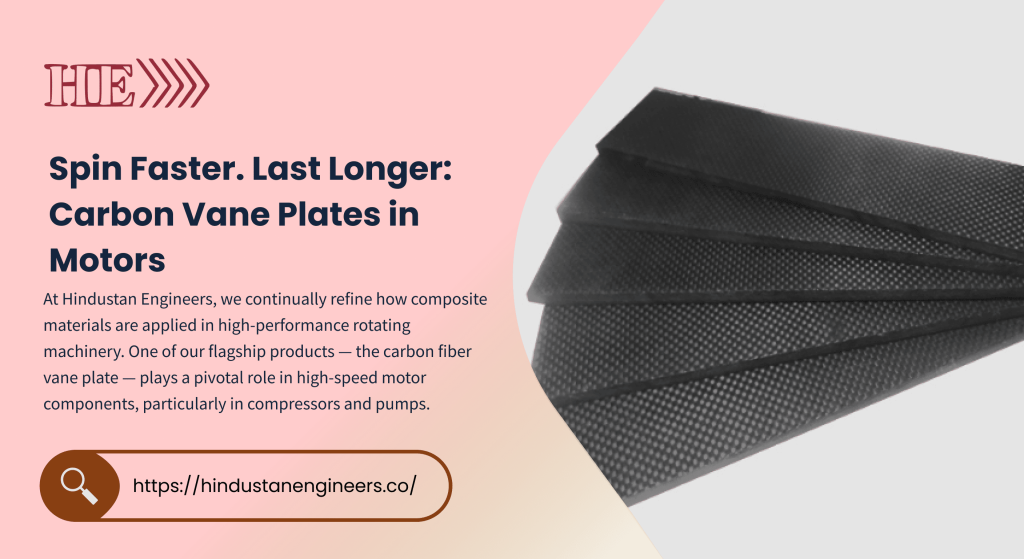
Understanding the Role of Carbon Fiber Vane Plates in High-Speed Motor Components
At Hindustan Engineers, we continually refine how composite materials are applied in high-performance rotating machinery. One of our flagship products — the carbon fiber vane plate — plays a pivotal role in high-speed motor components, particularly in compressors and pumps. In this blog, we’ll explore how these vane plates work, and why they matter for low inertia, reduced wear and key industrial applications.
What is a Carbon Fiber Vane Plate?
A vane plate is the stationary (or sometimes rotating) flat plate element in a vane-type machine (rotary vane motor, compressor or pump) that supports or guides the vanes. When manufactured from carbon fibre composites (rather than conventional metals), it becomes what we refer to as a carbon fibre vane plate. At Hindustan Engineers, our carbon fibre plates are made from layered sheets of high-quality carbon fibre and resin using compression-moulding techniques.
These vane plates may serve various functions: supporting rotor vanes, acting as end plates, or providing structural support in high-speed assemblies. In high-speed motor components (often in compressors, pumps, turbo-machines), every gram and every micrometre of vibration counts: this is where our expertise comes in.
Let’s unpack three major benefits of carbon fibre vane plates for high-speed motor components.
1. Low Inertia Advantages
One of the most powerful advantages of carbon fibre vane plates lies in their low inertia — that is, less mass and less rotational resistance.
The basic physics of high-speed rotors show that energy stored (and the forces encountered) grow with speed: E=12Iω2E = \frac12 I \omega^{2}E=21Iω2. Reducing inertia (I) means less energy demand, less stress and faster dynamic response.
Carbon fibre composites offer a much lower density and higher strength-to-weight ratio compared to steel and many metal alloys. This means we can manufacture vane plates that maintain stiffness and dimensional stability, yet weigh significantly less.
At Hindustan Engineers we note that our carbon fibre vane plates deliver “exceptional stiffness, thermal stability and resistance to fatigue in high-speed, high-stress environments”. hindustanengineers.co
In practical use: aside from faster acceleration/deceleration of the motor, lower inertia translates to less bearing load, less vibration, and longer machine life.
By designing vane plates with carbon fibre, we give machine designers the ability to raise rotational speeds, shrink the motor or compressor footprint, or improve system dynamics—without compromising structural integrity.
2. Reduced Wear & Improved Durability
Wear and maintenance are major cost centres in high-speed motor systems. Carbon fibre vane plates help reduce these costs via multiple mechanisms:
Dimensional stability: Carbon fibre’s low coefficient of thermal expansion means the plate remains stable even under thermal cycling. That stability reduces clearance changes, unwanted contact or vibration. (Our blog on vane materials covers this in more detail.) hindustanengineers.co
Surface and structural hardness: The layered composite construction allows for wear-resistant surfaces. Our manufacturing (compression moulding, hot & cold setting) produces plates with uniform strength through thickness.
Lower friction & self-lubricating potential: While not all carbon fibre composites are self-lubricating, composites of carbon fibre/resin generally exhibit lower friction than many metals. This means less heat generation, less wear at vane-plate contacts. External sources highlight that carbon–graphite vanes have “low wear rate, low density… good hardness… self lubricating, dry running”.
Fatigue resistance: High-speed machines subject components to cyclic stresses. Carbon fibre composites manage fatigue loads well, especially in applications where metals might begin to crack or deform.
For machine builders and operators, this means longer run intervals, fewer replacements, and less downtime — all of which improve total cost of ownership.
3. Application in Compressors & Pumps (High-Speed Motor Components)
When we refer to “high-speed motor components”, we’re typically talking about systems like rotary vane compressors, high-speed pumps, vacuum systems, turbo-compressors, etc. The carbon fibre vane plate becomes a strategic enabler in such systems.
In compressors & pumps:
The vane plate is often part of a rotor assembly in which vanes slide or rotate within slots, generating compression or pumping action.
High-speed operation means high centrifugal forces, thermal loads, vibration and wear. The vane plate needs to maintain precise geometry under those loads.
By using carbon fibre, our vane plates let the machine run faster with less mass, less vibration, more precise motion.
For instance: in vacuum pumps or rotary vane compressors, the clearance between vane tips and the chamber is critical. If the vane plate shifts, or deforms, efficiency drops. Carbon fibre’s stability ensures these tolerances hold up even at high speeds.
Also key: Reduced inertia means lower torque ramps, lower shock loads when starting, and improved responsiveness — meaning the high-speed motor component can deliver faster start-stop cycles or quicker transient responses.
Our product offering includes customised vane plates for vacuum cleaning machines, milking machines, etc., showing the breadth of applications and the ability of carbon fibre plates to meet industrial demands.
Why Choose Hindustan Engineers for Carbon Fibre Vane Plates?
We manufacture carbon fibre sheets and plates from 1 mm up to 40 mm thickness, customised for industrial uses.
Our carbon fibre vane plates are designed specifically for high-performance contexts (vacuum pumps, compressors, motors) — not just generic sheet stock.
Quality build: layered sheets of carbon fibre and resin, compression-moulded, giving uniform strength throughout the plate rather than being mere surface skins.
Based in Chennai (Ambattur Industrial Estate), we are set up for industrial supply to the Indian market, and accustomed to meeting OEM requirements.
Practical Considerations & Specification Tips
When incorporating carbon fibre vane plates into your high-speed motor or compressor system, consider these key specification and design points:
Thickness & size: Determine plate size, thickness and dimension tolerances based on the motor/compressor design. We offer up to 1 m×1 m sheets.
Finish & machining: Carbon fibre plates need proper machining, edge treatment, and surface finish to ensure optimal vane contact and sealing.
Compatibility: Ensure the resin system and composite meet the motor’s environmental demands (temperature, chemical exposure, lubrication regime).
Inertia budgeting: Use the reduced mass of carbon fibre to your advantage by revisiting rotor inertia values — lower mass means faster responsiveness.
Clearance & vibration: Analyse radial and axial clearances under full-speed and thermal load—carbon fibre helps reduce growth, but design must still account for rotor dynamics.
Wear contact surface: While carbon fibre offers excellent wear characteristics, the mating vane material must be compatible (hardness, sliding behaviour, lubrication).
Supply & testing: Choose a manufacturer experienced in high-speed applications. Hindustan Engineers has the domain know-how for high-speed vane plate manufacturing.
Final Thoughts
In high-speed motor components — whether compressors, pumps or specialized rotary machines — the mechanical and dynamic demands are intense. Every gram of mass matters, every micron of deformation impacts performance, every cycle of wear reduces uptime. That’s why the vane plate, though a smaller component, can be a major performance lever.
At Hindustan Engineers, our carbon fibre vane plates deliver exactly that: low inertia, reduced wear, and optimal performance for compressors and pumps that run fast, hard and reliably. If your next design or upgrade calls for a high-speed motor component with superior dynamics and reliability, let’s talk about how our carbon fibre vane plates can be the difference.
Feel free to reach out for a datasheet, custom size enquiry or design consultation — we’re here to support your industrial transformation.
Recent Post
How Carbon Fiber Composites Improve Machine Performance and Reduce Downtime
How Carbon Fiber Composites Improve Machine Performance and Reduce Downtime...
Read More
Selecting the Right Carbon Fiber Sheet: Grades, Thickness & Uses
Carbon fiber sheets have become a staple in high-performance industrial...
Read More
How Weather-Resistant Are Carbon Fiber and FRP in Outdoor Applications
Come Rain or Shine: Weatherproof Your Equipment with Composites When...
Read More