
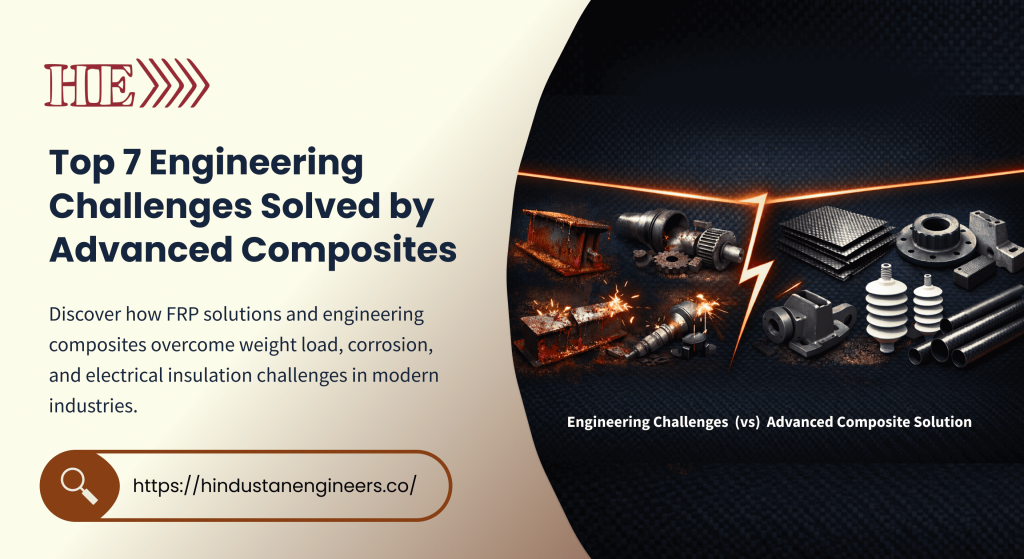
Top 7 Engineering Challenges Solved by Using Advanced Composites
In modern industrial environments, engineers constantly face complex challenges—heavy structural loads, corrosive chemicals, electrical risks, and demanding operating conditions. Traditional materials like steel, aluminum, and wood often struggle to deliver long-term performance in these harsh conditions.
This is where advanced engineering composites step in.
At Hindustan Engineers, we specialize in manufacturing high-performance composite components such as Carbon Fiber Products, FRP components, insulators, bushings, molded parts, and telescopic tubes that solve real engineering problems across industries like power transmission, heavy engineering, manufacturing, infrastructure, and industrial automation.
Advanced composites combine strength, durability, corrosion resistance, and lightweight performance—making them a powerful solution for modern engineering challenges.
In this article, we explore the Top 7 engineering challenges solved using advanced composites and how FRP solutions and carbon fiber engineering components are transforming industrial performance.
1. Excessive Structural Weight in Engineering Systems
One of the most common composite material challenges faced by engineers is the excessive weight of traditional materials. Steel structures, metal pipes, and mechanical assemblies add significant load to equipment and infrastructure.
Heavy components can lead to:
Increased energy consumption
Higher transportation and installation costs
Structural stress and fatigue
Reduced system efficiency
How Advanced Composites Solve It
Engineering composites such as carbon fiber and FRP materials provide an exceptional strength-to-weight ratio.
At Hindustan Engineers, our carbon fiber sheets, tubes, and molded composite components offer:
Up to 70% weight reduction compared to steel
Superior structural strength
High stiffness with minimal mass
Easier installation and handling
These lightweight composite solutions are widely used in industrial equipment, structural supports, robotic systems, and specialized engineering assemblies.
2. Corrosion and Chemical Exposure
Industrial environments often involve acidic chemicals, salt exposure, solvents, and moisture, which can quickly corrode traditional metal components.
Corrosion leads to:
Frequent maintenance
Equipment failure
Increased operational costs
Safety risks
FRP Solutions for Corrosion Resistance
Fiber Reinforced Polymer (FRP) materials are inherently corrosion-resistant, making them ideal for harsh chemical environments.
Our FRP molded components, vane plates, insulators, and structural parts are engineered to withstand:
Chemical processing environments
Water treatment facilities
Power generation plants
Coastal and marine installations
Unlike metals, FRP materials do not rust or degrade, ensuring long service life with minimal maintenance.
3. Electrical Insulation Requirements in Power Systems
In electrical infrastructure and power transmission systems, electrical insulation is critical for safety and reliability.
Metal components conduct electricity and can create short circuits, system failures, or safety hazards.
Composite-Based Electrical Isolation
Engineering composites offer excellent dielectric properties, making them perfect for high-voltage electrical insulation applications.
Hindustan Engineers manufactures specialized components such as:
Composite insulators
CT terminals
Electrical bushings
Insulated structural components
These products provide:
High dielectric strength
Electrical isolation in high-voltage systems
Heat resistance
Long operational life
Composite insulation components are widely used in power distribution systems, transformers, and switchgear assemblies.
4. Structural Fatigue and Repeated Stress
Many engineering components experience repeated mechanical loads, vibrations, and operational stress cycles.
Traditional materials can develop metal fatigue, leading to cracks, deformation, and eventual failure.
High Fatigue Resistance with Engineering Composites
Advanced composites like carbon fiber reinforced materials are designed to withstand cyclic loading and mechanical fatigue.
Our carbon fiber structural components and composite tubes provide:
-
High fatigue resistance
-
Superior dimensional stability
-
Long-term durability under repeated stress
This makes them ideal for applications such as:
Industrial automation equipment
-
Telescopic cleaning poles
-
Mechanical assemblies
-
Structural reinforcement systems
5. Complex Custom Engineering Requirements
Many industries require custom-shaped components that traditional manufacturing processes struggle to produce efficiently.
Metal fabrication often involves:
Multiple machining steps
Welding and finishing
High material wastage
Longer production cycles
Precision Composite Molding
Composite manufacturing allows complex geometries and custom engineering designs to be produced with precision.
Hindustan Engineers provides custom molded composite components, including:
Precision molded parts
FRP structural components
Composite nuts and bolts
Custom engineering assemblies
This flexibility allows engineers to design components specifically optimized for their application, improving performance and reducing production complexity.
6. Thermal Stability in Extreme Conditions
Industrial machinery and infrastructure frequently operate in high-temperature or fluctuating thermal environments.
Metals expand under heat, which can lead to:
Misalignment of mechanical systems
Structural distortion
Reduced equipment life
Composite Materials for Thermal Stability
Engineering composites offer excellent thermal stability and low thermal expansion.
Our carbon fiber and FRP components maintain their structural integrity even in demanding thermal environments.
Advantages include:
Low thermal expansion
Dimensional stability
Resistance to temperature fluctuations
Long-term mechanical reliability
These properties make composite materials suitable for precision engineering systems and industrial equipment operating under thermal stress.
7. Maintenance and Lifecycle Cost Challenges
Traditional engineering materials often require regular maintenance, replacements, and corrosion protection, leading to high lifecycle costs.
For many industries, reducing downtime and maintenance expenses is a key priority.
Long-Term Reliability with Composite Engineering
Advanced composites deliver long service life with minimal maintenance requirements.
Our composite products provide:
Corrosion resistance
Structural durability
Reduced repair frequency
Lower operational costs
For industries focused on long-term reliability and performance, composite engineering components offer a highly cost-effective solution.
The Future of Engineering with Advanced Composites
As industries continue to evolve, the demand for lightweight, durable, and high-performance materials will only grow.
Engineering composites are rapidly becoming the preferred material choice across multiple sectors, including:
Power and electrical infrastructure
Industrial manufacturing
Mechanical engineering
Chemical processing
Automation systems
Infrastructure development
At Hindustan Engineers, we are committed to delivering innovative composite solutions that solve real engineering challenges.
Our product portfolio includes:
Carbon fiber sheets and tubes
FRP molded components
Insulators and bushings
Composite structural parts
Industrial composite assemblies
By combining advanced materials technology with precision manufacturing, we help industries achieve greater efficiency, durability, and engineering excellence.
Looking for reliable FRP solutions or advanced engineering composites for your industrial applications?
Hindustan Engineers delivers high-performance composite components designed to solve your toughest engineering challenges.
Explore our solutions and discover how advanced composites can transform your engineering systems.
FRP (Fiber Reinforced Plastic) and Carbon Fiber are advanced weight optimization materials that significantly reduce the mass of moving machinery components such as conveyor systems, robotic arms, and rotating tools. By replacing traditional metals, manufacturers achieve higher speed, lower energy consumption, improved fatigue life, and greater design flexibility. Lightweight machinery components made from FRP and Carbon Fiber enable better performance, reduced maintenance, and long-term operational efficiency across industrial automation and material handling systems.
Recent Post

Why Telescopic Cleaning Poles Are the Best Solution for High-Reach Cleaning?
Cleaning hard-to-reach surfaces has always been a challenge for professionals...
Read More
How to Choose Between FRP Tubes vs Carbon Fiber Tubes for Your Application
How to Choose Between FRP Tubes vs Carbon Fiber Tubes...
Read More
How to Identify High-Quality Carbon Fiber Sheets: 6 Key Parameters
How to Identify High-Quality Carbon Fiber Sheets: 6 Key Parameters...
Read More