
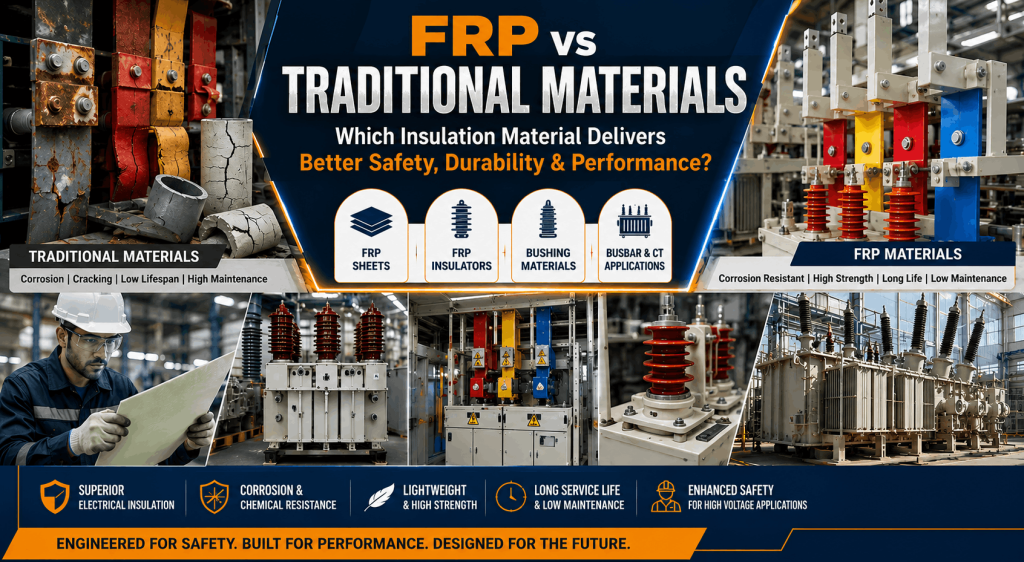
FRP vs Traditional Materials: What’s Best for Electrical Insulation?
In modern electrical infrastructure, the choice of insulation material directly impacts safety, durability, system efficiency, and maintenance costs. Industries handling high-voltage applications, transformers, busbars, switchgear systems, and current transformers (CTs) are moving away from conventional materials and adopting advanced composite solutions for long-term operational reliability.
At Hindustan Engineers, we specialize in high-performance engineered composite products including FRP sheets, FRP insulators, bushings, terminals, molded components, and electrical insulation solutions designed for demanding industrial applications.
But the question many industries still ask is:
Should you continue using traditional materials like metals and PVC for electrical insulation, or is FRP the smarter long-term investment?
Let’s explore the differences.
Understanding FRP in Electrical Insulation
Fibre-reinforced plastic is a composite material manufactured using reinforcing fibers combined with polymer resin systems. These materials are engineered to deliver high mechanical strength, superior dielectric properties, corrosion resistance, and lightweight performance.
In electrical applications, FRP sheets and FRP insulators are widely used because they combine structural durability with excellent electrical insulation performance.
At Hindustan Engineers, our FRP insulation products are designed specifically for:
- Busbar insulation systems
- CT terminals
- Transformer bushings
- Electrical panel components
- Switchgear insulation supports
- High-voltage applications
- Industrial electrical safety systems
FRP vs Traditional Materials: The Core Comparison
1. Electrical Insulation Performance
FRP Materials
FRP offers exceptional dielectric strength and low electrical conductivity, making it highly suitable for electrical insulation systems operating under demanding voltage conditions.
Key advantages include:
- Excellent insulation resistance
- Low moisture absorption
- Stable performance under temperature variation
- Reduced risk of electrical leakage
- Better arc resistance
FRP sheets maintain consistent insulation performance even in humid, chemically exposed, or outdoor industrial environments.
Metals
Metals like aluminum, steel, and copper are excellent conductors — which makes them unsuitable as standalone insulation materials. They require additional insulating layers or coatings, increasing system complexity and maintenance costs.
PVC
PVC has been traditionally used for electrical insulation because of its low cost. However, it has limitations:
- Lower mechanical strength
- Thermal degradation over time
- Cracking under environmental stress
- Reduced lifespan in heavy industrial environments
When compared with FRP sheets, PVC struggles in high-load and high-temperature applications.
Why Industries Prefer FRP Sheets Today
Superior Strength-to-Weight Ratio
One of the biggest advantages of FRP sheets is their lightweight yet high-strength construction.
Compared to metals:
- Easier installation
- Lower transportation costs
- Reduced structural load
- Simplified fabrication
This becomes critical in large electrical panels, transformer setups, and industrial busbar systems.
Corrosion & Chemical Resistance
Traditional metals are vulnerable to:
- Rust
- Corrosion
- Oxidation
- Chemical degradation
Industrial electrical environments often contain moisture, oils, chemicals, and pollutants that can degrade conventional materials over time.
FRP insulators and FRP sheets provide outstanding resistance against:
- Corrosive chemicals
- Moisture exposure
- Salt-laden environments
- Industrial pollutants
This significantly improves operational lifespan and reduces maintenance frequency.
FRP vs PVC: Which Lasts Longer?
PVC may appear economical initially, but long-term operational costs often tell a different story.
PVC Limitations
Over time, PVC can experience:
- Brittleness
- Surface cracking
- UV degradation
- Thermal instability
- Reduced dielectric performance
This can lead to insulation failures and increased replacement cycles.
FRP Longevity Advantage
FRP materials are engineered for long-term industrial use and maintain their structural and electrical properties for years under continuous operational stress.
At Hindustan Engineers, our FRP insulation products are designed to deliver:
- Extended service life
- Reduced maintenance downtime
- Consistent insulation performance
- Enhanced operational safety
This makes FRP a cost-effective solution in the long run.
Safety Benefits of FRP Insulators
Electrical safety is one of the most critical factors in industrial infrastructure.
FRP insulators help industries improve safety through:
Flame Resistance
Advanced FRP materials can be manufactured with flame-retardant properties, helping reduce fire risks in electrical systems.
Reduced Electrical Failures
Their high dielectric strength minimizes:
- Short circuits
- Electrical tracking
- Leakage currents
- Flashover risks
Improved Worker Safety
Because FRP is non-conductive, it reduces accidental shock hazards during maintenance and handling.
This is particularly important in:
- Transformer systems
- Switchyards
- Power distribution panels
- High-voltage industrial environments
Applications of FRP in Electrical Industries
1. Busbar Insulation Systems
Busbars carry large electrical currents and require highly reliable insulation systems.
FRP sheets are extensively used in busbar insulation because they provide:
- High dielectric strength
- Heat resistance
- Mechanical support
- Long-term dimensional stability
Unlike PVC, FRP can withstand heavy-duty industrial loading without deformation.
2. CT (Current Transformer) Components
Current transformer systems demand precision and insulation reliability.
FRP materials are ideal for:
- CT terminals
- Structural supports
- Insulation barriers
- Bushing materials
Their stability ensures safe and uninterrupted transformer performance.
3. Electrical Bushings & Terminal Applications
Bushing materials play a major role in preventing electrical leakage while safely conducting current through grounded barriers.
Traditional materials may degrade under environmental stress, but FRP bushings offer:
- High insulation resistance
- Corrosion protection
- Thermal stability
- Lightweight handling advantages
This improves operational reliability in high-voltage applications.
Why FRP is Becoming the Future of Electrical Insulation
Industries today require materials that are:
- Lightweight
- Durable
- Corrosion-resistant
- Electrically safe
- Low maintenance
- Long lasting
FRP successfully combines all these advantages into a single engineered solution.
As industrial electrical systems become more advanced and safety regulations become stricter, FRP sheets and FRP insulators are rapidly replacing traditional insulation materials across multiple sectors.
Hindustan Engineers: Advanced FRP Solutions for Modern Industries
At Hindustan Engineers, we manufacture and supply high-quality FRP-based electrical insulation solutions engineered for industrial reliability and performance.
Our product range includes:
- FRP Sheets
- FRP Insulators
- Bushing Materials
- CT Terminals
- Molded Electrical Components
- Industrial Insulation Products
- Composite Engineering Solutions
We focus on delivering:
✅ High dielectric performance
✅ Long operational life
✅ Industrial-grade durability
✅ Precision engineering
✅ Custom manufacturing solutions
Whether you are upgrading existing infrastructure or designing new electrical systems, our FRP solutions help improve safety, reduce maintenance costs, and enhance long-term operational efficiency.
Conclusion
When comparing FRP with traditional materials like metals and PVC, the advantages are clear.
FRP offers:
- Better electrical insulation
- Higher durability
- Improved corrosion resistance
- Enhanced safety
- Longer service life
- Lower maintenance requirements
For modern electrical applications involving busbars, terminals, CTs, and high-voltage insulation systems, FRP is no longer an alternative — it is becoming the industry standard.
If your industry is looking for reliable, high-performance electrical insulation solutions, Hindustan Engineers delivers engineered FRP products built for long-term industrial excellence.
FRP (Fiber Reinforced Plastic) and Carbon Fiber are advanced weight optimization materials that significantly reduce the mass of moving machinery components such as conveyor systems, robotic arms, and rotating tools. By replacing traditional metals, manufacturers achieve higher speed, lower energy consumption, improved fatigue life, and greater design flexibility. Lightweight machinery components made from FRP and Carbon Fiber enable better performance, reduced maintenance, and long-term operational efficiency across industrial automation and material handling systems.
Recent Post
Carbon Fiber Reinforcement in Industrial Automation Equipment: Emerging Trends
Carbon Fiber Reinforcement in Industrial Automation Equipment: Emerging Trends When...
Read More
Composites Tube Market Analysis: 2024-2030 Trends, Forecast, and Competition
Composites tubes, also known as FRP tubes or fiber-reinforced plastic...
Read More
Molded Components for Custom Engineering Needs – Why Precision Matters
Molded Components for Custom Engineering Needs – Why Precision Matters...
Read More