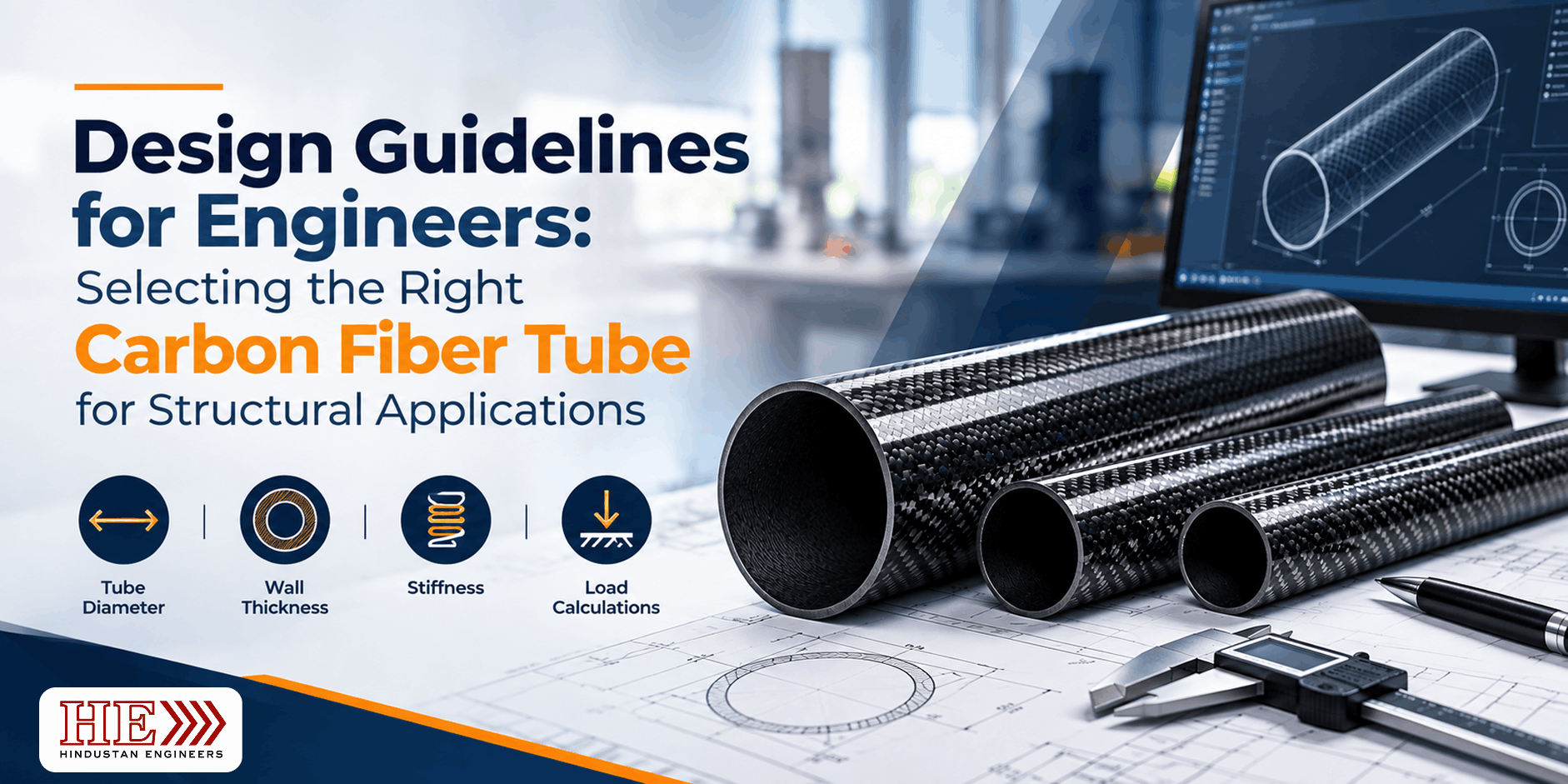

Fiber Reinforced Polymer (FRP) and carbon fiber composite tubes have become integral components across various industries, offering a blend of strength, durability, and lightweight properties. As a leading manufacturer in this domain, Hindustan Engineers is committed to delivering high-quality composite solutions tailored to diverse applications.
Introduction to FRP and Carbon Fiber Composite Tubes
FRP tubes are crafted by reinforcing polymers with fibers such as glass, carbon, or aramid. This combination results in materials that exhibit exceptional strength-to-weight ratios, corrosion resistance, and adaptability. Carbon fiber composite tubes, a subset of FRP, utilize carbon fibers to achieve even higher stiffness and strength, making them ideal for demanding engineering applications.
Comparison: FRP Tubes vs. Carbon Fiber Tubes
While both FRP and carbon fiber tubes offer significant advantages over traditional materials, key differences influence their selection:
Material Composition: FRP tubes typically incorporate glass fibers, whereas carbon fiber tubes are reinforced exclusively with carbon fibers.
Mechanical Properties: Carbon fiber tubes provide superior stiffness and tensile strength compared to standard FRP tubes.
Cost Considerations: FRP tubes are generally more cost-effective, while carbon fiber tubes, due to their enhanced properties, come at a higher price point.
Manufacturing Process
The production of FRP and carbon fiber tubes involves several critical stages:
Raw Materials: Selection of high-quality fibers (glass or carbon) and compatible polymer resins.
Molding Techniques:
- Pultrusion: Continuous fibers are pulled through a resin bath and shaped through a heated die, ideal for uniform cross-sectional profiles.
- Filament Winding: Fibers are wound under tension over a rotating mandrel, suitable for cylindrical shapes.
- Resin Transfer Molding (RTM): Fibers are placed into a mold, and resin is injected, allowing for complex geometries.
Curing: The molded composite is subjected to controlled heat and pressure to solidify the structure, ensuring optimal mechanical properties.
Applications
The versatility of FRP and carbon fiber tubes lends them to various sectors:
Industrial: Used in chemical processing equipment, piping systems, and structural supports due to their corrosion resistance and strength.
Aerospace: Employed in aircraft structures and components where weight reduction without compromising strength is crucial.
Marine: Ideal for boat masts, hulls, and other components exposed to harsh marine environments.
Automotive: Utilized in performance vehicles for drive shafts, roll cages, and body panels to enhance performance and fuel efficiency.
Construction: Applied in reinforcing structures, bridge components, and architectural elements requiring high strength and durability.
Leading Composite Tube Manufacturers and FRP Tube Suppliers in India
India hosts several reputable manufacturers specializing in composite tubes:
-
Hindustan Engineers: Renowned for their expertise in producing high-quality FRP and carbon fiber tubes tailored to client specifications.
-
Carbon Light Pvt. Ltd.: Specializes in carbon fiber composites for aerospace, defense, and industrial applications.
-
NitPro Composites: Offers a range of carbon fiber products, including rods, tubes, and sheets, catering to diverse industries.
Conclusion: Why Industries Prefer FRP and Carbon Fiber Over Metals
The shift from traditional metals to FRP and carbon fiber composites is driven by several factors:
Weight Reduction: Significantly lighter than metals, leading to improved efficiency and performance.
Corrosion Resistance: Inherent resistance to corrosion ensures longevity, especially in harsh environments.
Design Flexibility: Ability to mold into complex shapes allows for innovative engineering solutions.
Enhanced Mechanical Properties: Superior strength and stiffness meet the rigorous demands of modern applications.
Incorporating FRP and carbon fiber tubes into engineering projects not only enhances performance but also offers sustainable and cost-effective solutions, solidifying their place as the materials of choice in contemporary industry.
Recent Post
FRP vs Traditional Materials: What’s Best for Electrical Insulation?
FRP vs Traditional Materials: What’s Best for Electrical Insulation? In...
Read MoreInventory Management Tips for Bulk Buyers of Composite Products
The Real Challenge: Managing High-Value Composite Inventory When you invest...
Read MoreCarbon Fiber and FRP in Green Construction – What Architects Are Choosing Today
In today’s fast-evolving construction landscape, sustainability is no longer a...
Read More